

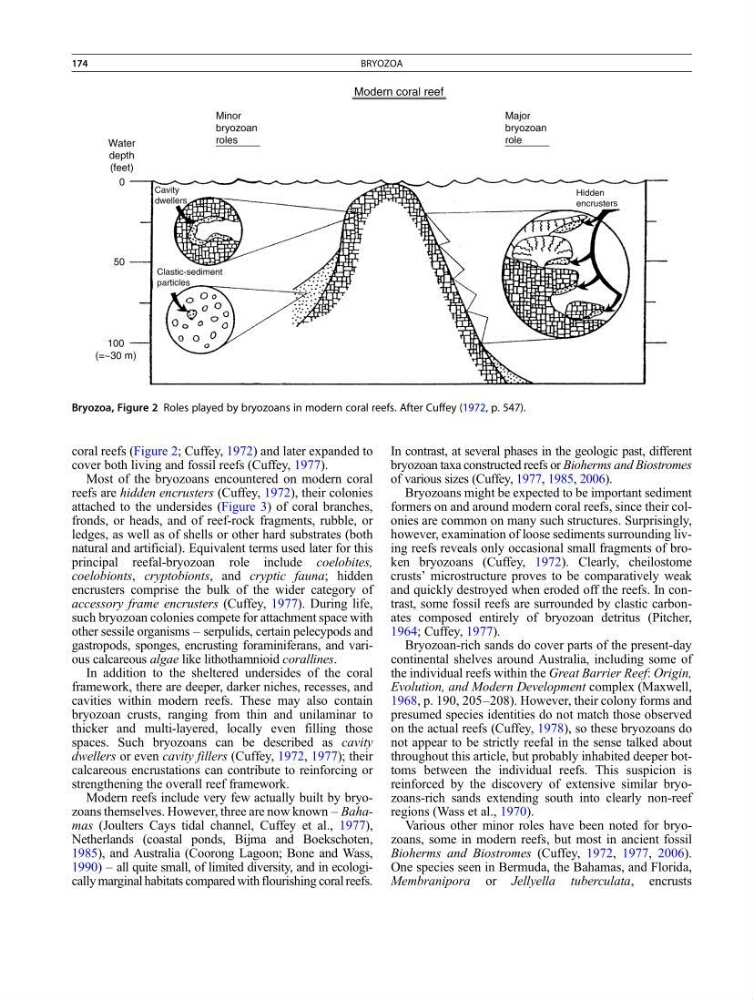
coral reefs (Figure 2; Cuffey, 1972) and later expanded to
cover both living and fossil reefs (Cuffey, 1977).
Most of the bryozoans encountered on modern coral
reefs are hidden encrusters (Cuffey, 1972), their colonies
attached to the undersides (Figure 3) of coral branches,
fronds, or heads, and of reef-rock fragments, rubble, or
ledges, as well as of shells or other hard substrates (both
natural and artificial). Equivalent terms used later for this
principal reefal-bryozoan role include coelobites,
coelobionts, cryptobionts, and cryptic fauna; hidden
encrusters comprise the bulk of the wider category of
accessory frame encrusters (Cuffey, 1977). During life,
such bryozoan colonies compete for attachment space with
other sessile organisms – serpulids, certain pelecypods and
gastropods, sponges, encrusting foraminiferans, and various calcareous algae like lithothamnioid corallines.
In addition to the sheltered undersides of the coral
framework, there are deeper, darker niches, recesses, and
cavities within modern reefs. These may also contain
bryozoan crusts, ranging from thin and unilaminar to
thicker and multi-layered, locally even filling those
spaces. Such bryozoans can be described as cavity
dwellers or even cavity fillers (Cuffey, 1972, 1977); their
calcareous encrustations can contribute to reinforcing or
strengthening the overall reef framework.
Modern reefs include very few actually built by bryozoans themselves. However, three are now known – Bahamas (Joulters Cays tidal channel, Cuffey et al., 1977),
Netherlands (coastal ponds, Bijma and Boekschoten,
1985), and Australia (Coorong Lagoon; Bone and Wass,
1990) – all quite small, of limited diversity, and in ecologically marginal habitats compared with flourishing coral reefs.
In contrast, at several phases in the geologic past, different
bryozoan taxa constructed reefs or Bioherms and Biostromes
of various sizes (Cuffey, 1977, 1985, 2006).
Bryozoans might be expected to be important sediment
formers on and around modern coral reefs, since their colonies are common on many such structures. Surprisingly,
however, examination of loose sediments surrounding living reefs reveals only occasional small fragments of broken bryozoans (Cuffey, 1972). Clearly, cheilostome
crusts’ microstructure proves to be comparatively weak
and quickly destroyed when eroded off the reefs. In contrast, some fossil reefs are surrounded by clastic carbonates composed entirely of bryozoan detritus (Pitcher,
1964; Cuffey, 1977).
Bryozoan-rich sands do cover parts of the present-day
continental shelves around Australia, including some of
the individual reefs within the Great Barrier Reef: Origin,
Evolution, and Modern Development complex (Maxwell,
1968, p. 190, 205–208). However, their colony forms and
presumed species identities do not match those observed
on the actual reefs (Cuffey, 1978), so these bryozoans do
not appear to be strictly reefal in the sense talked about
throughout this article, but probably inhabited deeper bottoms between the individual reefs. This suspicion is
reinforced by the discovery of extensive similar bryozoans-rich sands extending south into clearly non-reef
regions (Wass et al., 1970).
Various other minor roles have been noted for bryozoans, some in modern reefs, but most in ancient fossil
Bioherms and Biostromes (Cuffey, 1972, 1977, 2006).
One species seen in Bermuda, the Bahamas, and Florida,
Membranipora or Jellyella tuberculata, encrusts
Bryozoa, Figure 2 Roles played by bryozoans in modern coral reefs. After Cuffey (1972, p. 547).
174
BRYOZOA
cover both living and fossil reefs (Cuffey, 1977).
Most of the bryozoans encountered on modern coral
reefs are hidden encrusters (Cuffey, 1972), their colonies
attached to the undersides (Figure 3) of coral branches,
fronds, or heads, and of reef-rock fragments, rubble, or
ledges, as well as of shells or other hard substrates (both
natural and artificial). Equivalent terms used later for this
principal reefal-bryozoan role include coelobites,
coelobionts, cryptobionts, and cryptic fauna; hidden
encrusters comprise the bulk of the wider category of
accessory frame encrusters (Cuffey, 1977). During life,
such bryozoan colonies compete for attachment space with
other sessile organisms – serpulids, certain pelecypods and
gastropods, sponges, encrusting foraminiferans, and various calcareous algae like lithothamnioid corallines.
In addition to the sheltered undersides of the coral
framework, there are deeper, darker niches, recesses, and
cavities within modern reefs. These may also contain
bryozoan crusts, ranging from thin and unilaminar to
thicker and multi-layered, locally even filling those
spaces. Such bryozoans can be described as cavity
dwellers or even cavity fillers (Cuffey, 1972, 1977); their
calcareous encrustations can contribute to reinforcing or
strengthening the overall reef framework.
Modern reefs include very few actually built by bryozoans themselves. However, three are now known – Bahamas (Joulters Cays tidal channel, Cuffey et al., 1977),
Netherlands (coastal ponds, Bijma and Boekschoten,
1985), and Australia (Coorong Lagoon; Bone and Wass,
1990) – all quite small, of limited diversity, and in ecologically marginal habitats compared with flourishing coral reefs.
In contrast, at several phases in the geologic past, different
bryozoan taxa constructed reefs or Bioherms and Biostromes
of various sizes (Cuffey, 1977, 1985, 2006).
Bryozoans might be expected to be important sediment
formers on and around modern coral reefs, since their colonies are common on many such structures. Surprisingly,
however, examination of loose sediments surrounding living reefs reveals only occasional small fragments of broken bryozoans (Cuffey, 1972). Clearly, cheilostome
crusts’ microstructure proves to be comparatively weak
and quickly destroyed when eroded off the reefs. In contrast, some fossil reefs are surrounded by clastic carbonates composed entirely of bryozoan detritus (Pitcher,
1964; Cuffey, 1977).
Bryozoan-rich sands do cover parts of the present-day
continental shelves around Australia, including some of
the individual reefs within the Great Barrier Reef: Origin,
Evolution, and Modern Development complex (Maxwell,
1968, p. 190, 205–208). However, their colony forms and
presumed species identities do not match those observed
on the actual reefs (Cuffey, 1978), so these bryozoans do
not appear to be strictly reefal in the sense talked about
throughout this article, but probably inhabited deeper bottoms between the individual reefs. This suspicion is
reinforced by the discovery of extensive similar bryozoans-rich sands extending south into clearly non-reef
regions (Wass et al., 1970).
Various other minor roles have been noted for bryozoans, some in modern reefs, but most in ancient fossil
Bioherms and Biostromes (Cuffey, 1972, 1977, 2006).
One species seen in Bermuda, the Bahamas, and Florida,
Membranipora or Jellyella tuberculata, encrusts
Bryozoa, Figure 2 Roles played by bryozoans in modern coral reefs. After Cuffey (1972, p. 547).
174
BRYOZOA