

tracts and occupying hardened (usually calcareous) exoskeletal chambers (zooecia), joined together in small to
moderate-sized (cm-sized) colonies (zoaria). The vast
majority are eucoelomate, comprising the subphylum or
phylum Ectoprocta, so that at times the two Latin names
have been used interchangeably.
Reefal bryozoans: Reef-dwelling bryozoans; bryozoans found on or within coral-reef frameworks, rubble,
and flanking sediments.
Introduction: Bryozoans in modern reefs
Bryozoans are found worldwide, from tropical to polar,
and shoreline out to deep ocean. Some occur on reefs in
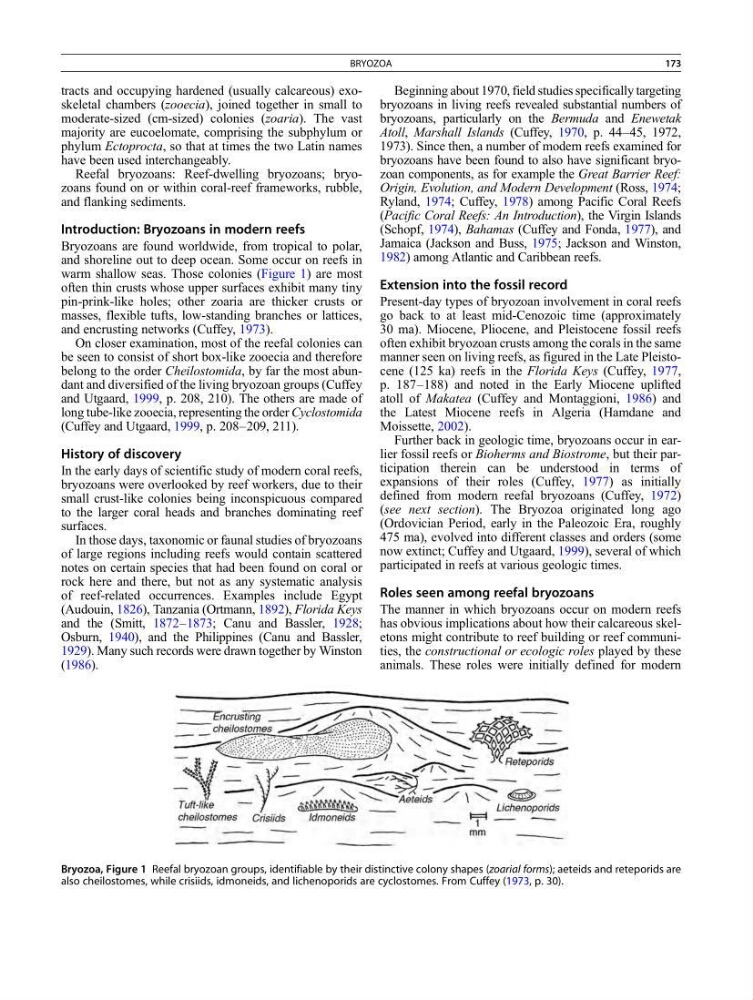
warm shallow seas. Those colonies (Figure 1) are most
often thin crusts whose upper surfaces exhibit many tiny
pin-prink-like holes; other zoaria are thicker crusts or
masses, flexible tufts, low-standing branches or lattices,
and encrusting networks (Cuffey, 1973).
On closer examination, most of the reefal colonies can
be seen to consist of short box-like zooecia and therefore
belong to the order Cheilostomida, by far the most abundant and diversified of the living bryozoan groups (Cuffey
and Utgaard, 1999, p. 208, 210). The others are made of
long tube-like zooecia, representing the order Cyclostomida
(Cuffey and Utgaard, 1999, p. 208–209, 211).
History of discovery
In the early days of scientific study of modern coral reefs,
bryozoans were overlooked by reef workers, due to their
small crust-like colonies being inconspicuous compared
to the larger coral heads and branches dominating reef
surfaces.
In those days, taxonomic or faunal studies of bryozoans
of large regions including reefs would contain scattered
notes on certain species that had been found on coral or
rock here and there, but not as any systematic analysis
of reef-related occurrences. Examples include Egypt
(Audouin, 1826), Tanzania (Ortmann, 1892), Florida Keys
and the (Smitt, 1872–1873; Canu and Bassler, 1928;
Osburn, 1940), and the Philippines (Canu and Bassler,
1929). Many such records were drawn together by Winston
(1986).
Beginning about 1970, field studies specifically targeting
bryozoans in living reefs revealed substantial numbers of
bryozoans, particularly on the Bermuda and Enewetak
Atoll, Marshall Islands (Cuffey, 1970, p. 44–45, 1972,
1973). Since then, a number of modern reefs examined for
bryozoans have been found to also have significant bryozoan components, as for example the Great Barrier Reef:
Origin, Evolution, and Modern Development (Ross, 1974;
Ryland, 1974; Cuffey, 1978) among Pacific Coral Reefs
(Pacific Coral Reefs: An Introduction), the Virgin Islands
(Schopf, 1974), Bahamas (Cuffey and Fonda, 1977), and
Jamaica (Jackson and Buss, 1975; Jackson and Winston,
1982) among Atlantic and Caribbean reefs.
Extension into the fossil record
Present-day types of bryozoan involvement in coral reefs
go back to at least mid-Cenozoic time (approximately
30 ma). Miocene, Pliocene, and Pleistocene fossil reefs
often exhibit bryozoan crusts among the corals in the same
manner seen on living reefs, as figured in the Late Pleistocene (125 ka) reefs in the Florida Keys (Cuffey, 1977,
p. 187–188) and noted in the Early Miocene uplifted
atoll of Makatea (Cuffey and Montaggioni, 1986) and
the Latest Miocene reefs in Algeria (Hamdane and
Moissette, 2002).
Further back in geologic time, bryozoans occur in earlier fossil reefs or Bioherms and Biostrome, but their participation therein can be understood in terms of
expansions of their roles (Cuffey, 1977) as initially
defined from modern reefal bryozoans (Cuffey, 1972)
(see next section). The Bryozoa originated long ago
(Ordovician Period, early in the Paleozoic Era, roughly
475 ma), evolved into different classes and orders (some
now extinct; Cuffey and Utgaard, 1999), several of which
participated in reefs at various geologic times.
Roles seen among reefal bryozoans
The manner in which bryozoans occur on modern reefs
has obvious implications about how their calcareous skeletons might contribute to reef building or reef communities, the constructional or ecologic roles played by these
animals. These roles were initially defined for modern
Bryozoa, Figure 1 Reefal bryozoan groups, identifiable by their distinctive colony shapes (zoarial forms); aeteids and reteporids are
also cheilostomes, while crisiids, idmoneids, and lichenoporids are cyclostomes. From Cuffey (1973, p. 30).
BRYOZOA
173
moderate-sized (cm-sized) colonies (zoaria). The vast
majority are eucoelomate, comprising the subphylum or
phylum Ectoprocta, so that at times the two Latin names
have been used interchangeably.
Reefal bryozoans: Reef-dwelling bryozoans; bryozoans found on or within coral-reef frameworks, rubble,
and flanking sediments.
Introduction: Bryozoans in modern reefs
Bryozoans are found worldwide, from tropical to polar,
and shoreline out to deep ocean. Some occur on reefs in
warm shallow seas. Those colonies (Figure 1) are most
often thin crusts whose upper surfaces exhibit many tiny
pin-prink-like holes; other zoaria are thicker crusts or
masses, flexible tufts, low-standing branches or lattices,
and encrusting networks (Cuffey, 1973).
On closer examination, most of the reefal colonies can
be seen to consist of short box-like zooecia and therefore
belong to the order Cheilostomida, by far the most abundant and diversified of the living bryozoan groups (Cuffey
and Utgaard, 1999, p. 208, 210). The others are made of
long tube-like zooecia, representing the order Cyclostomida
(Cuffey and Utgaard, 1999, p. 208–209, 211).
History of discovery
In the early days of scientific study of modern coral reefs,
bryozoans were overlooked by reef workers, due to their
small crust-like colonies being inconspicuous compared
to the larger coral heads and branches dominating reef
surfaces.
In those days, taxonomic or faunal studies of bryozoans
of large regions including reefs would contain scattered
notes on certain species that had been found on coral or
rock here and there, but not as any systematic analysis
of reef-related occurrences. Examples include Egypt
(Audouin, 1826), Tanzania (Ortmann, 1892), Florida Keys
and the (Smitt, 1872–1873; Canu and Bassler, 1928;
Osburn, 1940), and the Philippines (Canu and Bassler,
1929). Many such records were drawn together by Winston
(1986).
Beginning about 1970, field studies specifically targeting
bryozoans in living reefs revealed substantial numbers of
bryozoans, particularly on the Bermuda and Enewetak
Atoll, Marshall Islands (Cuffey, 1970, p. 44–45, 1972,
1973). Since then, a number of modern reefs examined for
bryozoans have been found to also have significant bryozoan components, as for example the Great Barrier Reef:
Origin, Evolution, and Modern Development (Ross, 1974;
Ryland, 1974; Cuffey, 1978) among Pacific Coral Reefs
(Pacific Coral Reefs: An Introduction), the Virgin Islands
(Schopf, 1974), Bahamas (Cuffey and Fonda, 1977), and
Jamaica (Jackson and Buss, 1975; Jackson and Winston,
1982) among Atlantic and Caribbean reefs.
Extension into the fossil record
Present-day types of bryozoan involvement in coral reefs
go back to at least mid-Cenozoic time (approximately
30 ma). Miocene, Pliocene, and Pleistocene fossil reefs
often exhibit bryozoan crusts among the corals in the same
manner seen on living reefs, as figured in the Late Pleistocene (125 ka) reefs in the Florida Keys (Cuffey, 1977,
p. 187–188) and noted in the Early Miocene uplifted
atoll of Makatea (Cuffey and Montaggioni, 1986) and
the Latest Miocene reefs in Algeria (Hamdane and
Moissette, 2002).
Further back in geologic time, bryozoans occur in earlier fossil reefs or Bioherms and Biostrome, but their participation therein can be understood in terms of
expansions of their roles (Cuffey, 1977) as initially
defined from modern reefal bryozoans (Cuffey, 1972)
(see next section). The Bryozoa originated long ago
(Ordovician Period, early in the Paleozoic Era, roughly
475 ma), evolved into different classes and orders (some
now extinct; Cuffey and Utgaard, 1999), several of which
participated in reefs at various geologic times.
Roles seen among reefal bryozoans
The manner in which bryozoans occur on modern reefs
has obvious implications about how their calcareous skeletons might contribute to reef building or reef communities, the constructional or ecologic roles played by these
animals. These roles were initially defined for modern
Bryozoa, Figure 1 Reefal bryozoan groups, identifiable by their distinctive colony shapes (zoarial forms); aeteids and reteporids are
also cheilostomes, while crisiids, idmoneids, and lichenoporids are cyclostomes. From Cuffey (1973, p. 30).
BRYOZOA
173