

a subsistence live style practiced by the former inhabitants. Perhaps, this may be the end of a chapter in human
history where a small society was able to sustain itself
and endure the rigors of nature and mankind for over several millennia, perhaps, among the longest any society has
ever survived in a small space during this modern era of
civilized humanity. In January 2009, the Kili-Bikini-Ejit
Local Government and the Republic of the Marshall
Islands nominated Bikini Atoll for World Heritage in early
2009. By the end of 2010, the World Heritage Committee
will make its recommendation on whether the atoll will be
inscribed as a World Heritage property.
Current investigations, controversies, and gaps in
current knowledge
Although much has been published about the people and
the impacts caused by the nuclear testing in Bikini, there
has been very little rigorous scientific research focused
on the degree to which the coral reefs of Bikini have
recovered after the 1950s. Buddemeier et al. (1974) sectioned the skeletons of corals that lived before and after
the nuclear test era at neighboring Enewetak. Although
comparable specimens were not collected at Bikini, the
Enewetak results showed no evidence of consistent differences in growth rate in the annual band widths laid down
by individual corals before and after the nuclear testing
era. Moreover, Agegian et al. (1987), the present writer,
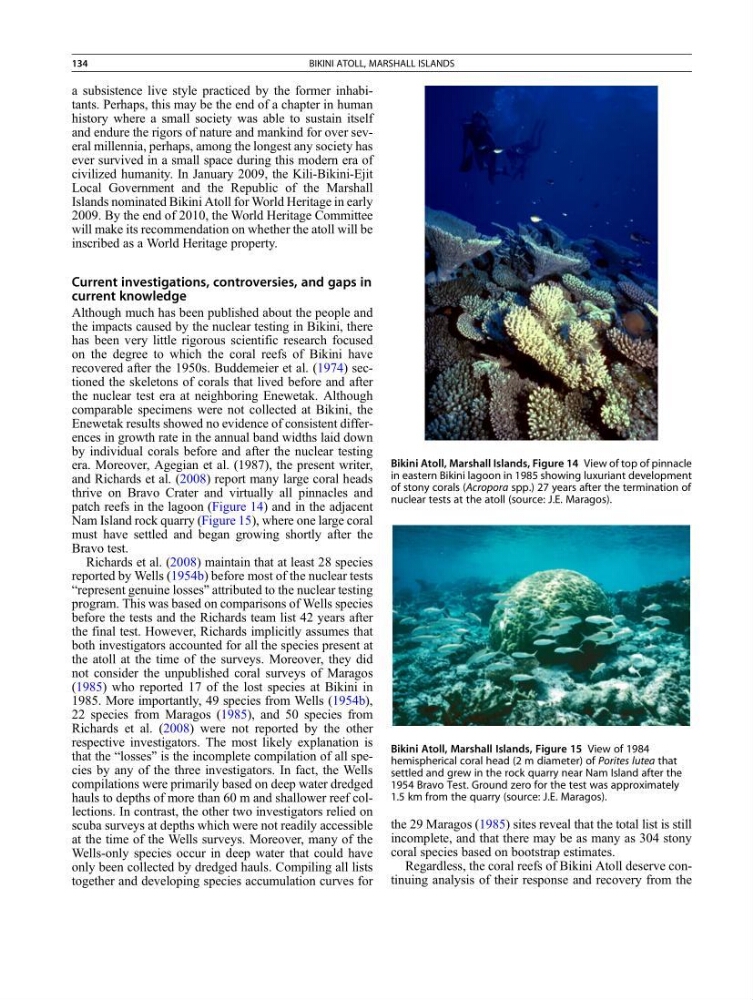
and Richards et al. (2008) report many large coral heads
thrive on Bravo Crater and virtually all pinnacles and
patch reefs in the lagoon (Figure 14) and in the adjacent
Nam Island rock quarry (Figure 15), where one large coral
must have settled and began growing shortly after the
Bravo test.
Richards et al. (2008) maintain that at least 28 species
reported by Wells (1954b) before most of the nuclear tests
“represent genuine losses” attributed to the nuclear testing
program. This was based on comparisons of Wells species
before the tests and the Richards team list 42 years after
the final test. However, Richards implicitly assumes that
both investigators accounted for all the species present at
the atoll at the time of the surveys. Moreover, they did
not consider the unpublished coral surveys of Maragos
(1985) who reported 17 of the lost species at Bikini in
1985. More importantly, 49 species from Wells (1954b),
22 species from Maragos (1985), and 50 species from
Richards et al. (2008) were not reported by the other
respective investigators. The most likely explanation is
that the “losses” is the incomplete compilation of all species by any of the three investigators. In fact, the Wells
compilations were primarily based on deep water dredged
hauls to depths of more than 60 m and shallower reef collections. In contrast, the other two investigators relied on
scuba surveys at depths which were not readily accessible
at the time of the Wells surveys. Moreover, many of the
Wells-only species occur in deep water that could have
only been collected by dredged hauls. Compiling all lists
together and developing species accumulation curves for
the 29 Maragos (1985) sites reveal that the total list is still
incomplete, and that there may be as many as 304 stony
coral species based on bootstrap estimates.
Regardless, the coral reefs of Bikini Atoll deserve continuing analysis of their response and recovery from the
Bikini Atoll, Marshall Islands, Figure 14 View of top of pinnacle
in eastern Bikini lagoon in 1985 showing luxuriant development
of stony corals (Acropora spp.) 27 years after the termination of
nuclear tests at the atoll (source: J.E. Maragos).
Bikini Atoll, Marshall Islands, Figure 15 View of 1984
hemispherical coral head (2 m diameter) of Porites lutea that
settled and grew in the rock quarry near Nam Island after the
1954 Bravo Test. Ground zero for the test was approximately
1.5 km from the quarry (source: J.E. Maragos).
134
BIKINI ATOLL, MARSHALL ISLANDS
history where a small society was able to sustain itself
and endure the rigors of nature and mankind for over several millennia, perhaps, among the longest any society has
ever survived in a small space during this modern era of
civilized humanity. In January 2009, the Kili-Bikini-Ejit
Local Government and the Republic of the Marshall
Islands nominated Bikini Atoll for World Heritage in early
2009. By the end of 2010, the World Heritage Committee
will make its recommendation on whether the atoll will be
inscribed as a World Heritage property.
Current investigations, controversies, and gaps in
current knowledge
Although much has been published about the people and
the impacts caused by the nuclear testing in Bikini, there
has been very little rigorous scientific research focused
on the degree to which the coral reefs of Bikini have
recovered after the 1950s. Buddemeier et al. (1974) sectioned the skeletons of corals that lived before and after
the nuclear test era at neighboring Enewetak. Although
comparable specimens were not collected at Bikini, the
Enewetak results showed no evidence of consistent differences in growth rate in the annual band widths laid down
by individual corals before and after the nuclear testing
era. Moreover, Agegian et al. (1987), the present writer,
and Richards et al. (2008) report many large coral heads
thrive on Bravo Crater and virtually all pinnacles and
patch reefs in the lagoon (Figure 14) and in the adjacent
Nam Island rock quarry (Figure 15), where one large coral
must have settled and began growing shortly after the
Bravo test.
Richards et al. (2008) maintain that at least 28 species
reported by Wells (1954b) before most of the nuclear tests
“represent genuine losses” attributed to the nuclear testing
program. This was based on comparisons of Wells species
before the tests and the Richards team list 42 years after
the final test. However, Richards implicitly assumes that
both investigators accounted for all the species present at
the atoll at the time of the surveys. Moreover, they did
not consider the unpublished coral surveys of Maragos
(1985) who reported 17 of the lost species at Bikini in
1985. More importantly, 49 species from Wells (1954b),
22 species from Maragos (1985), and 50 species from
Richards et al. (2008) were not reported by the other
respective investigators. The most likely explanation is
that the “losses” is the incomplete compilation of all species by any of the three investigators. In fact, the Wells
compilations were primarily based on deep water dredged
hauls to depths of more than 60 m and shallower reef collections. In contrast, the other two investigators relied on
scuba surveys at depths which were not readily accessible
at the time of the Wells surveys. Moreover, many of the
Wells-only species occur in deep water that could have
only been collected by dredged hauls. Compiling all lists
together and developing species accumulation curves for
the 29 Maragos (1985) sites reveal that the total list is still
incomplete, and that there may be as many as 304 stony
coral species based on bootstrap estimates.
Regardless, the coral reefs of Bikini Atoll deserve continuing analysis of their response and recovery from the
Bikini Atoll, Marshall Islands, Figure 14 View of top of pinnacle
in eastern Bikini lagoon in 1985 showing luxuriant development
of stony corals (Acropora spp.) 27 years after the termination of
nuclear tests at the atoll (source: J.E. Maragos).
Bikini Atoll, Marshall Islands, Figure 15 View of 1984
hemispherical coral head (2 m diameter) of Porites lutea that
settled and grew in the rock quarry near Nam Island after the
1954 Bravo Test. Ground zero for the test was approximately
1.5 km from the quarry (source: J.E. Maragos).
134
BIKINI ATOLL, MARSHALL ISLANDS