

The first two of these findings are still among the oldest
cultural dates yet reported for Micronesia outside the
Mariana Islands. The Bikini evidence relied on 18 radiocarbon dates, 58 confirmed indigenous artifacts, and several post holes and charcoal pits from an ancient village
site eroding at one of the atoll shorelines. Moreover, the
Marshallese legends and stories are consistent with the
archaeological evidence and suggest that people began
inhabiting the archipelago 2,000–3,500 years ago. Bikini
oral history suggests that a chief (iroij) and his people first
traveled from Wotje Atoll to Rongelap Atoll with a later
generation of the clan led by a chief Larkelon who eventually arrived at Bikini and displacing the then existing residents at the atoll. The modern Bikini people can still trace
their lineage back to Larkelon. The Bikini people were
known for their large ocean-going sailing canoes and ability to travel and navigate over long distances. Similar to
the situation with the Enewetak people, the Bikini people
were sufficiently isolated and independent from other
inhabited atolls and not subject to the rule of higher chiefs
(Iroij laplap) until the last century. The early residents
were also able to gain sufficient sustenance from the land
and sea to maintain their culture over many centuries, and
enhancing their independence and isolation.
Recent history
The Spanish explorer Saaverda and his ship Florida in
1528 is credited as the first westerner to make contact with
the residents of “Los Jardines,” either Bikini or Enewetak
atoll. Although English explorers visited several neighboring Marshall Islands in 1788, no other Europeans visited Bikini again for nearly four centuries until 1825,
when the German explorer Otto von Kotzebue sighted
Bikini from a distance and naming the atoll “Escholtz”
after the ship’s surgeon in 1823. Another possible visit
by a trading schooner at Bikini in 1834 led to a confrontation with local residents resulting in casualties on both
sides. In 1858, Chramtschenko, Kotzebue’s former lieutenant, returned to Bikini, entering the lagoon. German
copra traders began visiting the Marshalls in the 1860s,
and by 1885 Germany claimed the Marshalls, Marianas
(except Guam), and Carolines as protectorates. The copra
trade was concentrated in the southern and central
Marshalls where rainfall and production was much higher.
Although small scale copra trading occurred at Bikini, no
Germans ever settled on the atoll, and the Bikini people
maintained their isolation, customs, dialect, and self rule
until the dawn of the twentieth century.
In 1908 a Marshallese pastor arrived to establish the
first Christian mission at Bikini. In 1914, Japan seized
the Marshalls from Germany after the outbreak of WWI
and retained them after Germany’s defeat, via a League
of Nations Mandate in 1919. Japan promoted trade and
development until the early 1930s but then closed the
Marshalls and their other Pacific territories to outsiders
and began fortifying many of the atolls, in violation of
the earlier Mandate. During WWII, many residents of
Bikini became indentured laborers assisting Japanese
troops at Bikini who constructed a watchtower to guard
against a possible American invasion. Young male residents were later sent to other islands to assist in the construction of other garrisons. Bikini continued to serve as
an outpost during the remainder of the war. After the
Pacific war ended in 1945, the United States assumed control of the Marshall Islands. In 1947, the new United
Nations formalized U.S. custody of the Marshall, Caroline, and Mariana archipelagos as the Trust Territory of
the Pacific Islands (TTPI). The overall goal of the arrangement was to prepare the peoples of the TTPI for self government. However, in March 1946, the U.S. planned to
use of Bikini and Enewetak Atolls as part of the new
Pacific Proving Ground for nuclear weapons testing.
The nuclear nomads of Bikini
Commodore Ben H. Wyatt, military governor of the Marshalls District, reached agreement with the leaders of the
Bikini People to use Bikini “for the good of mankind and
to end all world wars.” As a result, the Bikini People were
required to leave their home atoll and were moved to
uninhabited Rongerik Atoll, to the east of inhabited
Rongelap Atoll. Rongerik was small, exposed to heavy
seas, and provided insufficient food for the new residents,
and in 1948, the Bikini People were evacuated again to
a tent city on Kwajalein Atoll until a permanent settlement
site could be found. Eventually, the Bikini People chose to
settle on Kili, a small single island in the southern Marshalls
lacking a lagoon, a protective anchorage, and ocean access
during seasons and periods of heavy seas. However, the
island was favored by the settlers because it was not under
the rule of any paramount chief and was uninhabited. Eventually, Kili was viewed as a prison, due to limitations on
ocean access, inhabitants highly dependent on outside
canned food and other essentials, and irregular visits by supply ships during heavy weather. At times, emergencies
required air drops of food and vital supplies.
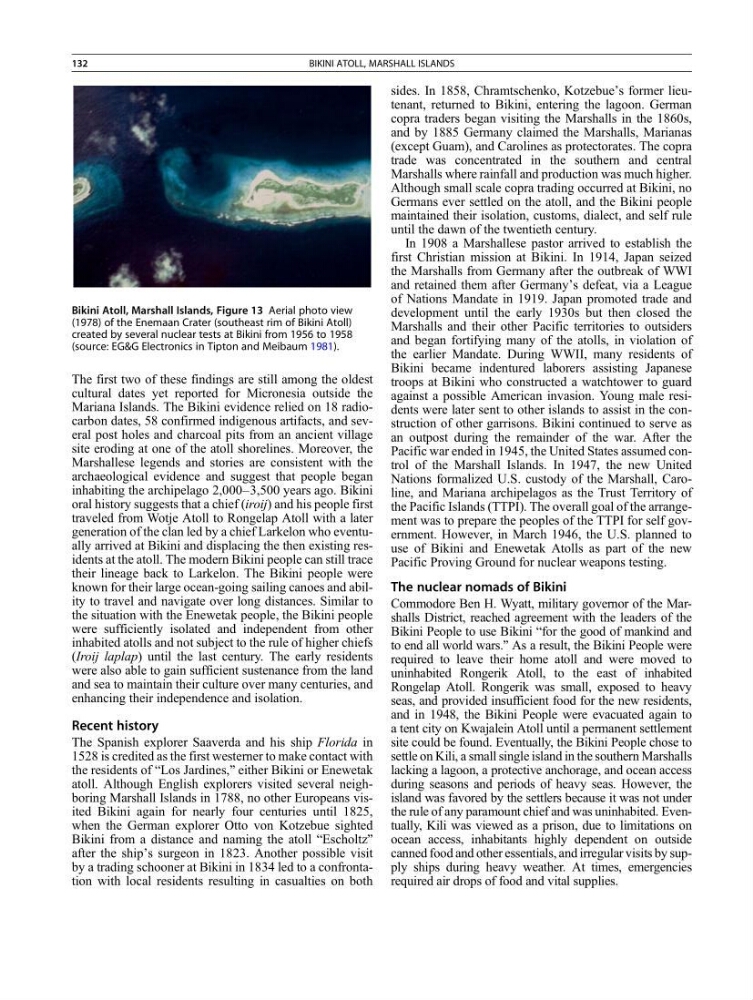
Bikini Atoll, Marshall Islands, Figure 13 Aerial photo view
(1978) of the Enemaan Crater (southeast rim of Bikini Atoll)
created by several nuclear tests at Bikini from 1956 to 1958
(source: EG&G Electronics in Tipton and Meibaum 1981).
132
BIKINI ATOLL, MARSHALL ISLANDS
cultural dates yet reported for Micronesia outside the
Mariana Islands. The Bikini evidence relied on 18 radiocarbon dates, 58 confirmed indigenous artifacts, and several post holes and charcoal pits from an ancient village
site eroding at one of the atoll shorelines. Moreover, the
Marshallese legends and stories are consistent with the
archaeological evidence and suggest that people began
inhabiting the archipelago 2,000–3,500 years ago. Bikini
oral history suggests that a chief (iroij) and his people first
traveled from Wotje Atoll to Rongelap Atoll with a later
generation of the clan led by a chief Larkelon who eventually arrived at Bikini and displacing the then existing residents at the atoll. The modern Bikini people can still trace
their lineage back to Larkelon. The Bikini people were
known for their large ocean-going sailing canoes and ability to travel and navigate over long distances. Similar to
the situation with the Enewetak people, the Bikini people
were sufficiently isolated and independent from other
inhabited atolls and not subject to the rule of higher chiefs
(Iroij laplap) until the last century. The early residents
were also able to gain sufficient sustenance from the land
and sea to maintain their culture over many centuries, and
enhancing their independence and isolation.
Recent history
The Spanish explorer Saaverda and his ship Florida in
1528 is credited as the first westerner to make contact with
the residents of “Los Jardines,” either Bikini or Enewetak
atoll. Although English explorers visited several neighboring Marshall Islands in 1788, no other Europeans visited Bikini again for nearly four centuries until 1825,
when the German explorer Otto von Kotzebue sighted
Bikini from a distance and naming the atoll “Escholtz”
after the ship’s surgeon in 1823. Another possible visit
by a trading schooner at Bikini in 1834 led to a confrontation with local residents resulting in casualties on both
sides. In 1858, Chramtschenko, Kotzebue’s former lieutenant, returned to Bikini, entering the lagoon. German
copra traders began visiting the Marshalls in the 1860s,
and by 1885 Germany claimed the Marshalls, Marianas
(except Guam), and Carolines as protectorates. The copra
trade was concentrated in the southern and central
Marshalls where rainfall and production was much higher.
Although small scale copra trading occurred at Bikini, no
Germans ever settled on the atoll, and the Bikini people
maintained their isolation, customs, dialect, and self rule
until the dawn of the twentieth century.
In 1908 a Marshallese pastor arrived to establish the
first Christian mission at Bikini. In 1914, Japan seized
the Marshalls from Germany after the outbreak of WWI
and retained them after Germany’s defeat, via a League
of Nations Mandate in 1919. Japan promoted trade and
development until the early 1930s but then closed the
Marshalls and their other Pacific territories to outsiders
and began fortifying many of the atolls, in violation of
the earlier Mandate. During WWII, many residents of
Bikini became indentured laborers assisting Japanese
troops at Bikini who constructed a watchtower to guard
against a possible American invasion. Young male residents were later sent to other islands to assist in the construction of other garrisons. Bikini continued to serve as
an outpost during the remainder of the war. After the
Pacific war ended in 1945, the United States assumed control of the Marshall Islands. In 1947, the new United
Nations formalized U.S. custody of the Marshall, Caroline, and Mariana archipelagos as the Trust Territory of
the Pacific Islands (TTPI). The overall goal of the arrangement was to prepare the peoples of the TTPI for self government. However, in March 1946, the U.S. planned to
use of Bikini and Enewetak Atolls as part of the new
Pacific Proving Ground for nuclear weapons testing.
The nuclear nomads of Bikini
Commodore Ben H. Wyatt, military governor of the Marshalls District, reached agreement with the leaders of the
Bikini People to use Bikini “for the good of mankind and
to end all world wars.” As a result, the Bikini People were
required to leave their home atoll and were moved to
uninhabited Rongerik Atoll, to the east of inhabited
Rongelap Atoll. Rongerik was small, exposed to heavy
seas, and provided insufficient food for the new residents,
and in 1948, the Bikini People were evacuated again to
a tent city on Kwajalein Atoll until a permanent settlement
site could be found. Eventually, the Bikini People chose to
settle on Kili, a small single island in the southern Marshalls
lacking a lagoon, a protective anchorage, and ocean access
during seasons and periods of heavy seas. However, the
island was favored by the settlers because it was not under
the rule of any paramount chief and was uninhabited. Eventually, Kili was viewed as a prison, due to limitations on
ocean access, inhabitants highly dependent on outside
canned food and other essentials, and irregular visits by supply ships during heavy weather. At times, emergencies
required air drops of food and vital supplies.
Bikini Atoll, Marshall Islands, Figure 13 Aerial photo view
(1978) of the Enemaan Crater (southeast rim of Bikini Atoll)
created by several nuclear tests at Bikini from 1956 to 1958
(source: EG&G Electronics in Tipton and Meibaum 1981).
132
BIKINI ATOLL, MARSHALL ISLANDS