

the 1986 team concluded that the avifauna of Bikini is
“typical of low coral atolls in the region, with significant
nesting populations of several species of seabirds. . .It is
likely that most or all current populations of Bikini Atoll
seabirds represent recolonization occurring after the conclusion of atomic bomb testing.” The presence of many
ground-nesting seabirds at the atoll suggests that some
of the outer islets were free of rodents, although the latter
were noticeably abundant on the main islands. Birds
were again surveyed at Bikini in 2002, and the authors
suggested that the absence of islanders at the atoll over
many years may be benefiting seabird populations.
Sea turtles
Hawkbill turtles (Eretmochelys imbricata) and green turtles (Chelonia mydas) were commonly observed swimming on ocean reefs and lagoon habitats during marine
biological surveys from 1984 to 1986. The seabird team,
Garrett and Schreiber (1988) also searched for turtle tracks
and pits during their surveys of 12 islets in 1986, and they
reported seeing a few nests and tracks only at Bikini
Island.
Atmospheric nuclear tests at Bikini
The nuclear program at Bikini totaled 23 tests from 1946
to 1958 and was the first site for the U.S. Pacific Proving
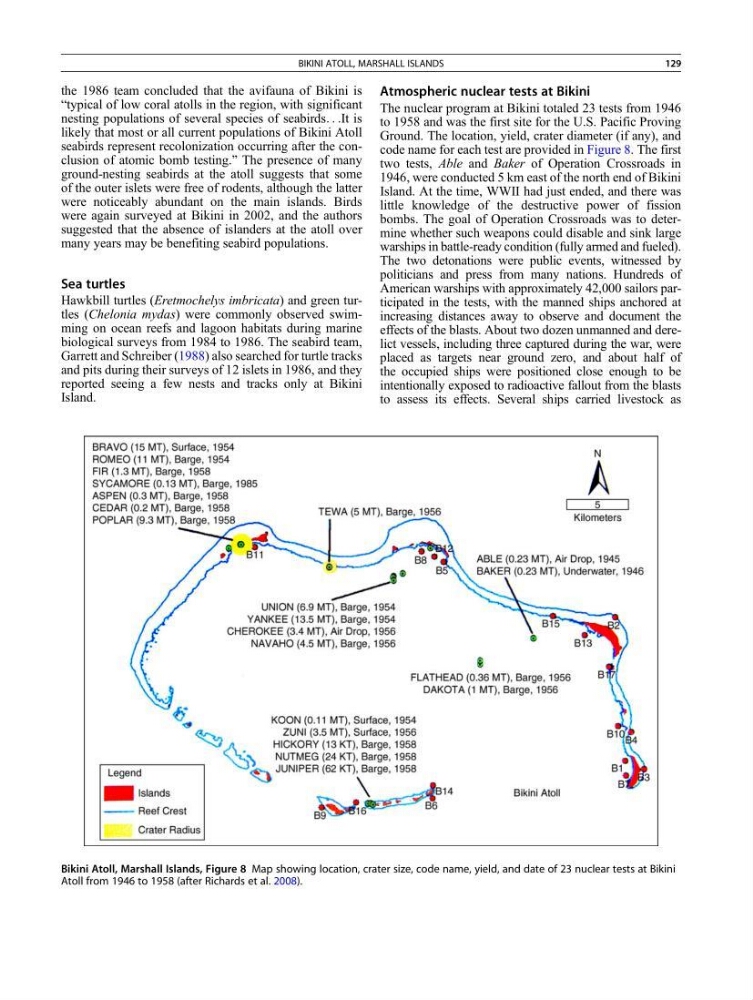
Ground. The location, yield, crater diameter (if any), and
code name for each test are provided in Figure 8. The first
two tests, Able and Baker of Operation Crossroads in
1946, were conducted 5 km east of the north end of Bikini
Island. At the time, WWII had just ended, and there was
little knowledge of the destructive power of fission
bombs. The goal of Operation Crossroads was to determine whether such weapons could disable and sink large
warships in battle-ready condition (fully armed and fueled).
The two detonations were public events, witnessed by
politicians and press from many nations. Hundreds of
American warships with approximately 42,000 sailors participated in the tests, with the manned ships anchored at
increasing distances away to observe and document the
effects of the blasts. About two dozen unmanned and derelict vessels, including three captured during the war, were
placed as targets near ground zero, and about half of
the occupied ships were positioned close enough to be
intentionally exposed to radioactive fallout from the blasts
to assess its effects. Several ships carried livestock as
Bikini Atoll, Marshall Islands, Figure 8 Map showing location, crater size, code name, yield, and date of 23 nuclear tests at Bikini
Atoll from 1946 to 1958 (after Richards et al. 2008).
BIKINI ATOLL, MARSHALL ISLANDS
129
“typical of low coral atolls in the region, with significant
nesting populations of several species of seabirds. . .It is
likely that most or all current populations of Bikini Atoll
seabirds represent recolonization occurring after the conclusion of atomic bomb testing.” The presence of many
ground-nesting seabirds at the atoll suggests that some
of the outer islets were free of rodents, although the latter
were noticeably abundant on the main islands. Birds
were again surveyed at Bikini in 2002, and the authors
suggested that the absence of islanders at the atoll over
many years may be benefiting seabird populations.
Sea turtles
Hawkbill turtles (Eretmochelys imbricata) and green turtles (Chelonia mydas) were commonly observed swimming on ocean reefs and lagoon habitats during marine
biological surveys from 1984 to 1986. The seabird team,
Garrett and Schreiber (1988) also searched for turtle tracks
and pits during their surveys of 12 islets in 1986, and they
reported seeing a few nests and tracks only at Bikini
Island.
Atmospheric nuclear tests at Bikini
The nuclear program at Bikini totaled 23 tests from 1946
to 1958 and was the first site for the U.S. Pacific Proving
Ground. The location, yield, crater diameter (if any), and
code name for each test are provided in Figure 8. The first
two tests, Able and Baker of Operation Crossroads in
1946, were conducted 5 km east of the north end of Bikini
Island. At the time, WWII had just ended, and there was
little knowledge of the destructive power of fission
bombs. The goal of Operation Crossroads was to determine whether such weapons could disable and sink large
warships in battle-ready condition (fully armed and fueled).
The two detonations were public events, witnessed by
politicians and press from many nations. Hundreds of
American warships with approximately 42,000 sailors participated in the tests, with the manned ships anchored at
increasing distances away to observe and document the
effects of the blasts. About two dozen unmanned and derelict vessels, including three captured during the war, were
placed as targets near ground zero, and about half of
the occupied ships were positioned close enough to be
intentionally exposed to radioactive fallout from the blasts
to assess its effects. Several ships carried livestock as
Bikini Atoll, Marshall Islands, Figure 8 Map showing location, crater size, code name, yield, and date of 23 nuclear tests at Bikini
Atoll from 1946 to 1958 (after Richards et al. 2008).
BIKINI ATOLL, MARSHALL ISLANDS
129