

efforts in all major habitats, deep and shallow at Bikini. In
comparison, lesser collecting and observational efforts to
depths of 30 m have yielded about 180 species of stony
corals at Enewetak, 175 at Arno, 180 at Ailinginae, 205
at Majuro (the second highest totals to date in the Marshall
Islands), and 203 species at Helen Atoll in southwestern
Palau. The latter Bikini surveys in 1985 and 2002 relied
primarily on scuba diving, and both documented prolific
recovery of corals within 27–44 years of the end of the
nuclear testing program.
The first comprehensive fish surveys in 1985 were
focused on estimates of species likely to be consumed by
the returning Bikini People and are not a comprehensive
inventory of all species. Yet, 250 species at 29 sites were
reported by Agegian et al. (1987). Later, Pinca et al.
(2002) independently conducted fish surveys at Bikini
and accounted for 359 species, but a combined list of both
the investigations was not compiled. Randall and Randall
reported more than 800 fish species at Enewetak based
on extensive observations and diverse collections including poison stations to account for cryptic species. Thus,
the higher diversity of fish species at Enewetak is attributed to considerably more survey effort and methods.
In comparison, 267 fish species were reported at nearby
Ailinginae Atoll at 33 sites in 2002. As with the 1985
Bikini survey, the emphasis on the Ailinginae surveys
included preferential attention to larger fish, and thus,
many cryptic and smaller species were not inventoried.
Bikini fish biomass and abundance was reported high in
both fish surveys.
Vegetation
Fosberg (1988) surveyed ten islets including four of the
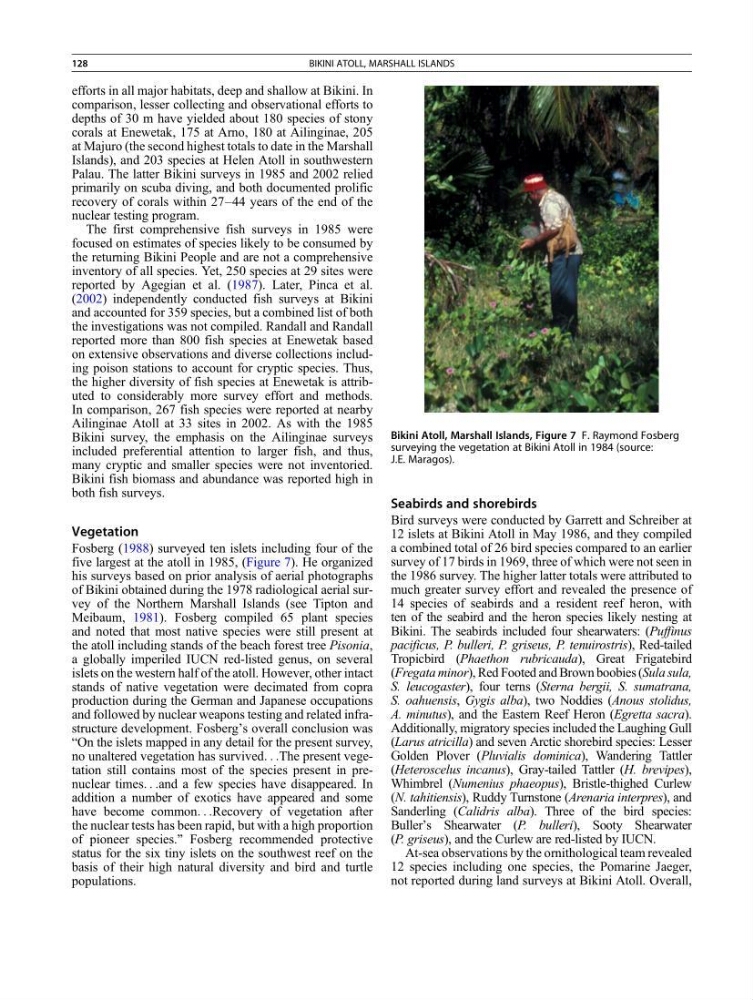
five largest at the atoll in 1985, (Figure 7). He organized
his surveys based on prior analysis of aerial photographs
of Bikini obtained during the 1978 radiological aerial survey of the Northern Marshall Islands (see Tipton and
Meibaum, 1981). Fosberg compiled 65 plant species
and noted that most native species were still present at
the atoll including stands of the beach forest tree Pisonia,
a globally imperiled IUCN red-listed genus, on several
islets on the western half of the atoll. However, other intact
stands of native vegetation were decimated from copra
production during the German and Japanese occupations
and followed by nuclear weapons testing and related infrastructure development. Fosberg’s overall conclusion was
“On the islets mapped in any detail for the present survey,
no unaltered vegetation has survived. . .The present vegetation still contains most of the species present in prenuclear times. . .and a few species have disappeared. In
addition a number of exotics have appeared and some
have become common. . .Recovery of vegetation after
the nuclear tests has been rapid, but with a high proportion
of pioneer species.” Fosberg recommended protective
status for the six tiny islets on the southwest reef on the
basis of their high natural diversity and bird and turtle
populations.
Seabirds and shorebirds
Bird surveys were conducted by Garrett and Schreiber at
12 islets at Bikini Atoll in May 1986, and they compiled
a combined total of 26 bird species compared to an earlier
survey of 17 birds in 1969, three of which were not seen in
the 1986 survey. The higher latter totals were attributed to
much greater survey effort and revealed the presence of
14 species of seabirds and a resident reef heron, with
ten of the seabird and the heron species likely nesting at
Bikini. The seabirds included four shearwaters: (Puffinus
pacificus, P. bulleri, P. griseus, P. tenuirostris), Red-tailed
Tropicbird (Phaethon rubricauda), Great Frigatebird
(Fregata minor), Red Footed and Brown boobies (Sula sula,
S. leucogaster), four terns (Sterna bergii, S. sumatrana,
S. oahuensis, Gygis alba), two Noddies (Anous stolidus,
A. minutus), and the Eastern Reef Heron (Egretta sacra).
Additionally, migratory species included the Laughing Gull
(Larus atricilla) and seven Arctic shorebird species: Lesser
Golden Plover (Pluvialis dominica), Wandering Tattler
(Heteroscelus incanus), Gray-tailed Tattler (H. brevipes),
Whimbrel (Numenius phaeopus), Bristle-thighed Curlew
(N. tahitiensis), Ruddy Turnstone (Arenaria interpres), and
Sanderling (Calidris alba). Three of the bird species:
Buller’s Shearwater (P. bulleri), Sooty Shearwater
(P. griseus), and the Curlew are red-listed by IUCN.
At-sea observations by the ornithological team revealed
12 species including one species, the Pomarine Jaeger,
not reported during land surveys at Bikini Atoll. Overall,
Bikini Atoll, Marshall Islands, Figure 7 F. Raymond Fosberg
surveying the vegetation at Bikini Atoll in 1984 (source:
J.E. Maragos).
128
BIKINI ATOLL, MARSHALL ISLANDS
comparison, lesser collecting and observational efforts to
depths of 30 m have yielded about 180 species of stony
corals at Enewetak, 175 at Arno, 180 at Ailinginae, 205
at Majuro (the second highest totals to date in the Marshall
Islands), and 203 species at Helen Atoll in southwestern
Palau. The latter Bikini surveys in 1985 and 2002 relied
primarily on scuba diving, and both documented prolific
recovery of corals within 27–44 years of the end of the
nuclear testing program.
The first comprehensive fish surveys in 1985 were
focused on estimates of species likely to be consumed by
the returning Bikini People and are not a comprehensive
inventory of all species. Yet, 250 species at 29 sites were
reported by Agegian et al. (1987). Later, Pinca et al.
(2002) independently conducted fish surveys at Bikini
and accounted for 359 species, but a combined list of both
the investigations was not compiled. Randall and Randall
reported more than 800 fish species at Enewetak based
on extensive observations and diverse collections including poison stations to account for cryptic species. Thus,
the higher diversity of fish species at Enewetak is attributed to considerably more survey effort and methods.
In comparison, 267 fish species were reported at nearby
Ailinginae Atoll at 33 sites in 2002. As with the 1985
Bikini survey, the emphasis on the Ailinginae surveys
included preferential attention to larger fish, and thus,
many cryptic and smaller species were not inventoried.
Bikini fish biomass and abundance was reported high in
both fish surveys.
Vegetation
Fosberg (1988) surveyed ten islets including four of the
five largest at the atoll in 1985, (Figure 7). He organized
his surveys based on prior analysis of aerial photographs
of Bikini obtained during the 1978 radiological aerial survey of the Northern Marshall Islands (see Tipton and
Meibaum, 1981). Fosberg compiled 65 plant species
and noted that most native species were still present at
the atoll including stands of the beach forest tree Pisonia,
a globally imperiled IUCN red-listed genus, on several
islets on the western half of the atoll. However, other intact
stands of native vegetation were decimated from copra
production during the German and Japanese occupations
and followed by nuclear weapons testing and related infrastructure development. Fosberg’s overall conclusion was
“On the islets mapped in any detail for the present survey,
no unaltered vegetation has survived. . .The present vegetation still contains most of the species present in prenuclear times. . .and a few species have disappeared. In
addition a number of exotics have appeared and some
have become common. . .Recovery of vegetation after
the nuclear tests has been rapid, but with a high proportion
of pioneer species.” Fosberg recommended protective
status for the six tiny islets on the southwest reef on the
basis of their high natural diversity and bird and turtle
populations.
Seabirds and shorebirds
Bird surveys were conducted by Garrett and Schreiber at
12 islets at Bikini Atoll in May 1986, and they compiled
a combined total of 26 bird species compared to an earlier
survey of 17 birds in 1969, three of which were not seen in
the 1986 survey. The higher latter totals were attributed to
much greater survey effort and revealed the presence of
14 species of seabirds and a resident reef heron, with
ten of the seabird and the heron species likely nesting at
Bikini. The seabirds included four shearwaters: (Puffinus
pacificus, P. bulleri, P. griseus, P. tenuirostris), Red-tailed
Tropicbird (Phaethon rubricauda), Great Frigatebird
(Fregata minor), Red Footed and Brown boobies (Sula sula,
S. leucogaster), four terns (Sterna bergii, S. sumatrana,
S. oahuensis, Gygis alba), two Noddies (Anous stolidus,
A. minutus), and the Eastern Reef Heron (Egretta sacra).
Additionally, migratory species included the Laughing Gull
(Larus atricilla) and seven Arctic shorebird species: Lesser
Golden Plover (Pluvialis dominica), Wandering Tattler
(Heteroscelus incanus), Gray-tailed Tattler (H. brevipes),
Whimbrel (Numenius phaeopus), Bristle-thighed Curlew
(N. tahitiensis), Ruddy Turnstone (Arenaria interpres), and
Sanderling (Calidris alba). Three of the bird species:
Buller’s Shearwater (P. bulleri), Sooty Shearwater
(P. griseus), and the Curlew are red-listed by IUCN.
At-sea observations by the ornithological team revealed
12 species including one species, the Pomarine Jaeger,
not reported during land surveys at Bikini Atoll. Overall,
Bikini Atoll, Marshall Islands, Figure 7 F. Raymond Fosberg
surveying the vegetation at Bikini Atoll in 1984 (source:
J.E. Maragos).
128
BIKINI ATOLL, MARSHALL ISLANDS