

1998). Because of their depth and distance from land,
these reefs are the poorest known in Bermuda.
Main terrace reefs
These reefs succeed the fore-reef slope reefs at the platform margin, covering a prominent terrace extending from
10 to 20 m seawards from the annular rim reefs. From
a narrow sediment apron at the outer edge of the rim reef
tract, at a depth of about 5 m, a series of reef ridges, separated by sand channels, form an anastomosing pattern similar to spur-and-groove structure. This feature is
particularly well shown along the western edge of the platform (Logan, 1988). Total coral coverage values for main
terrace reefs are the highest in Bermuda, frequently
reaching 50%, but coral diversity is again low. The bottom
has less relief than that of the fore-reef slope and is dominated by domal colonies of the two species of Diploria
(64%), encrusting or platy Montastrea franksi (32%),
and domal Porites astreoides (3%). This Diploria–
Montastrea–Porites reef-building community is typical
of all platform margin and lagoonal coral–algal reefs
across the platform.
Rim reefs
Rim reefs are developed on the elevated 100-km ring of
shallow shoals that encircle the lagoon and protect it from
open-ocean waves. These reefs extend lagoonwards by
lobate extensions and grade into main terrace reefs on
the seaward side. Their tops lie between 2 and 6 m depth
and are dissected by ramifying sand channels of about
10–15 m depth. The reef tops show relief of about 1 m
between coral heads, with about 22% coral coverage
(Dodge et al., 1982). Large gorgonaceans belonging to at
least six genera are attached to the reef tops and channel
sides, taking advantage of the almost constant surge from
the open ocean (Figure 3). The Diploria–Montastrea–
Porites coral assemblage is again predominant, their
species accounting for over 90% of the coral coverage,
with the two species of Diploria accounting for over
65% alone. A wide variety of coral growth forms occurs,
from domal to encrusting to platy, presumably in response
to varying light conditions. Sponges, zoanthids, hydrozoans, anemones, and corallimorphs are common, with
smaller colonies of less common coral species present as
understory species. Diverse coelobite communities colonize shaded areas beneath coral heads or in caves and tunnels near the base of the reef (Figure 4). While occasional
diseased coral colonies are encountered, the rim reefs
remain the most healthy and attractive reefs in Bermuda
and appear to have been little affected by bleaching or
anthropogenic influences.
Algal–vermetid cup reefs
These cup reefs, locally known as “boilers,” occur as
a discontinuous tract on the outer edge of the platform
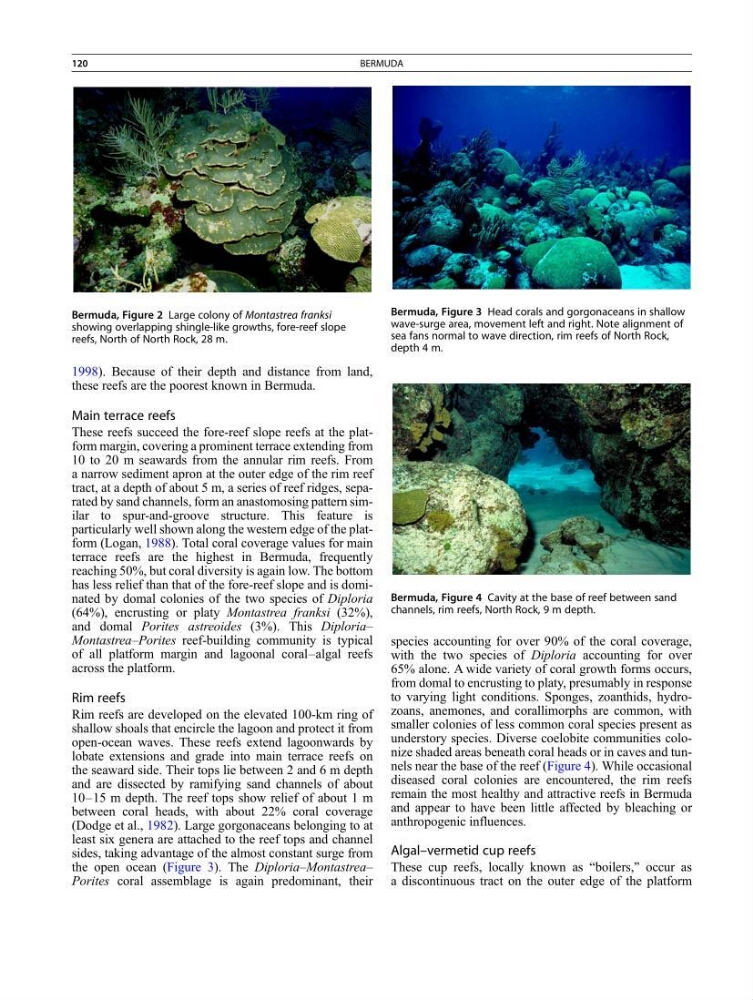
Bermuda, Figure 2 Large colony of Montastrea franksi
showing overlapping shingle-like growths, fore-reef slope
reefs, North of North Rock, 28 m.
Bermuda, Figure 3 Head corals and gorgonaceans in shallow
wave-surge area, movement left and right. Note alignment of
sea fans normal to wave direction, rim reefs of North Rock,
depth 4 m.
Bermuda, Figure 4 Cavity at the base of reef between sand
channels, rim reefs, North Rock, 9 m depth.
120
BERMUDA
these reefs are the poorest known in Bermuda.
Main terrace reefs
These reefs succeed the fore-reef slope reefs at the platform margin, covering a prominent terrace extending from
10 to 20 m seawards from the annular rim reefs. From
a narrow sediment apron at the outer edge of the rim reef
tract, at a depth of about 5 m, a series of reef ridges, separated by sand channels, form an anastomosing pattern similar to spur-and-groove structure. This feature is
particularly well shown along the western edge of the platform (Logan, 1988). Total coral coverage values for main
terrace reefs are the highest in Bermuda, frequently
reaching 50%, but coral diversity is again low. The bottom
has less relief than that of the fore-reef slope and is dominated by domal colonies of the two species of Diploria
(64%), encrusting or platy Montastrea franksi (32%),
and domal Porites astreoides (3%). This Diploria–
Montastrea–Porites reef-building community is typical
of all platform margin and lagoonal coral–algal reefs
across the platform.
Rim reefs
Rim reefs are developed on the elevated 100-km ring of
shallow shoals that encircle the lagoon and protect it from
open-ocean waves. These reefs extend lagoonwards by
lobate extensions and grade into main terrace reefs on
the seaward side. Their tops lie between 2 and 6 m depth
and are dissected by ramifying sand channels of about
10–15 m depth. The reef tops show relief of about 1 m
between coral heads, with about 22% coral coverage
(Dodge et al., 1982). Large gorgonaceans belonging to at
least six genera are attached to the reef tops and channel
sides, taking advantage of the almost constant surge from
the open ocean (Figure 3). The Diploria–Montastrea–
Porites coral assemblage is again predominant, their
species accounting for over 90% of the coral coverage,
with the two species of Diploria accounting for over
65% alone. A wide variety of coral growth forms occurs,
from domal to encrusting to platy, presumably in response
to varying light conditions. Sponges, zoanthids, hydrozoans, anemones, and corallimorphs are common, with
smaller colonies of less common coral species present as
understory species. Diverse coelobite communities colonize shaded areas beneath coral heads or in caves and tunnels near the base of the reef (Figure 4). While occasional
diseased coral colonies are encountered, the rim reefs
remain the most healthy and attractive reefs in Bermuda
and appear to have been little affected by bleaching or
anthropogenic influences.
Algal–vermetid cup reefs
These cup reefs, locally known as “boilers,” occur as
a discontinuous tract on the outer edge of the platform
Bermuda, Figure 2 Large colony of Montastrea franksi
showing overlapping shingle-like growths, fore-reef slope
reefs, North of North Rock, 28 m.
Bermuda, Figure 3 Head corals and gorgonaceans in shallow
wave-surge area, movement left and right. Note alignment of
sea fans normal to wave direction, rim reefs of North Rock,
depth 4 m.
Bermuda, Figure 4 Cavity at the base of reef between sand
channels, rim reefs, North Rock, 9 m depth.
120
BERMUDA