

rim, particularly on the south-eastern side from
St. David’s Head to South-West Breakers, where there
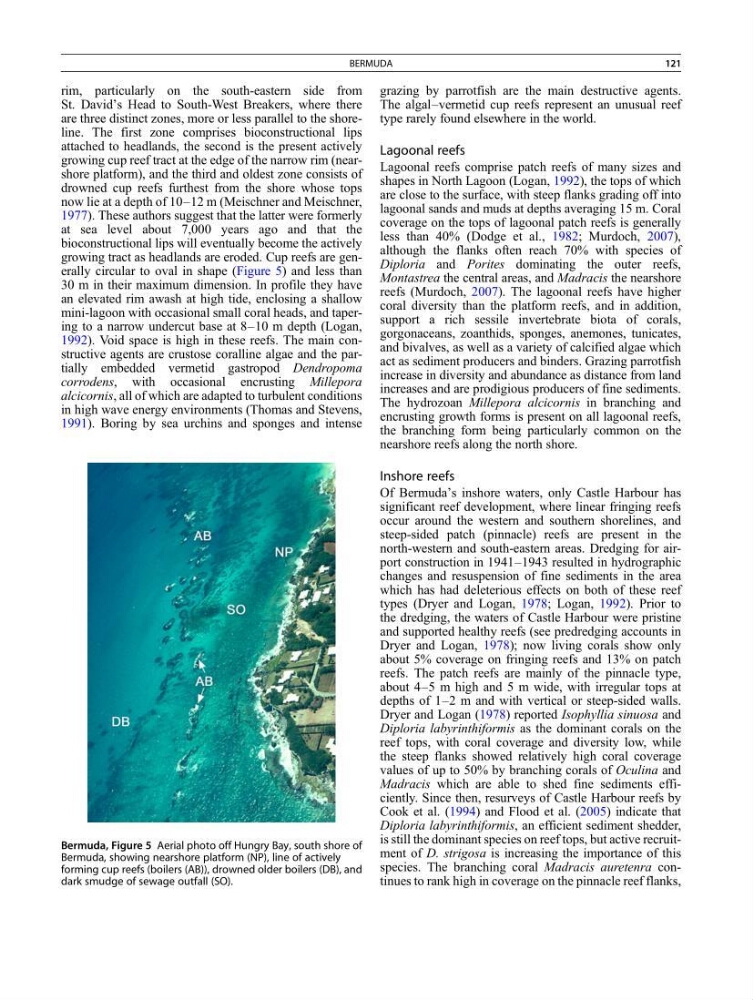
are three distinct zones, more or less parallel to the shoreline. The first zone comprises bioconstructional lips
attached to headlands, the second is the present actively
growing cup reef tract at the edge of the narrow rim (nearshore platform), and the third and oldest zone consists of
drowned cup reefs furthest from the shore whose tops
now lie at a depth of 10–12 m (Meischner and Meischner,
1977). These authors suggest that the latter were formerly
at sea level about 7,000 years ago and that the
bioconstructional lips will eventually become the actively
growing tract as headlands are eroded. Cup reefs are generally circular to oval in shape (Figure 5) and less than
30 m in their maximum dimension. In profile they have
an elevated rim awash at high tide, enclosing a shallow
mini-lagoon with occasional small coral heads, and tapering to a narrow undercut base at 8–10 m depth (Logan,
1992). Void space is high in these reefs. The main constructive agents are crustose coralline algae and the partially embedded vermetid gastropod Dendropoma
corrodens, with occasional encrusting Millepora
alcicornis, all of which are adapted to turbulent conditions
in high wave energy environments (Thomas and Stevens,
1991). Boring by sea urchins and sponges and intense
grazing by parrotfish are the main destructive agents.
The algal–vermetid cup reefs represent an unusual reef
type rarely found elsewhere in the world.
Lagoonal reefs
Lagoonal reefs comprise patch reefs of many sizes and
shapes in North Lagoon (Logan, 1992), the tops of which
are close to the surface, with steep flanks grading off into
lagoonal sands and muds at depths averaging 15 m. Coral
coverage on the tops of lagoonal patch reefs is generally
less than 40% (Dodge et al., 1982; Murdoch, 2007),
although the flanks often reach 70% with species of
Diploria and Porites dominating the outer reefs,
Montastrea the central areas, and Madracis the nearshore
reefs (Murdoch, 2007). The lagoonal reefs have higher
coral diversity than the platform reefs, and in addition,
support a rich sessile invertebrate biota of corals,
gorgonaceans, zoanthids, sponges, anemones, tunicates,
and bivalves, as well as a variety of calcified algae which
act as sediment producers and binders. Grazing parrotfish
increase in diversity and abundance as distance from land
increases and are prodigious producers of fine sediments.
The hydrozoan Millepora alcicornis in branching and
encrusting growth forms is present on all lagoonal reefs,
the branching form being particularly common on the
nearshore reefs along the north shore.
Inshore reefs
Of Bermuda’s inshore waters, only Castle Harbour has
significant reef development, where linear fringing reefs
occur around the western and southern shorelines, and
steep-sided patch (pinnacle) reefs are present in the
north-western and south-eastern areas. Dredging for airport construction in 1941–1943 resulted in hydrographic
changes and resuspension of fine sediments in the area
which has had deleterious effects on both of these reef
types (Dryer and Logan, 1978; Logan, 1992). Prior to
the dredging, the waters of Castle Harbour were pristine
and supported healthy reefs (see predredging accounts in
Dryer and Logan, 1978); now living corals show only
about 5% coverage on fringing reefs and 13% on patch
reefs. The patch reefs are mainly of the pinnacle type,
about 4–5 m high and 5 m wide, with irregular tops at
depths of 1–2 m and with vertical or steep-sided walls.
Dryer and Logan (1978) reported Isophyllia sinuosa and
Diploria labyrinthiformis as the dominant corals on the
reef tops, with coral coverage and diversity low, while
the steep flanks showed relatively high coral coverage
values of up to 50% by branching corals of Oculina and
Madracis which are able to shed fine sediments efficiently. Since then, resurveys of Castle Harbour reefs by
Cook et al. (1994) and Flood et al. (2005) indicate that
Diploria labyrinthiformis, an efficient sediment shedder,
is still the dominant species on reef tops, but active recruitment of D. strigosa is increasing the importance of this
species. The branching coral Madracis auretenra continues to rank high in coverage on the pinnacle reef flanks,
Bermuda, Figure 5 Aerial photo off Hungry Bay, south shore of
Bermuda, showing nearshore platform (NP), line of actively
forming cup reefs (boilers (AB)), drowned older boilers (DB), and
dark smudge of sewage outfall (SO).
BERMUDA
121
St. David’s Head to South-West Breakers, where there
are three distinct zones, more or less parallel to the shoreline. The first zone comprises bioconstructional lips
attached to headlands, the second is the present actively
growing cup reef tract at the edge of the narrow rim (nearshore platform), and the third and oldest zone consists of
drowned cup reefs furthest from the shore whose tops
now lie at a depth of 10–12 m (Meischner and Meischner,
1977). These authors suggest that the latter were formerly
at sea level about 7,000 years ago and that the
bioconstructional lips will eventually become the actively
growing tract as headlands are eroded. Cup reefs are generally circular to oval in shape (Figure 5) and less than
30 m in their maximum dimension. In profile they have
an elevated rim awash at high tide, enclosing a shallow
mini-lagoon with occasional small coral heads, and tapering to a narrow undercut base at 8–10 m depth (Logan,
1992). Void space is high in these reefs. The main constructive agents are crustose coralline algae and the partially embedded vermetid gastropod Dendropoma
corrodens, with occasional encrusting Millepora
alcicornis, all of which are adapted to turbulent conditions
in high wave energy environments (Thomas and Stevens,
1991). Boring by sea urchins and sponges and intense
grazing by parrotfish are the main destructive agents.
The algal–vermetid cup reefs represent an unusual reef
type rarely found elsewhere in the world.
Lagoonal reefs
Lagoonal reefs comprise patch reefs of many sizes and
shapes in North Lagoon (Logan, 1992), the tops of which
are close to the surface, with steep flanks grading off into
lagoonal sands and muds at depths averaging 15 m. Coral
coverage on the tops of lagoonal patch reefs is generally
less than 40% (Dodge et al., 1982; Murdoch, 2007),
although the flanks often reach 70% with species of
Diploria and Porites dominating the outer reefs,
Montastrea the central areas, and Madracis the nearshore
reefs (Murdoch, 2007). The lagoonal reefs have higher
coral diversity than the platform reefs, and in addition,
support a rich sessile invertebrate biota of corals,
gorgonaceans, zoanthids, sponges, anemones, tunicates,
and bivalves, as well as a variety of calcified algae which
act as sediment producers and binders. Grazing parrotfish
increase in diversity and abundance as distance from land
increases and are prodigious producers of fine sediments.
The hydrozoan Millepora alcicornis in branching and
encrusting growth forms is present on all lagoonal reefs,
the branching form being particularly common on the
nearshore reefs along the north shore.
Inshore reefs
Of Bermuda’s inshore waters, only Castle Harbour has
significant reef development, where linear fringing reefs
occur around the western and southern shorelines, and
steep-sided patch (pinnacle) reefs are present in the
north-western and south-eastern areas. Dredging for airport construction in 1941–1943 resulted in hydrographic
changes and resuspension of fine sediments in the area
which has had deleterious effects on both of these reef
types (Dryer and Logan, 1978; Logan, 1992). Prior to
the dredging, the waters of Castle Harbour were pristine
and supported healthy reefs (see predredging accounts in
Dryer and Logan, 1978); now living corals show only
about 5% coverage on fringing reefs and 13% on patch
reefs. The patch reefs are mainly of the pinnacle type,
about 4–5 m high and 5 m wide, with irregular tops at
depths of 1–2 m and with vertical or steep-sided walls.
Dryer and Logan (1978) reported Isophyllia sinuosa and
Diploria labyrinthiformis as the dominant corals on the
reef tops, with coral coverage and diversity low, while
the steep flanks showed relatively high coral coverage
values of up to 50% by branching corals of Oculina and
Madracis which are able to shed fine sediments efficiently. Since then, resurveys of Castle Harbour reefs by
Cook et al. (1994) and Flood et al. (2005) indicate that
Diploria labyrinthiformis, an efficient sediment shedder,
is still the dominant species on reef tops, but active recruitment of D. strigosa is increasing the importance of this
species. The branching coral Madracis auretenra continues to rank high in coverage on the pinnacle reef flanks,
Bermuda, Figure 5 Aerial photo off Hungry Bay, south shore of
Bermuda, showing nearshore platform (NP), line of actively
forming cup reefs (boilers (AB)), drowned older boilers (DB), and
dark smudge of sewage outfall (SO).
BERMUDA
121