

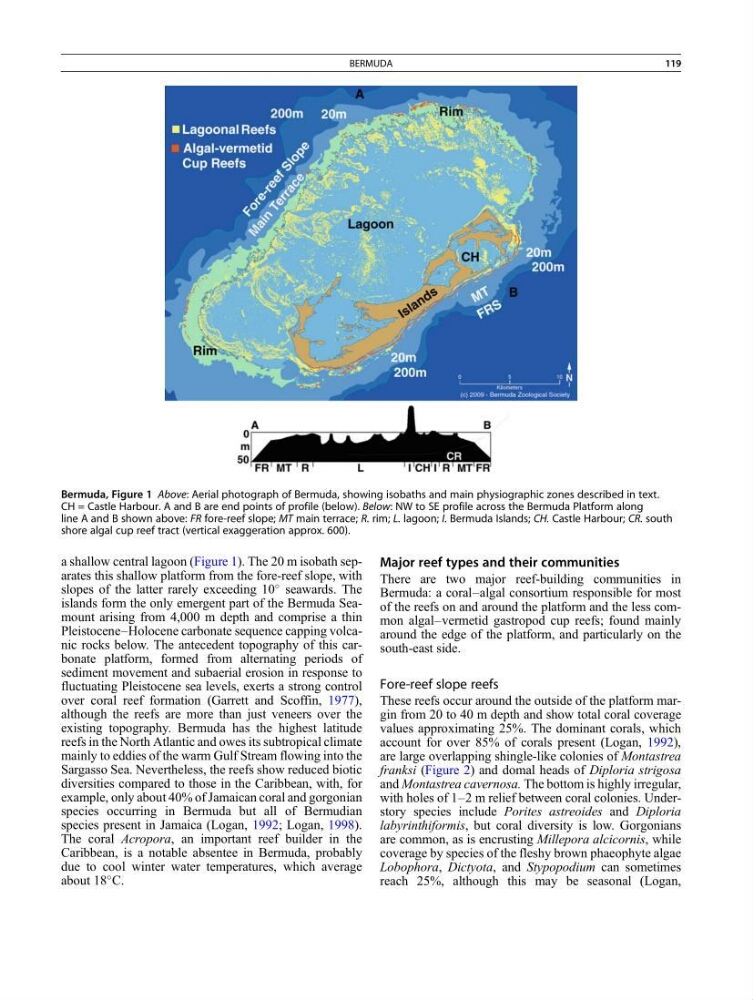
a shallow central lagoon (Figure 1). The 20 m isobath separates this shallow platform from the fore-reef slope, with
slopes of the latter rarely exceeding 10
seawards. The
islands form the only emergent part of the Bermuda Seamount arising from 4,000 m depth and comprise a thin
Pleistocene–Holocene carbonate sequence capping volcanic rocks below. The antecedent topography of this carbonate platform, formed from alternating periods of
sediment movement and subaerial erosion in response to
fluctuating Pleistocene sea levels, exerts a strong control
over coral reef formation (Garrett and Scoffin, 1977),
although the reefs are more than just veneers over the
existing topography. Bermuda has the highest latitude
reefs in the North Atlantic and owes its subtropical climate
mainly to eddies of the warm Gulf Stream flowing into the
Sargasso Sea. Nevertheless, the reefs show reduced biotic
diversities compared to those in the Caribbean, with, for
example, only about 40% of Jamaican coral and gorgonian
species occurring in Bermuda but all of Bermudian
species present in Jamaica (Logan, 1992; Logan, 1998).
The coral Acropora, an important reef builder in the
Caribbean, is a notable absentee in Bermuda, probably
due to cool winter water temperatures, which average
about 18
C.
Major reef types and their communities
There are two major reef-building communities in
Bermuda: a coral–algal consortium responsible for most
of the reefs on and around the platform and the less common algal–vermetid gastropod cup reefs; found mainly
around the edge of the platform, and particularly on the
south-east side.
Fore-reef slope reefs
These reefs occur around the outside of the platform margin from 20 to 40 m depth and show total coral coverage
values approximating 25%. The dominant corals, which
account for over 85% of corals present (Logan, 1992),
are large overlapping shingle-like colonies of Montastrea
franksi (Figure 2) and domal heads of Diploria strigosa
and Montastrea cavernosa. The bottom is highly irregular,
with holes of 1–2 m relief between coral colonies. Understory species include Porites astreoides and Diploria
labyrinthiformis, but coral diversity is low. Gorgonians
are common, as is encrusting Millepora alcicornis, while
coverage by species of the fleshy brown phaeophyte algae
Lobophora, Dictyota, and Stypopodium can sometimes
reach 25%, although this may be seasonal (Logan,
Bermuda, Figure 1 Above: Aerial photograph of Bermuda, showing isobaths and main physiographic zones described in text.
CH = Castle Harbour. A and B are end points of profile (below). Below: NW to SE profile across the Bermuda Platform along
line A and B shown above: FR fore-reef slope; MT main terrace; R. rim; L. lagoon; I. Bermuda Islands; CH. Castle Harbour; CR. south
shore algal cup reef tract (vertical exaggeration approx. 600).
BERMUDA
119
slopes of the latter rarely exceeding 10
seawards. The
islands form the only emergent part of the Bermuda Seamount arising from 4,000 m depth and comprise a thin
Pleistocene–Holocene carbonate sequence capping volcanic rocks below. The antecedent topography of this carbonate platform, formed from alternating periods of
sediment movement and subaerial erosion in response to
fluctuating Pleistocene sea levels, exerts a strong control
over coral reef formation (Garrett and Scoffin, 1977),
although the reefs are more than just veneers over the
existing topography. Bermuda has the highest latitude
reefs in the North Atlantic and owes its subtropical climate
mainly to eddies of the warm Gulf Stream flowing into the
Sargasso Sea. Nevertheless, the reefs show reduced biotic
diversities compared to those in the Caribbean, with, for
example, only about 40% of Jamaican coral and gorgonian
species occurring in Bermuda but all of Bermudian
species present in Jamaica (Logan, 1992; Logan, 1998).
The coral Acropora, an important reef builder in the
Caribbean, is a notable absentee in Bermuda, probably
due to cool winter water temperatures, which average
about 18
C.
Major reef types and their communities
There are two major reef-building communities in
Bermuda: a coral–algal consortium responsible for most
of the reefs on and around the platform and the less common algal–vermetid gastropod cup reefs; found mainly
around the edge of the platform, and particularly on the
south-east side.
Fore-reef slope reefs
These reefs occur around the outside of the platform margin from 20 to 40 m depth and show total coral coverage
values approximating 25%. The dominant corals, which
account for over 85% of corals present (Logan, 1992),
are large overlapping shingle-like colonies of Montastrea
franksi (Figure 2) and domal heads of Diploria strigosa
and Montastrea cavernosa. The bottom is highly irregular,
with holes of 1–2 m relief between coral colonies. Understory species include Porites astreoides and Diploria
labyrinthiformis, but coral diversity is low. Gorgonians
are common, as is encrusting Millepora alcicornis, while
coverage by species of the fleshy brown phaeophyte algae
Lobophora, Dictyota, and Stypopodium can sometimes
reach 25%, although this may be seasonal (Logan,
Bermuda, Figure 1 Above: Aerial photograph of Bermuda, showing isobaths and main physiographic zones described in text.
CH = Castle Harbour. A and B are end points of profile (below). Below: NW to SE profile across the Bermuda Platform along
line A and B shown above: FR fore-reef slope; MT main terrace; R. rim; L. lagoon; I. Bermuda Islands; CH. Castle Harbour; CR. south
shore algal cup reef tract (vertical exaggeration approx. 600).
BERMUDA
119