

and shelf areas; however, it was significantly decimated
by disease in recent years (Aronson and Precht, 1997).
Coastal reefs and restricted lagoons are dominated by the
tolerant Siderastrea siderea. Stoddart (1962), James
et al. (1976), James and Ginsburg (1979), and Macintyre
et al. (1987) defined zones in marginal reefs of Belize,
largely based on the occurrence of corals and other invertebrates and algae and based on submarine topography
(Figure 4). James and Ginsburg (1979) described the
deep forereef of Belize barrier and atoll reefs based on
submersible observations. At the base of the sloping
forereef in 15–40 m depth, they discovered a steep dropoff leading to an almost vertical wall that reaches down
to 100–150 m depth. At the base of the wall, a sediment
slope with rubble and larger blocks may be found.
Sediments
The Belize shelf is a classic example of a mixed carbonate–siliciclastic system (Figure 5). Siliciclastics originating from the southern mainland (Maya Mountains) and
carbonate largely produced on the outer shelf mix on the
inner shelf to form marl. Purdy (1974) elaborated the first
systematic sediment map of the Belize offshore area.
Gischler and Lomando (1999) detailed sediment types
on the offshore atolls. A compilation of existing data
including a detailed sediment map covering the entire
Belize offshore area may be found in Purdy and Gischler
(2003). Eleven facies may be delineated on the Belize
shelf and atolls, with corals, coralline algae, Halimeda,
mollusks, and benthic foraminifera being the most common skeletal constituents. Abundant nonskeletal grains,
largely peloids, occur only in shallow lagoon areas of
Glovers and Lighthouse Reefs. Carbonate mud on the
southern Belize shelf (Matthews, 1966) and in the atoll
lagoons (Gischler and Zingeler, 2002) is largely of biogenic
origin. The curious occurrence of high-magnesium-calcite
(HMC)-rich sediments on the northern Belize shelf is
a consequence of either the disintegration of micritized
HMC skeletal grains (Reid et al., 1992) or HMC precipitation (Macintyre and Aronson, 2006). Whitings, suspensions
of fine-grained carbonate potentially indicating precipitation of CaCO 3 in the water column, have been observed
on the northern Belize shelf (Purdy and Gischler, 2003).
Belize Barrier and Atoll Reefs, Figure 3 Southern Belize shelf from the satellite (from Purdy et al., 2003).
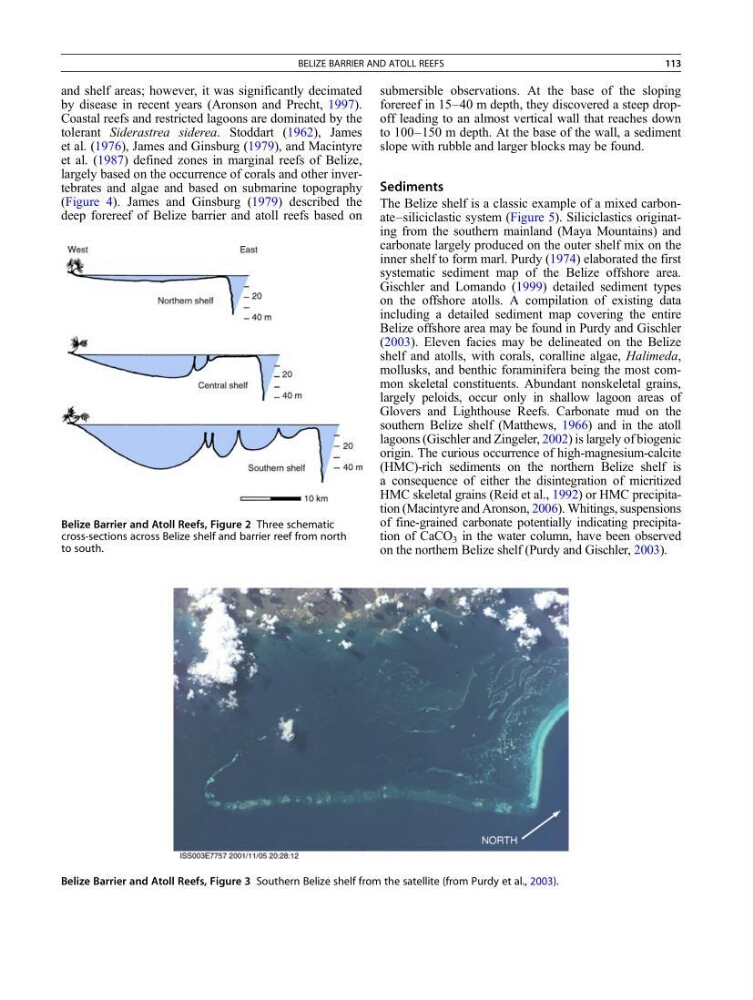
Belize Barrier and Atoll Reefs, Figure 2 Three schematic
cross-sections across Belize shelf and barrier reef from north
to south.
BELIZE BARRIER AND ATOLL REEFS
113
by disease in recent years (Aronson and Precht, 1997).
Coastal reefs and restricted lagoons are dominated by the
tolerant Siderastrea siderea. Stoddart (1962), James
et al. (1976), James and Ginsburg (1979), and Macintyre
et al. (1987) defined zones in marginal reefs of Belize,
largely based on the occurrence of corals and other invertebrates and algae and based on submarine topography
(Figure 4). James and Ginsburg (1979) described the
deep forereef of Belize barrier and atoll reefs based on
submersible observations. At the base of the sloping
forereef in 15–40 m depth, they discovered a steep dropoff leading to an almost vertical wall that reaches down
to 100–150 m depth. At the base of the wall, a sediment
slope with rubble and larger blocks may be found.
Sediments
The Belize shelf is a classic example of a mixed carbonate–siliciclastic system (Figure 5). Siliciclastics originating from the southern mainland (Maya Mountains) and
carbonate largely produced on the outer shelf mix on the
inner shelf to form marl. Purdy (1974) elaborated the first
systematic sediment map of the Belize offshore area.
Gischler and Lomando (1999) detailed sediment types
on the offshore atolls. A compilation of existing data
including a detailed sediment map covering the entire
Belize offshore area may be found in Purdy and Gischler
(2003). Eleven facies may be delineated on the Belize
shelf and atolls, with corals, coralline algae, Halimeda,
mollusks, and benthic foraminifera being the most common skeletal constituents. Abundant nonskeletal grains,
largely peloids, occur only in shallow lagoon areas of
Glovers and Lighthouse Reefs. Carbonate mud on the
southern Belize shelf (Matthews, 1966) and in the atoll
lagoons (Gischler and Zingeler, 2002) is largely of biogenic
origin. The curious occurrence of high-magnesium-calcite
(HMC)-rich sediments on the northern Belize shelf is
a consequence of either the disintegration of micritized
HMC skeletal grains (Reid et al., 1992) or HMC precipitation (Macintyre and Aronson, 2006). Whitings, suspensions
of fine-grained carbonate potentially indicating precipitation of CaCO 3 in the water column, have been observed
on the northern Belize shelf (Purdy and Gischler, 2003).
Belize Barrier and Atoll Reefs, Figure 3 Southern Belize shelf from the satellite (from Purdy et al., 2003).
Belize Barrier and Atoll Reefs, Figure 2 Three schematic
cross-sections across Belize shelf and barrier reef from north
to south.
BELIZE BARRIER AND ATOLL REEFS
113