

Geology
The low northern part of Belize is largely covered
by Cenozoic limestone. The mountainous south of the
country (Maya Mountains) is characterized by Paleozoic
siliciclastics and magmatic rocks, fringed by Cretaceous
limestone and dolostone (Figure 6). A series of NNEtrending normal faults characterize the structural grain of
the Belize passive continental margin. The hanging walls
of these major faults form the basement of the Belize reef
system. Offshore exploration wells and seismics have
shown that up to 3.5 km of Meso-Cenozoic carbonates
overlie the Paleozoic basement around the barrier reef
(Purdy et al., 2003). Cenozoic carbonates on the offshore
atolls are up to 1 km thick. The thickness of Pleistocene
reefs ranges from 100 to 150 m. Studies on Pleistocene
reefs are based on limited outcrops and a few deep wells
in the northeastern and southern parts of the country
(Mazzullo, 2006; Gischler et al., 2010) as well as on Pleistocene reef limestone recovered in shallow coreholes
below Holocene reef deposits (Gischler, 2006a). Pleistocene facies may be compared to modern ones, with the
exception of the occurrence of Pleistocene oolites in
northern Belize. Based on the sedimentologic and stratigraphic analysis of a long piston core taken in the deep
forereef east of the barrier reef, Droxler et al. (2003) came
to the conclusion that the modern barrier reef, as source of
carbonate detritus, only came into existence during the
exceptionally long and warm marine isotope stage 11,
some 400 kyBP.
Late Quaternary reef development, sea level, and
antecedent topography
Postglacial reef growth started >8.26 kyBP on the Belize
Barrier Reef (Gischler and Hudson, 2004) and 7.78 kyBP
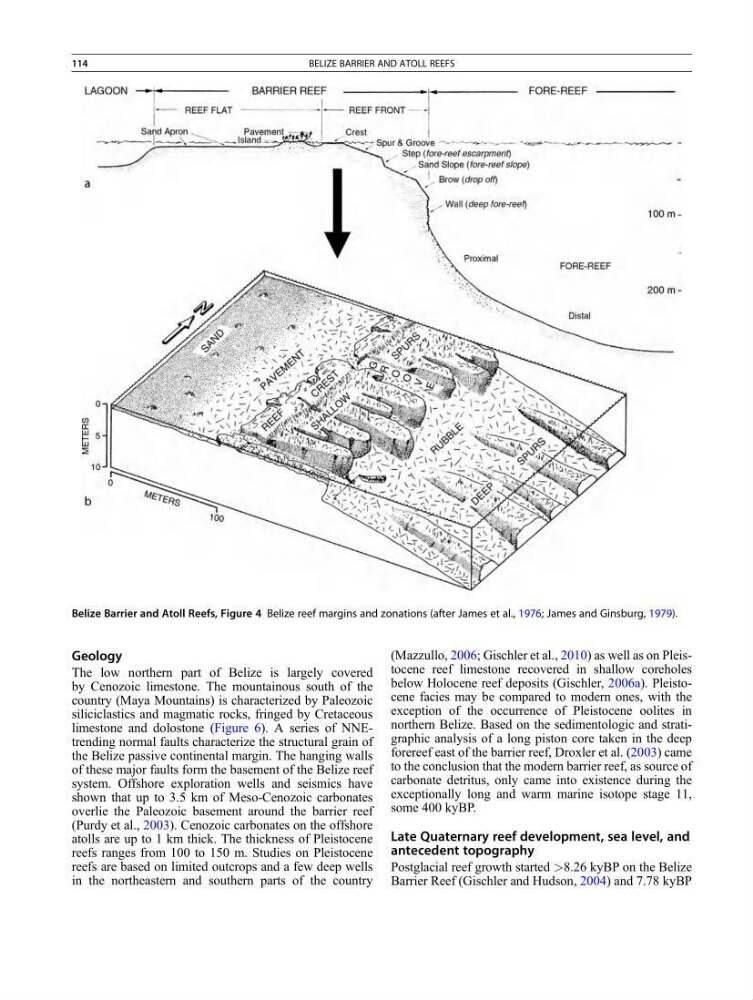
Belize Barrier and Atoll Reefs, Figure 4 Belize reef margins and zonations (after James et al., 1976; James and Ginsburg, 1979).
114
BELIZE BARRIER AND ATOLL REEFS
The low northern part of Belize is largely covered
by Cenozoic limestone. The mountainous south of the
country (Maya Mountains) is characterized by Paleozoic
siliciclastics and magmatic rocks, fringed by Cretaceous
limestone and dolostone (Figure 6). A series of NNEtrending normal faults characterize the structural grain of
the Belize passive continental margin. The hanging walls
of these major faults form the basement of the Belize reef
system. Offshore exploration wells and seismics have
shown that up to 3.5 km of Meso-Cenozoic carbonates
overlie the Paleozoic basement around the barrier reef
(Purdy et al., 2003). Cenozoic carbonates on the offshore
atolls are up to 1 km thick. The thickness of Pleistocene
reefs ranges from 100 to 150 m. Studies on Pleistocene
reefs are based on limited outcrops and a few deep wells
in the northeastern and southern parts of the country
(Mazzullo, 2006; Gischler et al., 2010) as well as on Pleistocene reef limestone recovered in shallow coreholes
below Holocene reef deposits (Gischler, 2006a). Pleistocene facies may be compared to modern ones, with the
exception of the occurrence of Pleistocene oolites in
northern Belize. Based on the sedimentologic and stratigraphic analysis of a long piston core taken in the deep
forereef east of the barrier reef, Droxler et al. (2003) came
to the conclusion that the modern barrier reef, as source of
carbonate detritus, only came into existence during the
exceptionally long and warm marine isotope stage 11,
some 400 kyBP.
Late Quaternary reef development, sea level, and
antecedent topography
Postglacial reef growth started >8.26 kyBP on the Belize
Barrier Reef (Gischler and Hudson, 2004) and 7.78 kyBP
Belize Barrier and Atoll Reefs, Figure 4 Belize reef margins and zonations (after James et al., 1976; James and Ginsburg, 1979).
114
BELIZE BARRIER AND ATOLL REEFS