

constitutes lime muds and bioturbated muddy lime sands
with isolated colonies of branching corals.
Thickness of these facies varies, determined by the rate of
relative sea-level rise at the time of their construction, for
example, the A. palmata zones can have a vertical thickness of 20 m.
Diagenesis and caliche
Barbados is an excellent field site for studying diagenisis
and caliche formation (Figure 3). In the more arid south
and west, aragonite and Mg calcite may be retained in corals
and other organisms for 300 ky (thousand years). In the
more humid west, Mg calcite is absent for the 83 ky reefs
and aragonite is not found in anything older than 200 ky.
Caliche (calcrete), the product of diagenetic modification at and immediately below the rock-soil/air interface
is common on many of the Pleistocene reef terraces
of Barbados. The caliche profiles vary from thin, relatively dense, laminated brown micritic crusts to
horizons over 1 m in thickness comprising brown micritic
stringers subparallel to the surface and cutting through the
host structure or substrate (Harrison, 1977; Humphrey,
1997).
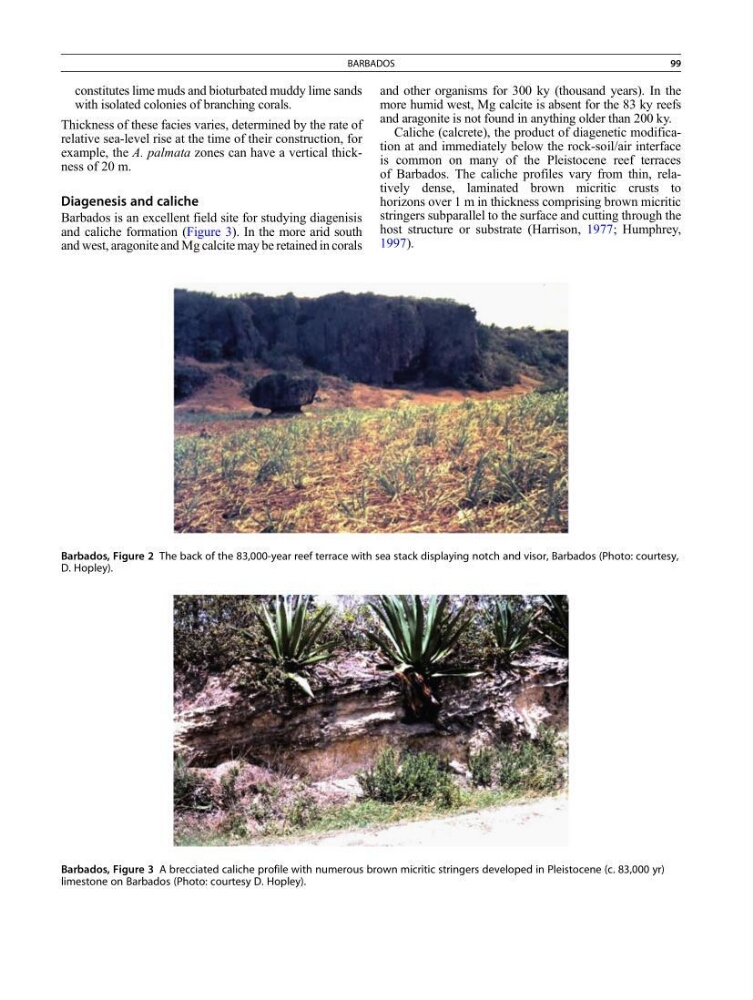
Barbados, Figure 2 The back of the 83,000-year reef terrace with sea stack displaying notch and visor, Barbados (Photo: courtesy,
D. Hopley).
Barbados, Figure 3 A brecciated caliche profile with numerous brown micritic stringers developed in Pleistocene (c. 83,000 yr)
limestone on Barbados (Photo: courtesy D. Hopley).
BARBADOS
99
with isolated colonies of branching corals.
Thickness of these facies varies, determined by the rate of
relative sea-level rise at the time of their construction, for
example, the A. palmata zones can have a vertical thickness of 20 m.
Diagenesis and caliche
Barbados is an excellent field site for studying diagenisis
and caliche formation (Figure 3). In the more arid south
and west, aragonite and Mg calcite may be retained in corals
and other organisms for 300 ky (thousand years). In the
more humid west, Mg calcite is absent for the 83 ky reefs
and aragonite is not found in anything older than 200 ky.
Caliche (calcrete), the product of diagenetic modification at and immediately below the rock-soil/air interface
is common on many of the Pleistocene reef terraces
of Barbados. The caliche profiles vary from thin, relatively dense, laminated brown micritic crusts to
horizons over 1 m in thickness comprising brown micritic
stringers subparallel to the surface and cutting through the
host structure or substrate (Harrison, 1977; Humphrey,
1997).
Barbados, Figure 2 The back of the 83,000-year reef terrace with sea stack displaying notch and visor, Barbados (Photo: courtesy,
D. Hopley).
Barbados, Figure 3 A brecciated caliche profile with numerous brown micritic stringers developed in Pleistocene (c. 83,000 yr)
limestone on Barbados (Photo: courtesy D. Hopley).
BARBADOS
99