

Submerged reefs
Submerged reefs formed during the post-glacial transgression are also found in Barbados, Macintyre (1967) recognized two offshore ridges that parallel most of the west
coast at depths of 15–20 m and 70 m. However, further work
quoted in Macintyre et al. (2007a), has shown an impressive
series of backstepping of reefs dominated by A. palmata
starting at depths of about <120 m and flourishing $19
kya to $14 kya, which were then stranded by the meltwater
pulse 1a when the reef could not keep up with the rate of sealevel rise. A further reef was established to shoreward at a
present depth of about À80 m forming 25 m of framework
before it too “gave up” in response to meltwater pulse 1b
(11.3–11.0 kya). Blanchon and Shaw (1995) identified
a further reef at the shelf edge at ca À40 m, which “gave
up” $7.6 kya À6.5 kya in response to a further meltwater
pulse. This has been a point of some contention and continued discussion (Blanchon, 2005; Toscano and Macintyre,
2005). While Blanchon has suggested that the composite
sea-level curve has been smoothed by incorporating
transported clasts, Toscano and Macintyre have justified
the lack of a visible “jump” in their curve at about 7.6 ka as
being the result of sea level starting to rise above the shelf
edge at this time and the resulting “inimical” shelf waters
causing the demise of reefs for a short period through sedimentation and eutrophication, rather than a rapid rise in sea
level. Factors that need consideration in differentiating
between the two arguments include the range with which
A. palmata can be found (at least 5 m and possibly more
on structures such as spurs and grooves) and then extended
by storm deposited clasts (>5 m). Also, Barbados’ mean
uplift rate of $34 cm/ka is not steady but irregular in occurrence. Further, the A. palmata C
14 dates may not provide an
accurate framework for rapid sea-level changes (Toscano
and Macintyre, 2003; Bard, 1998). Nonetheless, the reefs
of Barbados, both submerged and emerged provide
a source of Quaternary environmental data matched by
few places elsewhere. For example, dating of the reefs that
developed between each of these jumps also further
constrained the offset between the radiocarbon and calendar
timescale and were subsequently used to establish
a standardized protocol for correcting the radiocarbon ages
beyond 10 ka tree-ring record (Bard et al., 1990; Fairbanks
et al., 2005).
Acropora palmata demise and the origin of
Cobblers Reef
Goreau (1959) was the first to identify the dominant role
of A. palmata in Caribbean reef zonation. However, concern has been expressed over the widespread loss of this
species since the 1980s (see Macintyre et al., 2007a, b,
for references). The dominant cause has been white band
disease.
A. palmata is a dominant component of Pleistocene
reefs of Barbados (Figure 4) but as noted initially by
Lewis (1960), like elsewhere in the Caribbean there is
a distinct paucity of this coral in the modern fringing reefs,
although Lewis (1984) later found A. palmata was
forming the foundation upon which modern reefs were
growing. However, more recent studies, especially of
Cobblers Reef along the southern shores of Barbados,
have led to conflicting interpretations of the evidence for
the demise of A. palmata on the island.
Cobblers Reef forms a significant bank barrier reef
15 km long on the south-eastern shores of Barbados with
a history of vigorous A. palmata growth which is now
dead, covered by a rich algal growth and sparse living
non-acroporid corals (Macintyre et al., 2007b). Dating of
A. palmata clasts from this reef suggested various storm
damage about 4,500 to 3,000 cal years ago with subsequent high energy conditions limiting herbivory and
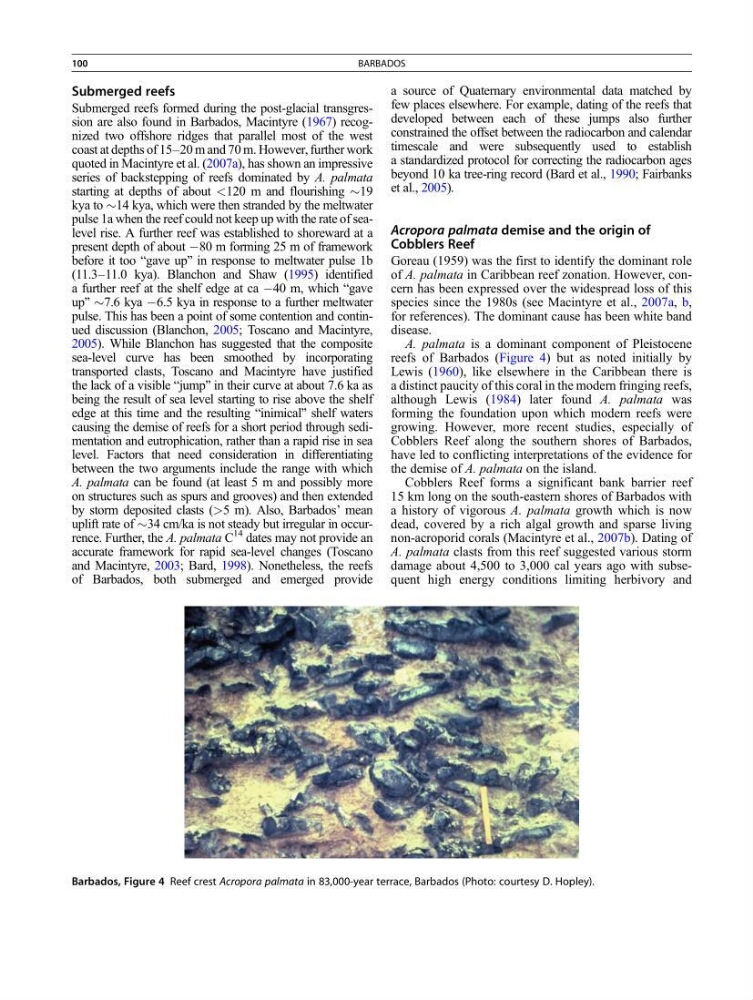
Barbados, Figure 4 Reef crest Acropora palmata in 83,000-year terrace, Barbados (Photo: courtesy D. Hopley).
100
BARBADOS
Submerged reefs formed during the post-glacial transgression are also found in Barbados, Macintyre (1967) recognized two offshore ridges that parallel most of the west
coast at depths of 15–20 m and 70 m. However, further work
quoted in Macintyre et al. (2007a), has shown an impressive
series of backstepping of reefs dominated by A. palmata
starting at depths of about <120 m and flourishing $19
kya to $14 kya, which were then stranded by the meltwater
pulse 1a when the reef could not keep up with the rate of sealevel rise. A further reef was established to shoreward at a
present depth of about À80 m forming 25 m of framework
before it too “gave up” in response to meltwater pulse 1b
(11.3–11.0 kya). Blanchon and Shaw (1995) identified
a further reef at the shelf edge at ca À40 m, which “gave
up” $7.6 kya À6.5 kya in response to a further meltwater
pulse. This has been a point of some contention and continued discussion (Blanchon, 2005; Toscano and Macintyre,
2005). While Blanchon has suggested that the composite
sea-level curve has been smoothed by incorporating
transported clasts, Toscano and Macintyre have justified
the lack of a visible “jump” in their curve at about 7.6 ka as
being the result of sea level starting to rise above the shelf
edge at this time and the resulting “inimical” shelf waters
causing the demise of reefs for a short period through sedimentation and eutrophication, rather than a rapid rise in sea
level. Factors that need consideration in differentiating
between the two arguments include the range with which
A. palmata can be found (at least 5 m and possibly more
on structures such as spurs and grooves) and then extended
by storm deposited clasts (>5 m). Also, Barbados’ mean
uplift rate of $34 cm/ka is not steady but irregular in occurrence. Further, the A. palmata C
14 dates may not provide an
accurate framework for rapid sea-level changes (Toscano
and Macintyre, 2003; Bard, 1998). Nonetheless, the reefs
of Barbados, both submerged and emerged provide
a source of Quaternary environmental data matched by
few places elsewhere. For example, dating of the reefs that
developed between each of these jumps also further
constrained the offset between the radiocarbon and calendar
timescale and were subsequently used to establish
a standardized protocol for correcting the radiocarbon ages
beyond 10 ka tree-ring record (Bard et al., 1990; Fairbanks
et al., 2005).
Acropora palmata demise and the origin of
Cobblers Reef
Goreau (1959) was the first to identify the dominant role
of A. palmata in Caribbean reef zonation. However, concern has been expressed over the widespread loss of this
species since the 1980s (see Macintyre et al., 2007a, b,
for references). The dominant cause has been white band
disease.
A. palmata is a dominant component of Pleistocene
reefs of Barbados (Figure 4) but as noted initially by
Lewis (1960), like elsewhere in the Caribbean there is
a distinct paucity of this coral in the modern fringing reefs,
although Lewis (1984) later found A. palmata was
forming the foundation upon which modern reefs were
growing. However, more recent studies, especially of
Cobblers Reef along the southern shores of Barbados,
have led to conflicting interpretations of the evidence for
the demise of A. palmata on the island.
Cobblers Reef forms a significant bank barrier reef
15 km long on the south-eastern shores of Barbados with
a history of vigorous A. palmata growth which is now
dead, covered by a rich algal growth and sparse living
non-acroporid corals (Macintyre et al., 2007b). Dating of
A. palmata clasts from this reef suggested various storm
damage about 4,500 to 3,000 cal years ago with subsequent high energy conditions limiting herbivory and
Barbados, Figure 4 Reef crest Acropora palmata in 83,000-year terrace, Barbados (Photo: courtesy D. Hopley).
100
BARBADOS