

Appendicularia from the Indian Ocean, the Red Sea and the Persian Gulf
411
new for the Bay of Bengal and, among these, 2 were unknown in the Indian Ocean. The
composition of the group formed by the most abundant and the most frequent species
is characteristic of the fauna of the Indian Ocean. O. longicauda represents 50% of the
total number of specimens collected, followed by o. rufescens 40%, and M. huxley; 8%.
The density of the species in the occidental zone decreases fairly regularly with latitude:
21 species in the south, then going on towards the north, 14, 11 and 2 species. In the
area south of the Straits of Malacca only 5 species were found, but there were 18 where it
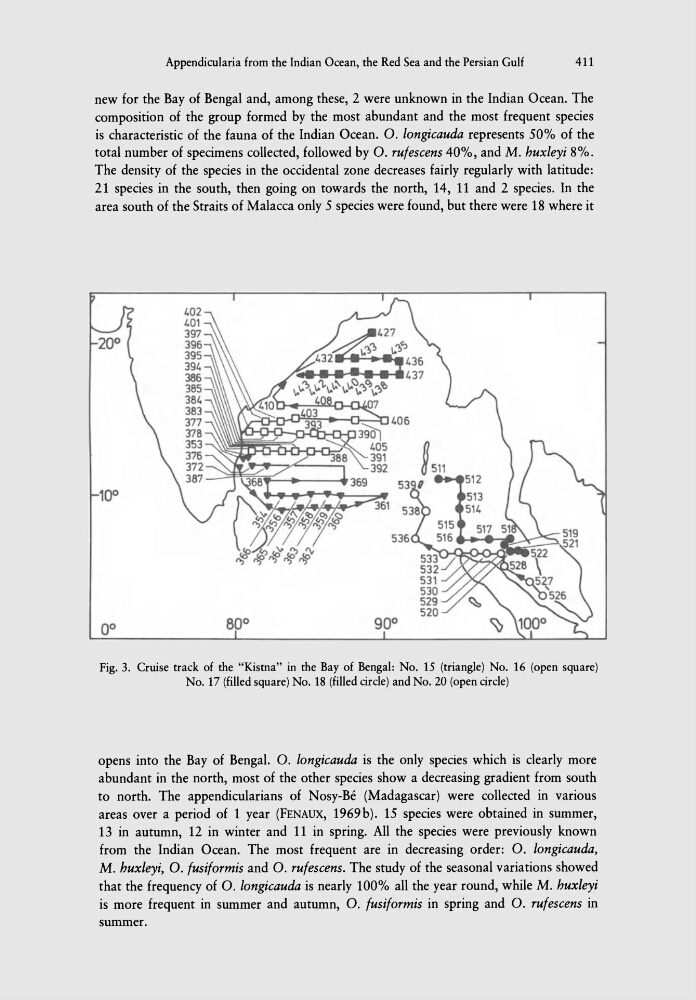
Fig. 3. Cruise track of the "Kisma" in the Bay of Bengal: No. 15 (triangle) No. 16 (open square)
No. 17 (filled square) No. 18 (filled circle) and No. 20 (open circle)
opens into the Bay of Bengal. O. longicauda is the only species which is clearly more
abundant in the north, most of the other species show a decreasing gradient from south
to north. The appendicularians of Nosy-Be (Madagascar) were collected in various
areas over a period of 1 year (FENAUX, 1969b). 15 species were obtained in summer,
13 in autumn, 12 in winter and 11 in spring. All the species were previously known
from the Indian Ocean. The most frequent are in decreasing order: o. longicauda,
M. huxleyi, o. fusiformis and o. rufescens. The study of the seasonal variations showed
that the frequency of O. longicauda is nearly 100% all the year round, while M. huxleyi
is more frequent in summer and autumn, O. fusiformis in spring and o. rufescens in
summer.
411
new for the Bay of Bengal and, among these, 2 were unknown in the Indian Ocean. The
composition of the group formed by the most abundant and the most frequent species
is characteristic of the fauna of the Indian Ocean. O. longicauda represents 50% of the
total number of specimens collected, followed by o. rufescens 40%, and M. huxley; 8%.
The density of the species in the occidental zone decreases fairly regularly with latitude:
21 species in the south, then going on towards the north, 14, 11 and 2 species. In the
area south of the Straits of Malacca only 5 species were found, but there were 18 where it
Fig. 3. Cruise track of the "Kisma" in the Bay of Bengal: No. 15 (triangle) No. 16 (open square)
No. 17 (filled square) No. 18 (filled circle) and No. 20 (open circle)
opens into the Bay of Bengal. O. longicauda is the only species which is clearly more
abundant in the north, most of the other species show a decreasing gradient from south
to north. The appendicularians of Nosy-Be (Madagascar) were collected in various
areas over a period of 1 year (FENAUX, 1969b). 15 species were obtained in summer,
13 in autumn, 12 in winter and 11 in spring. All the species were previously known
from the Indian Ocean. The most frequent are in decreasing order: o. longicauda,
M. huxleyi, o. fusiformis and o. rufescens. The study of the seasonal variations showed
that the frequency of O. longicauda is nearly 100% all the year round, while M. huxleyi
is more frequent in summer and autumn, O. fusiformis in spring and o. rufescens in
summer.