

410
R. FENAUX:
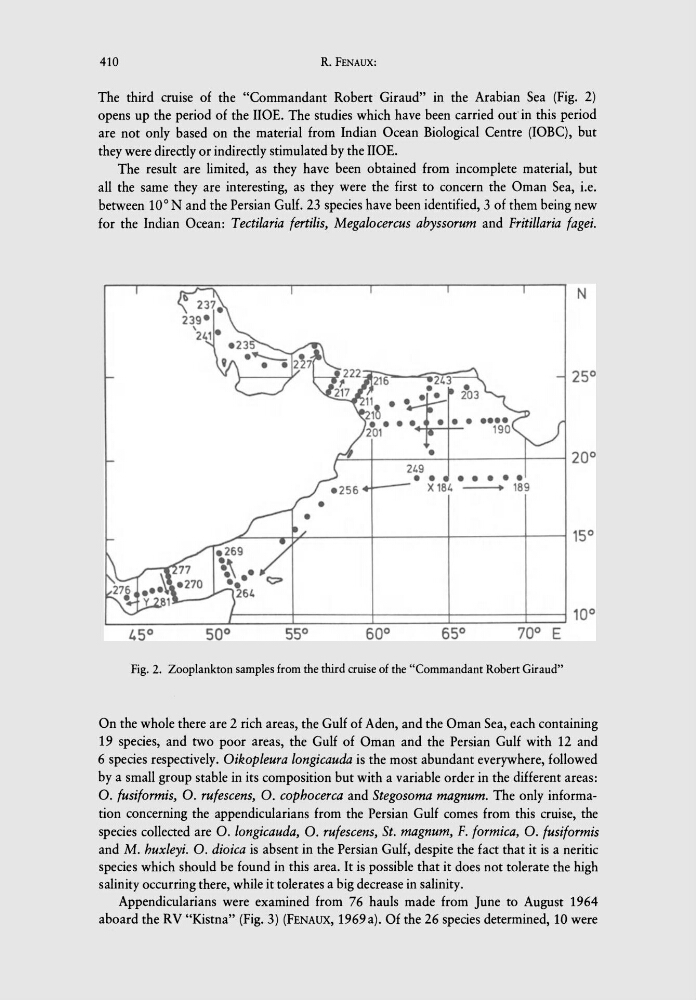
The third cruise of the "Commandant Robert Giraud" in the Arabian Sea (Fig. 2)
opens up the period of the HOE. The studies which have been carried out in this period
are not only based on the material from Indian Ocean Biological Centre (IOBC), but
they were directly or indirectly stimulated by the HOE.
The result are limited, as they have been obtained from incomplete material, but
all the same they are interesting, as they were the first to concern the Oman Sea, i.e.
between 10° N and the Persian Gulf. 23 species have been identified, 3 of them being new
for the Indian Ocean: Tectilaria fertilis, Megalocercus abyssorum and Fritillaria fagei.
N
~ __ ~ ____ ~+-_ _____ ~ __ ~20°
~~-.~L------+-------r-------r--~ 15°
Fig. 2. Zooplankton samples from the third cruise of the "Commandant Robert Giraud"
On the whole there are 2 rich areas, the Gulf of Aden, and the Oman Sea, each containing
19 species, and two poor areas, the Gulf of Oman and the Persian Gulf with 12 and
6 species respectively. Oikopleura longicauda is the most abundant everywhere, followed
by a small group stable in its composition but with a variable order in the different areas:
o. fusiformis, o. rufescens, o. cophocerca and Stegosoma magnum. The only information concerning the appendicularians from the Persian Gulf comes from this cruise, the
species collected are o. longicauda, o. rufescens, St. magnum, F. formica, o. fusiformis
and M. huxleyi. o. dioica is absent in the Persian Gulf, despite the fact that it is a neritic
species which should be found in this area. It is possible that it does not tolerate the high
salinity occurring there, while it tolerates a big decrease in salinity.
Appendicularians were examined from 76 hauls made from June to August 1964
aboard the RV "Kistna" (Fig. 3) (FENAUX, 1969a). Of the 26 species determined, 10 were
R. FENAUX:
The third cruise of the "Commandant Robert Giraud" in the Arabian Sea (Fig. 2)
opens up the period of the HOE. The studies which have been carried out in this period
are not only based on the material from Indian Ocean Biological Centre (IOBC), but
they were directly or indirectly stimulated by the HOE.
The result are limited, as they have been obtained from incomplete material, but
all the same they are interesting, as they were the first to concern the Oman Sea, i.e.
between 10° N and the Persian Gulf. 23 species have been identified, 3 of them being new
for the Indian Ocean: Tectilaria fertilis, Megalocercus abyssorum and Fritillaria fagei.
N
~ __ ~ ____ ~+-_ _____ ~ __ ~20°
~~-.~L------+-------r-------r--~ 15°
Fig. 2. Zooplankton samples from the third cruise of the "Commandant Robert Giraud"
On the whole there are 2 rich areas, the Gulf of Aden, and the Oman Sea, each containing
19 species, and two poor areas, the Gulf of Oman and the Persian Gulf with 12 and
6 species respectively. Oikopleura longicauda is the most abundant everywhere, followed
by a small group stable in its composition but with a variable order in the different areas:
o. fusiformis, o. rufescens, o. cophocerca and Stegosoma magnum. The only information concerning the appendicularians from the Persian Gulf comes from this cruise, the
species collected are o. longicauda, o. rufescens, St. magnum, F. formica, o. fusiformis
and M. huxleyi. o. dioica is absent in the Persian Gulf, despite the fact that it is a neritic
species which should be found in this area. It is possible that it does not tolerate the high
salinity occurring there, while it tolerates a big decrease in salinity.
Appendicularians were examined from 76 hauls made from June to August 1964
aboard the RV "Kistna" (Fig. 3) (FENAUX, 1969a). Of the 26 species determined, 10 were