

4.19
Appendicularia from the
Indian Ocean, the Red Sea and the Persian Gulf
R. FENAUX
In the present study, I intend to show how our knowledge of the appendicularians
living in the Indian Ocean, the Red Sea and the Persian Gulf developed.
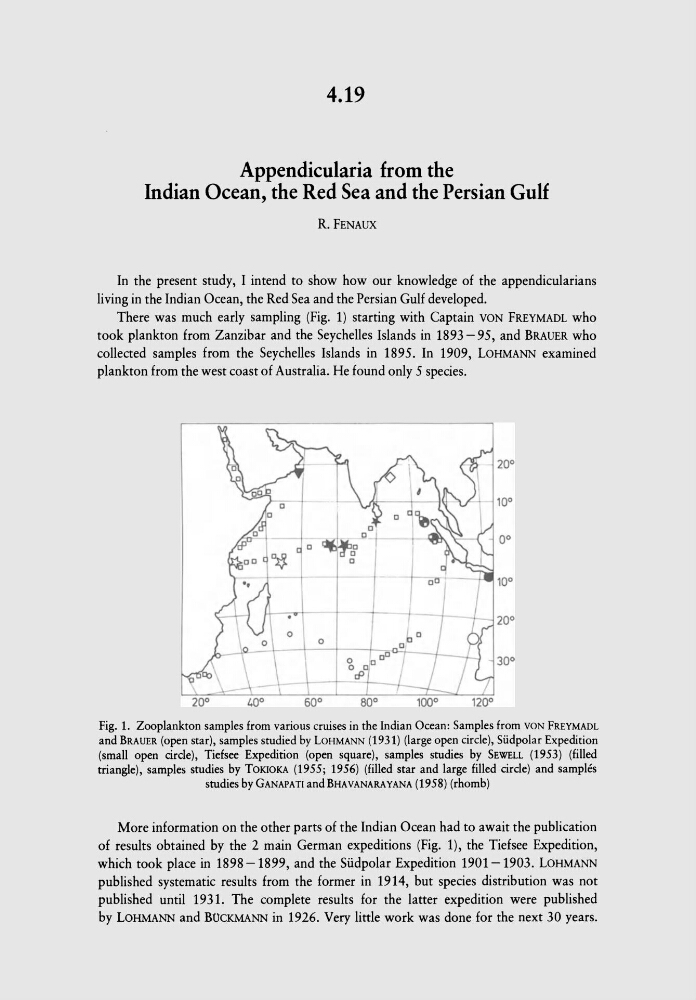
There was much early sampling (Fig. 1) starting with Captain VON FREYMADL who
took plankton from Zanzibar and the Seychelles Islands in 1893 - 95, and BRAUER who
collected samples from the Seychelles Islands in 1895. In 1909, LOHMANN examined
plankton from the west coast of Australia. He found only 5 species.
Fig. 1. Zooplankton samples from various cruises in the Indian Ocean: Samples from VON FREYMADL
and BRAUER (open star), samples studied by LOHMANN (1931) (large open circle), Siidpolar Expedition
(small open circle), Tiefsee Expedition (open square), samples studies by SEWELL (1953) (filled
triangle), samples studies by TOKIOKA (1955; 1956) (filled star and large filled circle) and samples
studies byGANAPATI andBHAVANARAYANA (1958) (rhomb)
More information on the other parts of the Indian Ocean had to await the publication
of results obtained by the 2 main German expeditions (Fig. 1), the Tiefsee Expedition,
which took place in 1898 -1899, and the Siidpolar Expedition 1901-1903. LOHMANN
published systematic results from the former in 1914, but species distribution was not
published until 1931. The complete results for the latter expedition were published
by LOHMANN and BOCKMANN in 1926. Very little work was done for the next 30 years.
Appendicularia from the
Indian Ocean, the Red Sea and the Persian Gulf
R. FENAUX
In the present study, I intend to show how our knowledge of the appendicularians
living in the Indian Ocean, the Red Sea and the Persian Gulf developed.
There was much early sampling (Fig. 1) starting with Captain VON FREYMADL who
took plankton from Zanzibar and the Seychelles Islands in 1893 - 95, and BRAUER who
collected samples from the Seychelles Islands in 1895. In 1909, LOHMANN examined
plankton from the west coast of Australia. He found only 5 species.
Fig. 1. Zooplankton samples from various cruises in the Indian Ocean: Samples from VON FREYMADL
and BRAUER (open star), samples studied by LOHMANN (1931) (large open circle), Siidpolar Expedition
(small open circle), Tiefsee Expedition (open square), samples studies by SEWELL (1953) (filled
triangle), samples studies by TOKIOKA (1955; 1956) (filled star and large filled circle) and samples
studies byGANAPATI andBHAVANARAYANA (1958) (rhomb)
More information on the other parts of the Indian Ocean had to await the publication
of results obtained by the 2 main German expeditions (Fig. 1), the Tiefsee Expedition,
which took place in 1898 -1899, and the Siidpolar Expedition 1901-1903. LOHMANN
published systematic results from the former in 1914, but species distribution was not
published until 1931. The complete results for the latter expedition were published
by LOHMANN and BOCKMANN in 1926. Very little work was done for the next 30 years.