

380
E. BRINTON and K. GOPALAKRISHNAN:
ber - March (Fig. 8 b), but co-occur to the north of it during May - September (Fig. 8 a)
when the north equatorial flow is easterly.
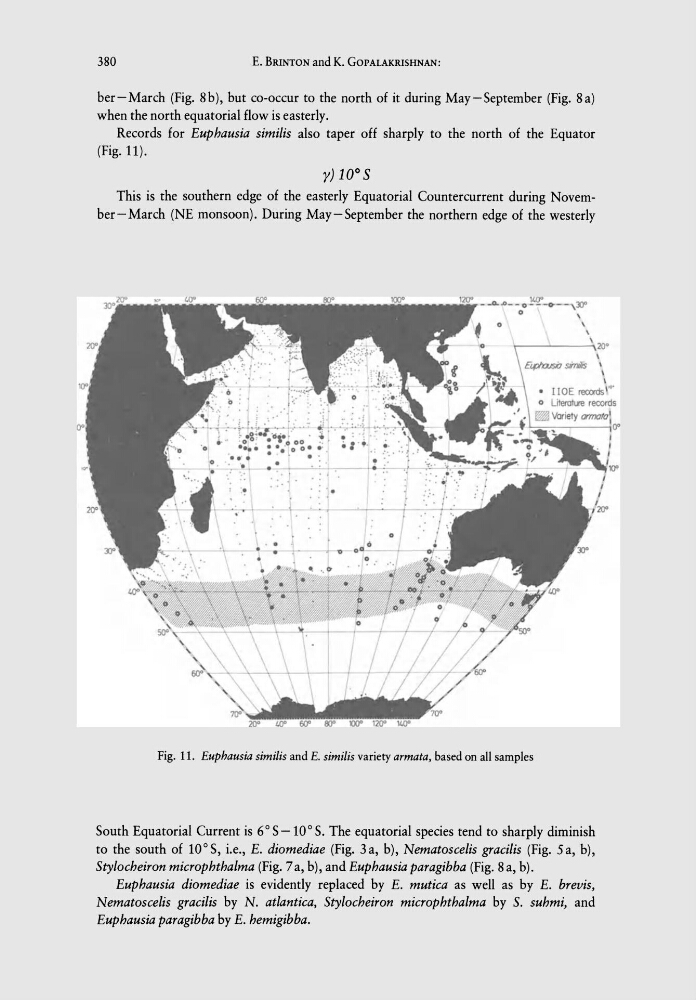
Records for Euphausia similis also taper off sharply to the north of the Equator
(Fig. 11).
y) 10 0 S
This is the southern edge of the easterly Equatorial Countercurrent during November- March (NE monsoon). During May- September the northern edge of the westerly
Fig. 11. Euphausia similis and E. similis variety armata, based on all samples
South Equatorial Current is 6° S-lO° S. The equatorial species tend to sharply diminish
to the south of 10° S, i.e., E. diomediae (Fig. 3 a, b), Nematoscelis gracilis (Fig. 5 a, b),
Stylocheiron microphthalma (Fig. 7 a, b), and Euphausia paragibba (Fig. 8 a, b).
Euphausia diomediae is evidently replaced by E. mutica as well as by E. brevis,
Nematoscelis gracilis by N. atlantica, Stylocheiron microphthalma by S. suhmi, and
Euphausia paragibba by E. hemigibba.
E. BRINTON and K. GOPALAKRISHNAN:
ber - March (Fig. 8 b), but co-occur to the north of it during May - September (Fig. 8 a)
when the north equatorial flow is easterly.
Records for Euphausia similis also taper off sharply to the north of the Equator
(Fig. 11).
y) 10 0 S
This is the southern edge of the easterly Equatorial Countercurrent during November- March (NE monsoon). During May- September the northern edge of the westerly
Fig. 11. Euphausia similis and E. similis variety armata, based on all samples
South Equatorial Current is 6° S-lO° S. The equatorial species tend to sharply diminish
to the south of 10° S, i.e., E. diomediae (Fig. 3 a, b), Nematoscelis gracilis (Fig. 5 a, b),
Stylocheiron microphthalma (Fig. 7 a, b), and Euphausia paragibba (Fig. 8 a, b).
Euphausia diomediae is evidently replaced by E. mutica as well as by E. brevis,
Nematoscelis gracilis by N. atlantica, Stylocheiron microphthalma by S. suhmi, and
Euphausia paragibba by E. hemigibba.