

The Distribution of Indian Ocean Euphausiids
379
Euphausia pseudogibba (Fig. 8a, b) and Thysanopoda aequalis (Fig. 9a, b) occupy
the zone of 0 -10 0 N, including the Andaman Sea. Here, both tend to replace more
southern cognates, E. paragibba and T. subaequalis. It may be noted that while
E. pseudogibba and T. aequalis occupy the same habitat in the Indian Ocean, they do
not in the Pacific. E. pseudogibba more consistently co-occurs with T. subaequalis in
the Pacific, where T. aequalis is a central water mass species (BRINTON, 1962).
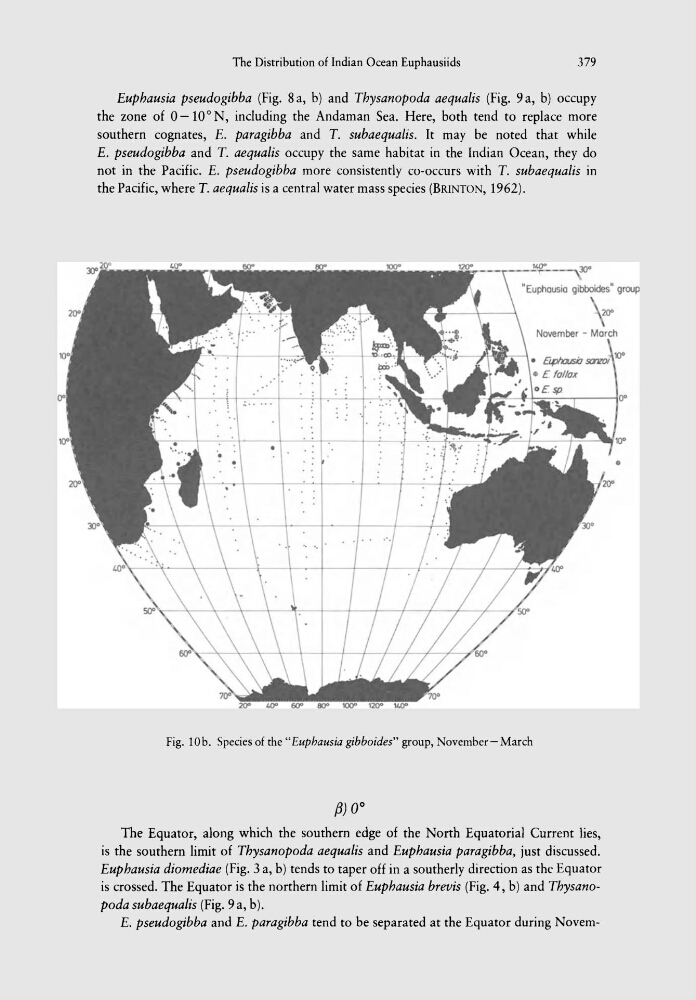
Fig. lOb. Species of the" Euphausia gibboides" group, November - March
The Equator, along which the southern edge of the North Equatorial Current lies,
is the southern limit of Thysanopoda aequalis and Euphausia paragibba, just discussed.
Euphausia diomediae (Fig. 3 a, b) tends to taper off in a southerly direction as the Equator
is crossed. The Equator is the northern limit of Euphausia brevis (Fig. 4, b) and Thysanopoda subaequalis (Fig. 9 a, b).
E. pseudogibba and E. paragibba tend to be separated at the Equator during Novem-
379
Euphausia pseudogibba (Fig. 8a, b) and Thysanopoda aequalis (Fig. 9a, b) occupy
the zone of 0 -10 0 N, including the Andaman Sea. Here, both tend to replace more
southern cognates, E. paragibba and T. subaequalis. It may be noted that while
E. pseudogibba and T. aequalis occupy the same habitat in the Indian Ocean, they do
not in the Pacific. E. pseudogibba more consistently co-occurs with T. subaequalis in
the Pacific, where T. aequalis is a central water mass species (BRINTON, 1962).
Fig. lOb. Species of the" Euphausia gibboides" group, November - March
The Equator, along which the southern edge of the North Equatorial Current lies,
is the southern limit of Thysanopoda aequalis and Euphausia paragibba, just discussed.
Euphausia diomediae (Fig. 3 a, b) tends to taper off in a southerly direction as the Equator
is crossed. The Equator is the northern limit of Euphausia brevis (Fig. 4, b) and Thysanopoda subaequalis (Fig. 9 a, b).
E. pseudogibba and E. paragibba tend to be separated at the Equator during Novem-