

378
E. BRINTON and K. GOPALAKRISHNAN:
Nematobrachion flexipes
Stylocheiron abbreviatum
Stylocheiron longicorne
All of these species except Euphausia tenera are scarce or lacking in both the eastern
equatorial Pacific and the Arabian Sea - Bay of Bengal.
The northern limits of the 2 other species restricted to the Pacific and Indian Ocean,
Stylocheiron microphthalma (Fig. 7 a, b) and Euphausia paragibba (Fig. 8 a, b), are
near 10 0 N but these limits are not distinct. Both species occur regularly only to the
___ 129" ____ , . . . ____ 11.2" - __ :no
"Euphausia g ibboides· group
. ,
r
· ~::-J
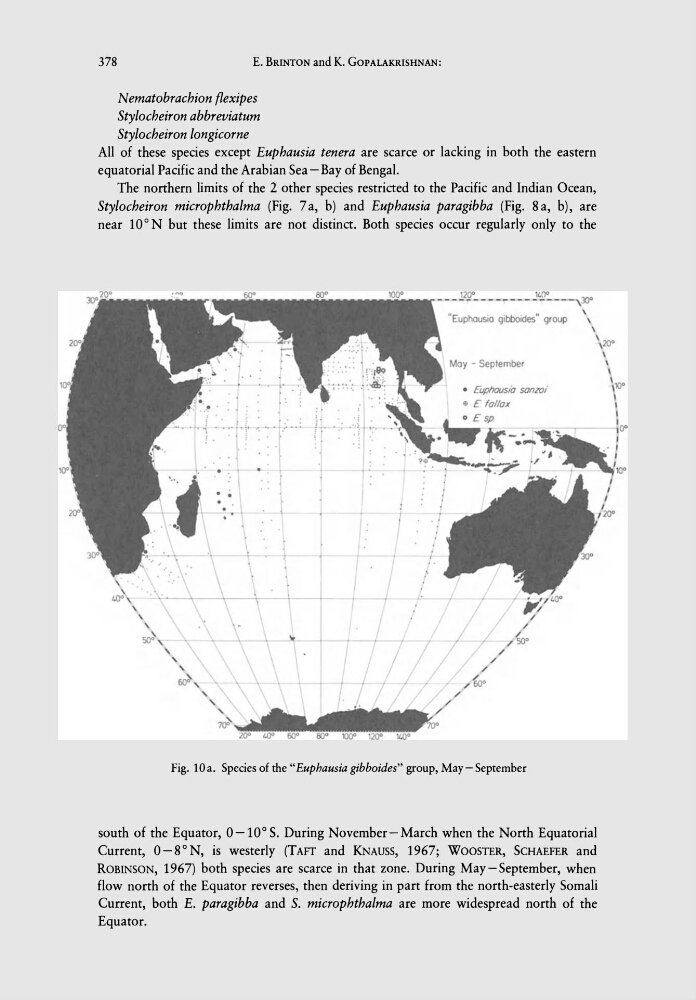
• . t--- -:--r-Fig. lOa. Species of the "Euphausia gibboides" group, May-September
south of the Equator, 0-10 0 S. During November- March when the North Equatorial
Current, 0-8°N, is westerly (TAFT and KNAUSS, 1967; WOOSTER, SCHAEFER and
ROBINSON, 1967) both species are scarce in that zone. During May-September, when
flow north of the Equator reverses, then deriving in part from the north-easterly Somali
Current, both E. paragibba and S. microphthalma are more widespread north of the
Equator.
E. BRINTON and K. GOPALAKRISHNAN:
Nematobrachion flexipes
Stylocheiron abbreviatum
Stylocheiron longicorne
All of these species except Euphausia tenera are scarce or lacking in both the eastern
equatorial Pacific and the Arabian Sea - Bay of Bengal.
The northern limits of the 2 other species restricted to the Pacific and Indian Ocean,
Stylocheiron microphthalma (Fig. 7 a, b) and Euphausia paragibba (Fig. 8 a, b), are
near 10 0 N but these limits are not distinct. Both species occur regularly only to the
___ 129" ____ , . . . ____ 11.2" - __ :no
"Euphausia g ibboides· group
. ,
r
· ~::-J
• . t--- -:--r-Fig. lOa. Species of the "Euphausia gibboides" group, May-September
south of the Equator, 0-10 0 S. During November- March when the North Equatorial
Current, 0-8°N, is westerly (TAFT and KNAUSS, 1967; WOOSTER, SCHAEFER and
ROBINSON, 1967) both species are scarce in that zone. During May-September, when
flow north of the Equator reverses, then deriving in part from the north-easterly Somali
Current, both E. paragibba and S. microphthalma are more widespread north of the
Equator.