

362
E. BRINTON and K. GOPALAKRISHNAN:
WElG~1ANN (1971) describes a geographical variant of P./ati/TOns living in the Persian
Gulf, and points out that Pseudeuphausia colosii TORELLI, 1934, described from the Red
Sea, and recorded there by PONOMAREVA (1968), is synonymous with P. lati(rons G. O.
SARS (1883).
Essentially a neritic euphausiid, P. lati(rons was nevertheless caught sporadically
, , , ,
50" ,
, ,
" "
fff' ,
" ,
,', ',' :' ,.,
r ' "
- - - .!.2Q" - - - -- - - - l'-Q"- --, JOO
\.
May - September
, ,
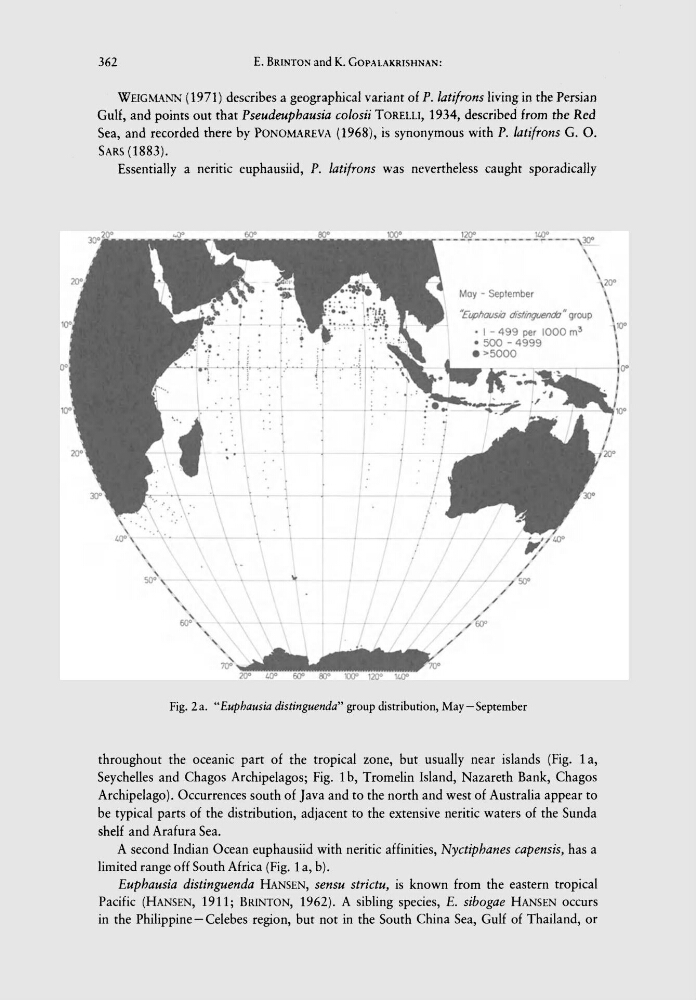
Fig. 2 a. "Euphausia distinguenda" group distribution, May - September
throughout the oceanic part of the tropical zone, but usually near islands (Fig. 1 a,
Seychelles and Chagos Archipelagos; Fig. 1 b, Tromelin Island, Nazareth Bank, Chagos
Archipelago). Occurrences south of Java and to the north and west of Australia appear to
be typical parts of the distribution, adjacent to the extensive neritic waters of the Sunda
shelf and Arafura Sea.
A second Indian Ocean euphausiid with neritic affinities, Nyctiphanes capensis, has a
limited range off South Africa (Fig. 1 a, b).
Euphausia distinguenda HANSEN, sensu strictu, is known from the eastern tropical
Pacific (HANSEN, 1911; BRINTON, 1962). A sibling species, E. sihogae HANSEN occurs
in the Philippine - Celebes region, but not in the South China Sea, Gulf of Thailand, or
E. BRINTON and K. GOPALAKRISHNAN:
WElG~1ANN (1971) describes a geographical variant of P./ati/TOns living in the Persian
Gulf, and points out that Pseudeuphausia colosii TORELLI, 1934, described from the Red
Sea, and recorded there by PONOMAREVA (1968), is synonymous with P. lati(rons G. O.
SARS (1883).
Essentially a neritic euphausiid, P. lati(rons was nevertheless caught sporadically
, , , ,
50" ,
, ,
" "
fff' ,
" ,
,', ',' :' ,.,
r ' "
- - - .!.2Q" - - - -- - - - l'-Q"- --, JOO
\.
May - September
, ,
Fig. 2 a. "Euphausia distinguenda" group distribution, May - September
throughout the oceanic part of the tropical zone, but usually near islands (Fig. 1 a,
Seychelles and Chagos Archipelagos; Fig. 1 b, Tromelin Island, Nazareth Bank, Chagos
Archipelago). Occurrences south of Java and to the north and west of Australia appear to
be typical parts of the distribution, adjacent to the extensive neritic waters of the Sunda
shelf and Arafura Sea.
A second Indian Ocean euphausiid with neritic affinities, Nyctiphanes capensis, has a
limited range off South Africa (Fig. 1 a, b).
Euphausia distinguenda HANSEN, sensu strictu, is known from the eastern tropical
Pacific (HANSEN, 1911; BRINTON, 1962). A sibling species, E. sihogae HANSEN occurs
in the Philippine - Celebes region, but not in the South China Sea, Gulf of Thailand, or