

The Distribution of Indian Ocean Euphausiids
363
Java Sea. As has been pointed out (SEBASTIAN, 1966; JONES, personal communication)
the form in the northern Indian Ocean more nearly resembles E. sihogae than E.
distinguenda, though it has heretofore been reported only under the latter name (e.g.,
TATTERSALL, 1939; BRINTON, 1962; WEIGMANN, 1970). Until the taxonomy within this
complex is better understood, we shall refer to the Indian Ocean populations as the E.
- - - 1.29" ____ ,.. ___ l'Q ~30.
\.
• November - Morch
"Euphousio dislinquendo· group
• I -499 per 1000 m 3
• 500 - 4999
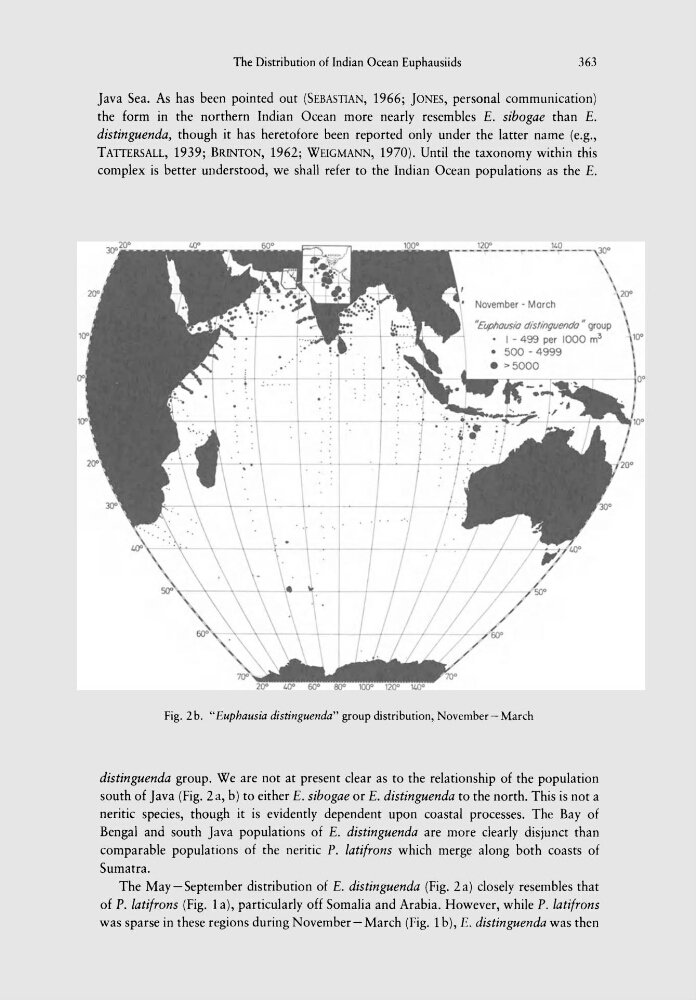
Fig. 2 b. "Euphausia distinguenda" group distribution, November - March
distinguenda group. We are not at present clear as to the relationship of the population
south of Java (Fig. 2a, b) to either E. sihogae or E. distinguenda to the north. This is not a
neritic species, though it is evidently dependent upon coastal processes. The Bay of
Bengal and south Java populations of E. distinguenda are more clearly disjunct than
comparable populations of the neritic P. latifrons which merge along both coasts of
Sumatra.
The May-September distribution of E. distinguenda (Fig. 2a) closely resembles that
of P. latifrons (Fig. 1 a), particularly off Somalia and Arabia. However, while P. latifrons
was sparse in these regions during November- March (Fig. 1 b), E. distinguenda was then
363
Java Sea. As has been pointed out (SEBASTIAN, 1966; JONES, personal communication)
the form in the northern Indian Ocean more nearly resembles E. sihogae than E.
distinguenda, though it has heretofore been reported only under the latter name (e.g.,
TATTERSALL, 1939; BRINTON, 1962; WEIGMANN, 1970). Until the taxonomy within this
complex is better understood, we shall refer to the Indian Ocean populations as the E.
- - - 1.29" ____ ,.. ___ l'Q ~30.
\.
• November - Morch
"Euphousio dislinquendo· group
• I -499 per 1000 m 3
• 500 - 4999
Fig. 2 b. "Euphausia distinguenda" group distribution, November - March
distinguenda group. We are not at present clear as to the relationship of the population
south of Java (Fig. 2a, b) to either E. sihogae or E. distinguenda to the north. This is not a
neritic species, though it is evidently dependent upon coastal processes. The Bay of
Bengal and south Java populations of E. distinguenda are more clearly disjunct than
comparable populations of the neritic P. latifrons which merge along both coasts of
Sumatra.
The May-September distribution of E. distinguenda (Fig. 2a) closely resembles that
of P. latifrons (Fig. 1 a), particularly off Somalia and Arabia. However, while P. latifrons
was sparse in these regions during November- March (Fig. 1 b), E. distinguenda was then