

Chaetognaths of the Arabian Sea
309
Somalia and Gulf of Aden). These samples were taken mostly during the NE monsoon
period (11 samples) and a few (3 samples) in the later part of the SW monsoon period
(August-September-early October).
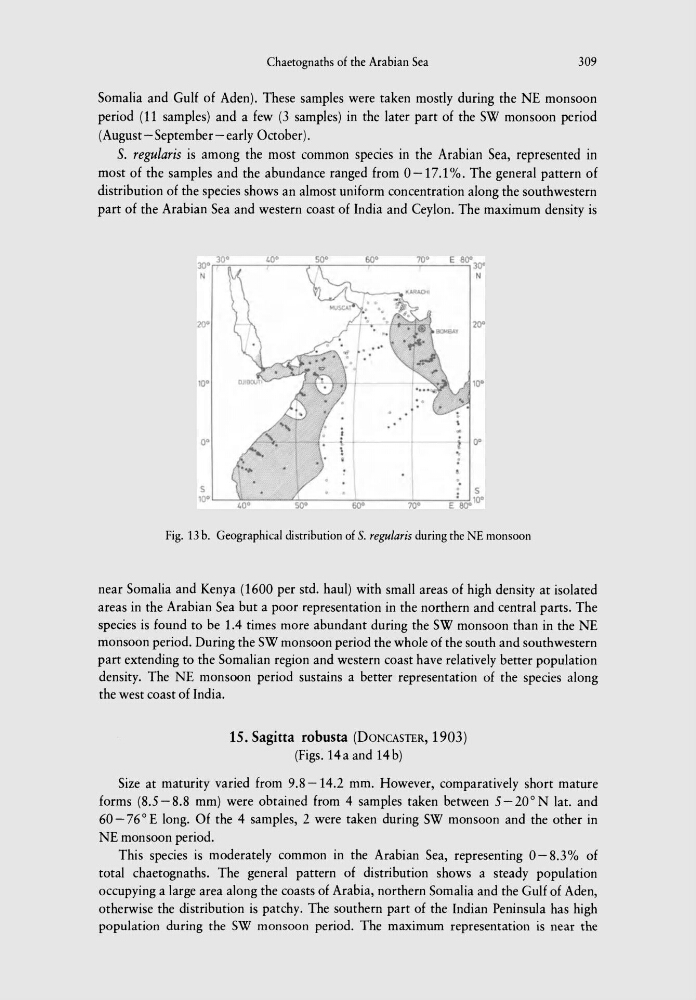
S. regularis is among the most common species in the Arabian Sea, represented in
most of the samples and the abundance ranged from 0 -17.1 %. The general pattern of
distribution of the species shows an almost uniform concentration along the southwestern
part of the Arabian Sea and western coast of India and Ceylon. The maximum density is
30' 30'
N
20°
10'
o·
s
10'
i
i
'\
•
bO"
60'
70'
E 80"30"
N
0
.1
00
S
E :80"100
70'
Fig. 13 b. Geographical distribution of S. regularis during the NE monsoon
near Somalia and Kenya (1600 per std. haul) with small areas of high density at isolated
areas in the Arabian Sea but a poor representation in the northern and central parts. The
species is found to be 1.4 times more abundant during the SW monsoon than in the NE
monsoon period. During the SW monsoon period the whole of the south and southwestern
part extending to the Somalian region and western coast have relatively better population
density. The NE monsoon period sustains a better representation of the species along
the west coast of India.
15. Sagitta robusta (DONCASTER, 1903)
(Figs. 14a and 14b)
Size at maturity varied from 9.8 -14.2 mm. However, comparatively short mature
forms (8.5 - 8.8 mm) were obtained from 4 samples taken between 5 - 20° N lat. and
60 -76° E long. Of the 4 samples, 2 were taken during SW monsoon and the other in
NE monsoon period.
This species is moderately common in the Arabian Sea, representing 0 - 8.3 % of
total chaetognaths. The general pattern of distribution shows a steady population
occupying a large area along the coasts of Arabia, northern Somalia and the Gulf of Aden,
otherwise the distribution is patchy. The southern part of the Indian Peninsula has high
population during the SW mon soon period. The maximum representation is near the
309
Somalia and Gulf of Aden). These samples were taken mostly during the NE monsoon
period (11 samples) and a few (3 samples) in the later part of the SW monsoon period
(August-September-early October).
S. regularis is among the most common species in the Arabian Sea, represented in
most of the samples and the abundance ranged from 0 -17.1 %. The general pattern of
distribution of the species shows an almost uniform concentration along the southwestern
part of the Arabian Sea and western coast of India and Ceylon. The maximum density is
30' 30'
N
20°
10'
o·
s
10'
i
i
'\
•
bO"
60'
70'
E 80"30"
N
0
.1
00
S
E :80"100
70'
Fig. 13 b. Geographical distribution of S. regularis during the NE monsoon
near Somalia and Kenya (1600 per std. haul) with small areas of high density at isolated
areas in the Arabian Sea but a poor representation in the northern and central parts. The
species is found to be 1.4 times more abundant during the SW monsoon than in the NE
monsoon period. During the SW monsoon period the whole of the south and southwestern
part extending to the Somalian region and western coast have relatively better population
density. The NE monsoon period sustains a better representation of the species along
the west coast of India.
15. Sagitta robusta (DONCASTER, 1903)
(Figs. 14a and 14b)
Size at maturity varied from 9.8 -14.2 mm. However, comparatively short mature
forms (8.5 - 8.8 mm) were obtained from 4 samples taken between 5 - 20° N lat. and
60 -76° E long. Of the 4 samples, 2 were taken during SW monsoon and the other in
NE monsoon period.
This species is moderately common in the Arabian Sea, representing 0 - 8.3 % of
total chaetognaths. The general pattern of distribution shows a steady population
occupying a large area along the coasts of Arabia, northern Somalia and the Gulf of Aden,
otherwise the distribution is patchy. The southern part of the Indian Peninsula has high
population during the SW mon soon period. The maximum representation is near the