

306
V. R. NAIR and T. S. S. RAo:
11. Sagitta negIecta (AIDA, 1897)
(Figs. lOa and lOb)
This species is moderately common, having a range of 0 - 8.3% of the total chaetognaths. The distribution of the species shows an affinity towards the coastal region.
Highest density is noticed on the southern part of the Indian Peninsula and near Arabia
and Persia. The maximum number (820 per std. haul) of specimens is obtained from a
station near Arabia. They are very scarce south of the Equator. Better representation of
the species was noticed during the NE monsoon when the average number of the specimens per haul is 1.5 times higher. During the NE monsoon high values are found near
Arabia and Persia, at the mouth of the Red Sea and off the coast of India. The SW monsoon period has a greater density near and off Somalia and Arabia, the southern part of
India and isolated patches north of the Equator. In the "Sealark" material (BURFIELD
and HARVEY, 1926) S. neglecta was scarce, probably because the collections were taken
far away from the coast.
12. Sagitta pacifica (TOKIOKA, 1940)
(Figs. 11 a and 11 b)
S. pacifica reported from the Pacific (ALVARIi~o, 1961) South China Sea and Gulf
of Thailand (ALVARINO, 1967) has ovaries reaching the level of the ventral ganglion,
and even to the neck region in fully mature specimens. In the present specimens the ovaries
are found to extend up to the middle of the anterior fin, rarely up to the ventral ganglion,
and never beyond that.
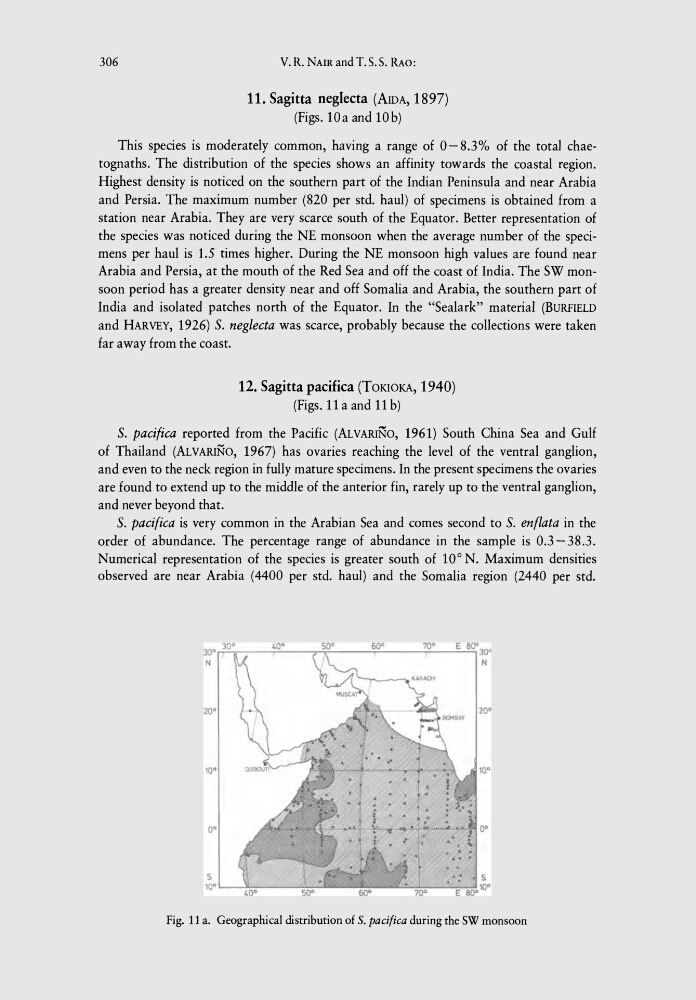
S. pacifica is very common in the Arabian Sea and comes second to S. enflata in the
order of abundance. The percentage range of abundance in the sample is 0.3 - 38.3.
Numerical representation of the species is greater south of 10° N. Maximum densities
observed are near Arabia (4400 per std. haul) and the Somalia region (2440 per std.
30. 30·
N
20·
10·
o·
60·
.
70·
. '
. .
.E 80"30.
N
200
0"
. .
. , .
o' S
. ~ 800 100
Fig. 11 a. Geographical distribution of S. pacifica during the SW monsoon
V. R. NAIR and T. S. S. RAo:
11. Sagitta negIecta (AIDA, 1897)
(Figs. lOa and lOb)
This species is moderately common, having a range of 0 - 8.3% of the total chaetognaths. The distribution of the species shows an affinity towards the coastal region.
Highest density is noticed on the southern part of the Indian Peninsula and near Arabia
and Persia. The maximum number (820 per std. haul) of specimens is obtained from a
station near Arabia. They are very scarce south of the Equator. Better representation of
the species was noticed during the NE monsoon when the average number of the specimens per haul is 1.5 times higher. During the NE monsoon high values are found near
Arabia and Persia, at the mouth of the Red Sea and off the coast of India. The SW monsoon period has a greater density near and off Somalia and Arabia, the southern part of
India and isolated patches north of the Equator. In the "Sealark" material (BURFIELD
and HARVEY, 1926) S. neglecta was scarce, probably because the collections were taken
far away from the coast.
12. Sagitta pacifica (TOKIOKA, 1940)
(Figs. 11 a and 11 b)
S. pacifica reported from the Pacific (ALVARIi~o, 1961) South China Sea and Gulf
of Thailand (ALVARINO, 1967) has ovaries reaching the level of the ventral ganglion,
and even to the neck region in fully mature specimens. In the present specimens the ovaries
are found to extend up to the middle of the anterior fin, rarely up to the ventral ganglion,
and never beyond that.
S. pacifica is very common in the Arabian Sea and comes second to S. enflata in the
order of abundance. The percentage range of abundance in the sample is 0.3 - 38.3.
Numerical representation of the species is greater south of 10° N. Maximum densities
observed are near Arabia (4400 per std. haul) and the Somalia region (2440 per std.
30. 30·
N
20·
10·
o·
60·
.
70·
. '
. .
.E 80"30.
N
200
0"
. .
. , .
o' S
. ~ 800 100
Fig. 11 a. Geographical distribution of S. pacifica during the SW monsoon