

Chaetognaths of the Arabian Sea
4. Sagitta bedoti (BERANECK, 1895)
(Figs. 4a and 4b)
299
This is a very common species, constituting 0-35.8% of the total chaetognaths in
the samples. In one "Varuna" sample (20
0
19' Nand 72
0
29' E) they are dominant. The
general pattern of distribution of the species shows that they are more abundant in the
areas adjacent to continents. The western side of the Arabian Sea shows almost uniform
high density population. The maximum number is along the Somali coast (4160 per std.
haul). Scattered patches of high values are observed particularly in the Gulf of Aden,
near Arabia, in the Gulf of Mannar and off Tanganyika. The western coast of India and
Ceylon also maintain a comparatively high concentration. Most of the northern, central
and southern parts are poor in the representation of the species. The pattern of distribution
for the different periods is more or less the same except that the maximum density at
Somalia extends over a wider area during the SW monsoon period. Comparatively better
representation of the species is seen along the west coast of India during the NE monsoon
period. This species is 1.14 times more abundant during the NE monsoon. It seams to
avoid poor waters but is not tied to specially productive waters.
5. Sagitta bipunctata (QUOY and GAIMARD, 1827)
(Figs. 5 a and 5 b)
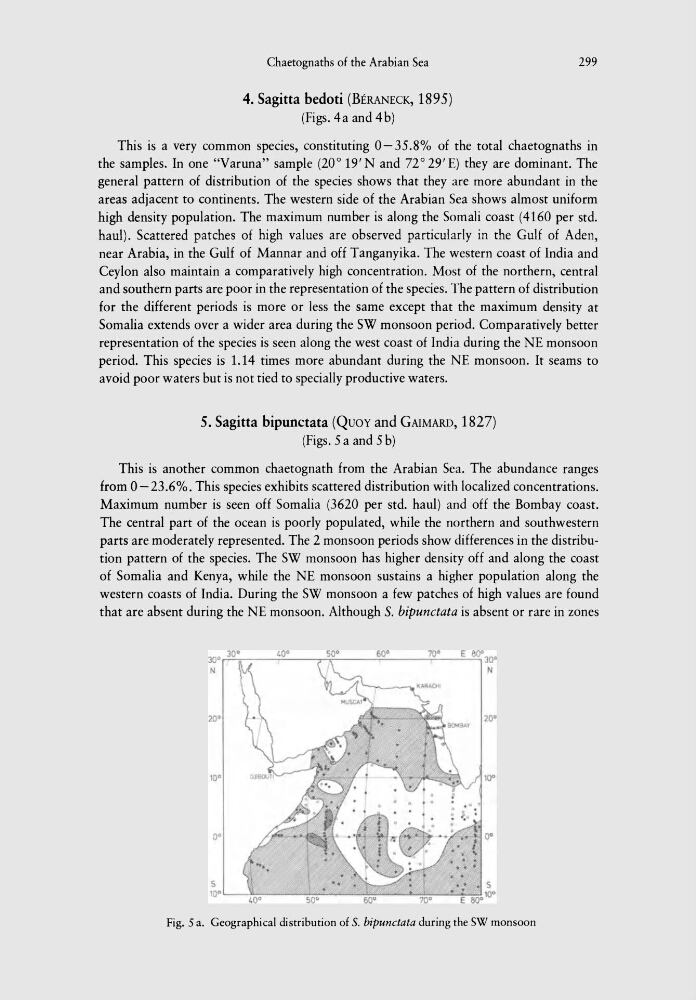
This is another common chaetognath from the Arabian Sea. The abundance ranges
from 0 - 23.6%. This species exhibits scattered distribution with localized concentrations.
Maximum number is seen off Somalia (3620 per std. haul) and off the Bombay coast.
The central part of the ocean is poorly populated, while the northern and southwestern
parts are moderately represented. The 2 monsoon periods show differences in the distribution pattern of the species. The SW monsoon has higher density off and along the coast
of Somalia and Kenya, while the NE monsoon sustains a higher population along the
western coasts of India. During the SW monsoon a few patches of high values are found
that are absent during the NE monsoon. Although S. bipunctata is absent or rare in zones
300 30°
N
20°
10°
0°
S
10·
60°
so·
70°
E 800 300
N
200
. .
. . .
't S
• ~ 800 100
Fig. 5 a. Geographical distribution of S. bipunctata during the SW monsoon
4. Sagitta bedoti (BERANECK, 1895)
(Figs. 4a and 4b)
299
This is a very common species, constituting 0-35.8% of the total chaetognaths in
the samples. In one "Varuna" sample (20
0
19' Nand 72
0
29' E) they are dominant. The
general pattern of distribution of the species shows that they are more abundant in the
areas adjacent to continents. The western side of the Arabian Sea shows almost uniform
high density population. The maximum number is along the Somali coast (4160 per std.
haul). Scattered patches of high values are observed particularly in the Gulf of Aden,
near Arabia, in the Gulf of Mannar and off Tanganyika. The western coast of India and
Ceylon also maintain a comparatively high concentration. Most of the northern, central
and southern parts are poor in the representation of the species. The pattern of distribution
for the different periods is more or less the same except that the maximum density at
Somalia extends over a wider area during the SW monsoon period. Comparatively better
representation of the species is seen along the west coast of India during the NE monsoon
period. This species is 1.14 times more abundant during the NE monsoon. It seams to
avoid poor waters but is not tied to specially productive waters.
5. Sagitta bipunctata (QUOY and GAIMARD, 1827)
(Figs. 5 a and 5 b)
This is another common chaetognath from the Arabian Sea. The abundance ranges
from 0 - 23.6%. This species exhibits scattered distribution with localized concentrations.
Maximum number is seen off Somalia (3620 per std. haul) and off the Bombay coast.
The central part of the ocean is poorly populated, while the northern and southwestern
parts are moderately represented. The 2 monsoon periods show differences in the distribution pattern of the species. The SW monsoon has higher density off and along the coast
of Somalia and Kenya, while the NE monsoon sustains a higher population along the
western coasts of India. During the SW monsoon a few patches of high values are found
that are absent during the NE monsoon. Although S. bipunctata is absent or rare in zones
300 30°
N
20°
10°
0°
S
10·
60°
so·
70°
E 800 300
N
200
. .
. . .
't S
• ~ 800 100
Fig. 5 a. Geographical distribution of S. bipunctata during the SW monsoon