

Biogeographical Problems of the Red Sea Area Exemplified by Hydroids
285
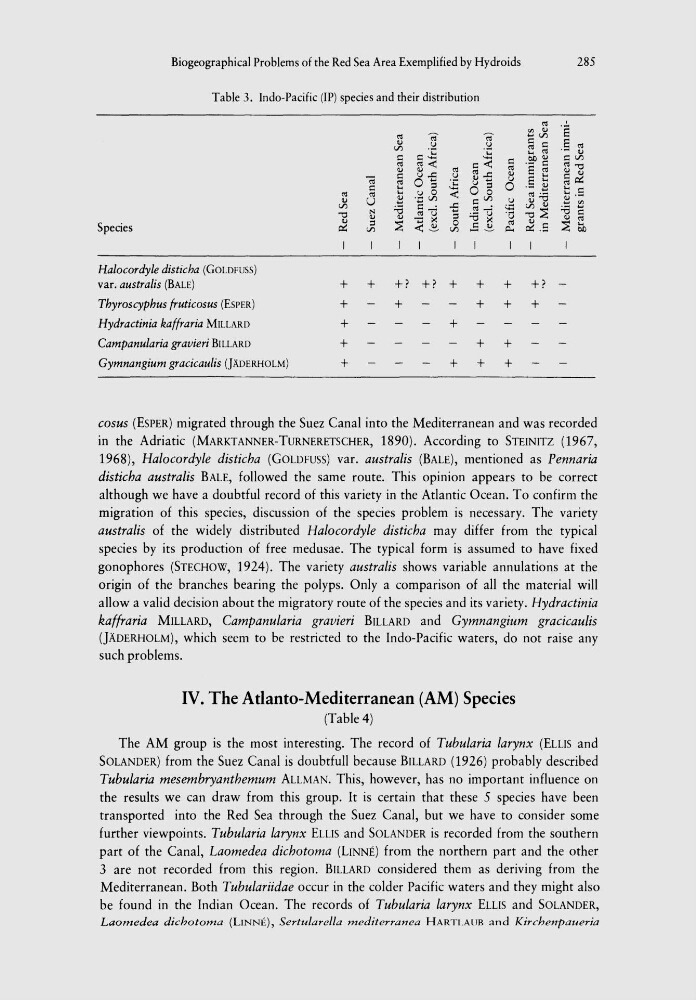
Table 3. Indo-Pacific (lP) species and their distribution
Species
Halocordyle disticha (GOLDFUSS)
var. australis (BALE)
Thyroscyphus fruticosus (ESPER)
Hydractinia kaffraria MILLARD
Campanularia gravieri BILLARD
Gymnangium gracicaulis (JADERHOLM)
+ + +? +? + + + +?
+
+
+ + +
+
+
+
+
+ +
+ + +
casus (ESPER) migrated through the Suez Canal into the Mediterranean and was recorded
in the Adriatic (MARKTANNER-TuRNERETSCHER, 1890). According to STEINITZ (1967,
1968), Halocordyle disticha (GOLDFUSS) var. australis (BALE), mentioned as Penna ria
disticha australis BALE, followed the same route. This opinion appears to be correct
although we have a doubtful record of this variety in the Atlantic Ocean. To confirm the
migration of this species, discussion of the species problem is necessary. The variety
australis of the widely distributed Halocordyle disticha may differ from the typical
species by its production of free medusae. The typical form is assumed to have fixed
gonophores (STECHOW, 1924). The variety australis shows variable annulations at the
origin of the branches bearing the polyps. Only a comparison of all the material will
allow a valid decision about the migratory route of the species and its variety. Hydractinia
kaffraria MILLARD, Campanularia gravieri BILLARD and Gymnangium gracicaulis
(JADERHOLM), which seem to be restricted to the Indo-Pacific waters, do not raise any
such problems.
IV. The Atlanto-Mediterranean (AM) Species
(Table 4)
The AM group is the most interesting. The record of Tubularia larynx (ELLIS and
SOLANDER) from the Suez Canal is doubtfull because BILLARD (1926) probably described
Tubularia mesembryanthemum ALLMAN. This, however, has no important influence on
the results we can draw from this group. It is certain that these 5 species have been
transported into the Red Sea through the Suez Canal, but we have to consider some
further viewpoints. Tubularia larynx ELLIS and SOLANDER is recorded from the southern
part of the Canal, Laomedea dichotoma (LINNE) from the northern part and the other
3 are not recorded from this region. BILLARD considered them as deriving from the
Mediterranean. Both Tubulariidae occur in the colder Pacific waters and they might also
be found in the Indian Ocean. The records of Tubularia larynx ELLIS and SOLANDER,
Laomedea dichotoma (LINNE), Sertularella mediterranea HARTLAUB and Kirchenpaueria
285
Table 3. Indo-Pacific (lP) species and their distribution
Species
Halocordyle disticha (GOLDFUSS)
var. australis (BALE)
Thyroscyphus fruticosus (ESPER)
Hydractinia kaffraria MILLARD
Campanularia gravieri BILLARD
Gymnangium gracicaulis (JADERHOLM)
+ + +? +? + + + +?
+
+
+ + +
+
+
+
+
+ +
+ + +
casus (ESPER) migrated through the Suez Canal into the Mediterranean and was recorded
in the Adriatic (MARKTANNER-TuRNERETSCHER, 1890). According to STEINITZ (1967,
1968), Halocordyle disticha (GOLDFUSS) var. australis (BALE), mentioned as Penna ria
disticha australis BALE, followed the same route. This opinion appears to be correct
although we have a doubtful record of this variety in the Atlantic Ocean. To confirm the
migration of this species, discussion of the species problem is necessary. The variety
australis of the widely distributed Halocordyle disticha may differ from the typical
species by its production of free medusae. The typical form is assumed to have fixed
gonophores (STECHOW, 1924). The variety australis shows variable annulations at the
origin of the branches bearing the polyps. Only a comparison of all the material will
allow a valid decision about the migratory route of the species and its variety. Hydractinia
kaffraria MILLARD, Campanularia gravieri BILLARD and Gymnangium gracicaulis
(JADERHOLM), which seem to be restricted to the Indo-Pacific waters, do not raise any
such problems.
IV. The Atlanto-Mediterranean (AM) Species
(Table 4)
The AM group is the most interesting. The record of Tubularia larynx (ELLIS and
SOLANDER) from the Suez Canal is doubtfull because BILLARD (1926) probably described
Tubularia mesembryanthemum ALLMAN. This, however, has no important influence on
the results we can draw from this group. It is certain that these 5 species have been
transported into the Red Sea through the Suez Canal, but we have to consider some
further viewpoints. Tubularia larynx ELLIS and SOLANDER is recorded from the southern
part of the Canal, Laomedea dichotoma (LINNE) from the northern part and the other
3 are not recorded from this region. BILLARD considered them as deriving from the
Mediterranean. Both Tubulariidae occur in the colder Pacific waters and they might also
be found in the Indian Ocean. The records of Tubularia larynx ELLIS and SOLANDER,
Laomedea dichotoma (LINNE), Sertularella mediterranea HARTLAUB and Kirchenpaueria