

284
H.-E. SCHMIDT:
II. The Indo-Pacific-Atlanto-Mediterranean (IPAM) Species II
(Table 2)
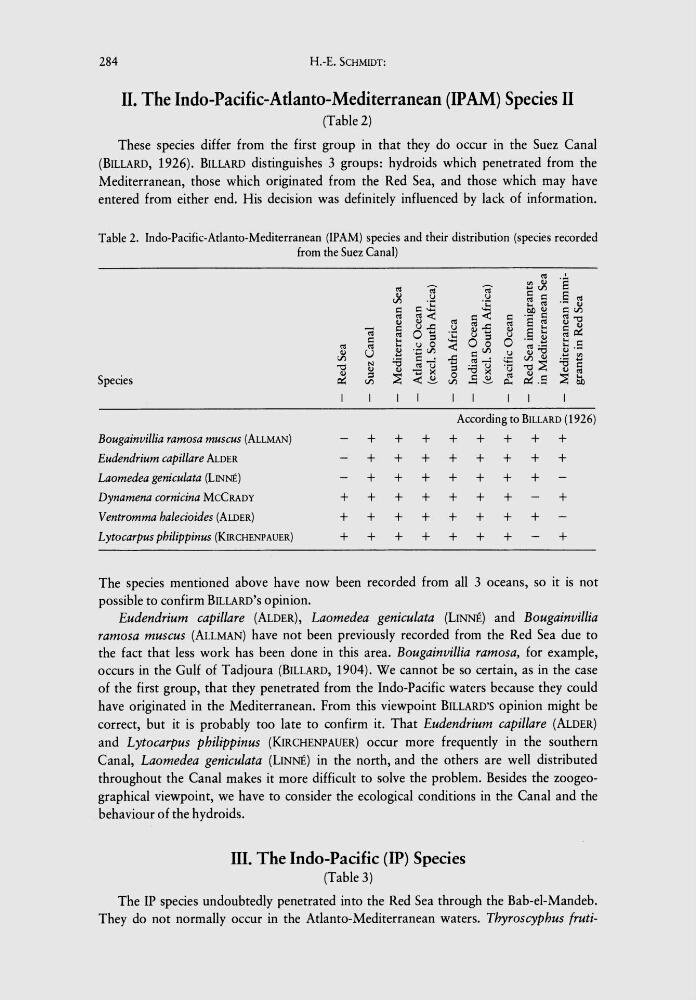
These species differ from the first group in that they do occur in the Suez Canal
(BILLARD, 1926). BILLARD distinguishes 3 groups: hydroids which penetrated from the
Mediterranean, those which originated from the Red Sea, and those which may have
entered from either end. His decision was definitely influenced by lack of information.
Table 2. Indo-Pacific-Atlanto-Mediterranean (IPAM) species and their distribution (species recorded
from the Suez Canal)
Species
Bougainvillia ramosa muscus (ALLMAN)
Eudendrium capillare ALDER
Laomedea geniculata (LINNE)
Dynamena cornicina MCCRADY
Ventromma halecioides (ALDER)
Lytocarpus philippinus (KIRCHENPAUER)
According to BILLARD (1926)
+ + + + + + + +
+ + + + + + + +
+ + + + + + +
+ + + + + + +
+
+ + + + + + + +
+ + + + + + +
+
The species mentioned above have now been recorded from all 3 oceans, so it is not
possible to confirm BILLARD's opinion.
Eudendrium capillare (ALDER), Laomedea geniculata (LINNE) and Bougainvillia
ramosa muscus (ALLMAN) have not been previously recorded from the Red Sea due to
the fact that less work has been done in this area. Bougainvillia ramosa, for example,
occurs in the Gulf of Tadjoura (BILLARD, 1904). We cannot be so certain, as in the case
of the first group, that they penetrated from the Indo-Pacific waters because they could
have originated in the Mediterranean. From this viewpoint BILLARD'S opinion might be
correct, but it is probably too late to confirm it. That Eudendrium capillare (ALDER)
and Lytocarpus philippinus (KIRCHENPAUER) occur more frequently in the southern
Canal, Laomedea geniculata (LINNE) in the north, and the others are well distributed
throughout the Canal makes it more difficult to solve the problem. Besides the zoogeographical viewpoint, we have to consider the ecological conditions in the Canal and the
behaviour of the hydroids.
III. The Indo-Pacific (IP) Species
(Table3)
The IP species undoubtedly penetrated into the Red Sea through the Bab-el-Mandeb.
They do not normally occur in the Atlanto-Mediterranean waters. Thyroscyphus fruti-
H.-E. SCHMIDT:
II. The Indo-Pacific-Atlanto-Mediterranean (IPAM) Species II
(Table 2)
These species differ from the first group in that they do occur in the Suez Canal
(BILLARD, 1926). BILLARD distinguishes 3 groups: hydroids which penetrated from the
Mediterranean, those which originated from the Red Sea, and those which may have
entered from either end. His decision was definitely influenced by lack of information.
Table 2. Indo-Pacific-Atlanto-Mediterranean (IPAM) species and their distribution (species recorded
from the Suez Canal)
Species
Bougainvillia ramosa muscus (ALLMAN)
Eudendrium capillare ALDER
Laomedea geniculata (LINNE)
Dynamena cornicina MCCRADY
Ventromma halecioides (ALDER)
Lytocarpus philippinus (KIRCHENPAUER)
According to BILLARD (1926)
+ + + + + + + +
+ + + + + + + +
+ + + + + + +
+ + + + + + +
+
+ + + + + + + +
+ + + + + + +
+
The species mentioned above have now been recorded from all 3 oceans, so it is not
possible to confirm BILLARD's opinion.
Eudendrium capillare (ALDER), Laomedea geniculata (LINNE) and Bougainvillia
ramosa muscus (ALLMAN) have not been previously recorded from the Red Sea due to
the fact that less work has been done in this area. Bougainvillia ramosa, for example,
occurs in the Gulf of Tadjoura (BILLARD, 1904). We cannot be so certain, as in the case
of the first group, that they penetrated from the Indo-Pacific waters because they could
have originated in the Mediterranean. From this viewpoint BILLARD'S opinion might be
correct, but it is probably too late to confirm it. That Eudendrium capillare (ALDER)
and Lytocarpus philippinus (KIRCHENPAUER) occur more frequently in the southern
Canal, Laomedea geniculata (LINNE) in the north, and the others are well distributed
throughout the Canal makes it more difficult to solve the problem. Besides the zoogeographical viewpoint, we have to consider the ecological conditions in the Canal and the
behaviour of the hydroids.
III. The Indo-Pacific (IP) Species
(Table3)
The IP species undoubtedly penetrated into the Red Sea through the Bab-el-Mandeb.
They do not normally occur in the Atlanto-Mediterranean waters. Thyroscyphus fruti-