

4.4
Biogeographical Problems of the Red Sea Area
Exemplified by Hydroids
H.-E. SCHMIDT
There is at present very little information available concerning Red Sea faunistic
regions; this makes it impossible to draw any certain conclusions about hydroid
distribution. On the other hand, it becomes increasingly interesting to consider the
origin of the species found in the Red Sea. A fair number of species recorded from there
are widely distributed throughout the Atlantic, Pacific and Indian Ocean and the
Mediterranean. They are restricted to tropical and subtropical waters or are cosmopolitans and could be divided into 3 groups: Indo-Pacific-Atlanto-Mediterranean (IPAM)
species, Indo-Pacific (IP) species, and Atlanto-Mediterranean (AM) species.
I. The Indo-Pacific-Atlanto-Mediterranean (IPAM) Species I
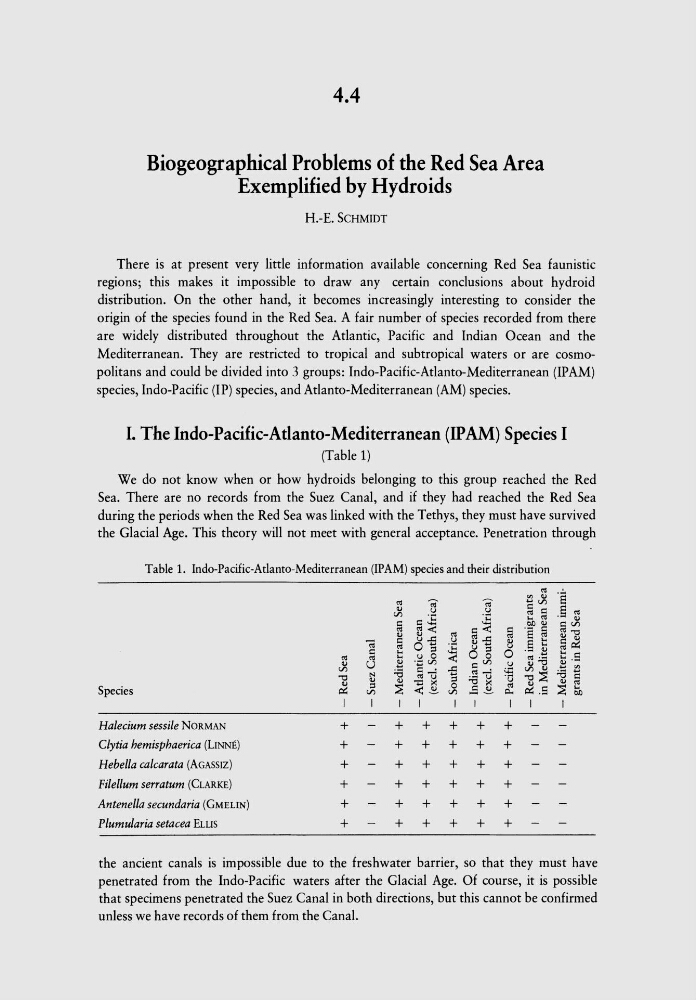
(Table 1)
We do not know when or how hydroids belonging to this group reached the Red
Sea. There are no records from the Suez Canal, and if they had reached the Red Sea
during the periods when the Red Sea was linked with the Tethys, they must have survived
the Glacial Age. This theory will not meet with general acceptance. Penetration through
Table 1. Indo-Pacific-Atlanto-Mediterranean (IPAM) species and their distribution
Species
Halecium sessile NORMAN
Clytia hemisphaerica (LINNE)
Hebella calcarata (AGASSIZ)
Filellum serratum (CLARKE)
Antenella secundaria (GMELIN)
P lumularia setacea ELLIS
+
+
+
+
+
+
' " a
u
N
OJ
::l
Vl
I
+ + + + +
+ + + + +
+ + + + +
+ + + + +
+ + + + +
+ + + + +
the ancient canals is impossible due to the freshwater barrier, so that they must have
penetrated from the Indo-Pacific waters after the Glacial Age. Of course, it is possible
that specimens penetrated the Suez Canal in both directions, but this cannot be confirmed
unless we have records of them from the Canal.
Biogeographical Problems of the Red Sea Area
Exemplified by Hydroids
H.-E. SCHMIDT
There is at present very little information available concerning Red Sea faunistic
regions; this makes it impossible to draw any certain conclusions about hydroid
distribution. On the other hand, it becomes increasingly interesting to consider the
origin of the species found in the Red Sea. A fair number of species recorded from there
are widely distributed throughout the Atlantic, Pacific and Indian Ocean and the
Mediterranean. They are restricted to tropical and subtropical waters or are cosmopolitans and could be divided into 3 groups: Indo-Pacific-Atlanto-Mediterranean (IPAM)
species, Indo-Pacific (IP) species, and Atlanto-Mediterranean (AM) species.
I. The Indo-Pacific-Atlanto-Mediterranean (IPAM) Species I
(Table 1)
We do not know when or how hydroids belonging to this group reached the Red
Sea. There are no records from the Suez Canal, and if they had reached the Red Sea
during the periods when the Red Sea was linked with the Tethys, they must have survived
the Glacial Age. This theory will not meet with general acceptance. Penetration through
Table 1. Indo-Pacific-Atlanto-Mediterranean (IPAM) species and their distribution
Species
Halecium sessile NORMAN
Clytia hemisphaerica (LINNE)
Hebella calcarata (AGASSIZ)
Filellum serratum (CLARKE)
Antenella secundaria (GMELIN)
P lumularia setacea ELLIS
+
+
+
+
+
+
' " a
u
N
OJ
::l
Vl
I
+ + + + +
+ + + + +
+ + + + +
+ + + + +
+ + + + +
+ + + + +
the ancient canals is impossible due to the freshwater barrier, so that they must have
penetrated from the Indo-Pacific waters after the Glacial Age. Of course, it is possible
that specimens penetrated the Suez Canal in both directions, but this cannot be confirmed
unless we have records of them from the Canal.