

266
S. M. HAQ, ]. ALI KHAN, and S. CHUGTAI:
was located about 30 miles east of station 67/9 where high abundances of the above
species were found in the surface haul of the 180-0 m column. Vertical hauls were taken
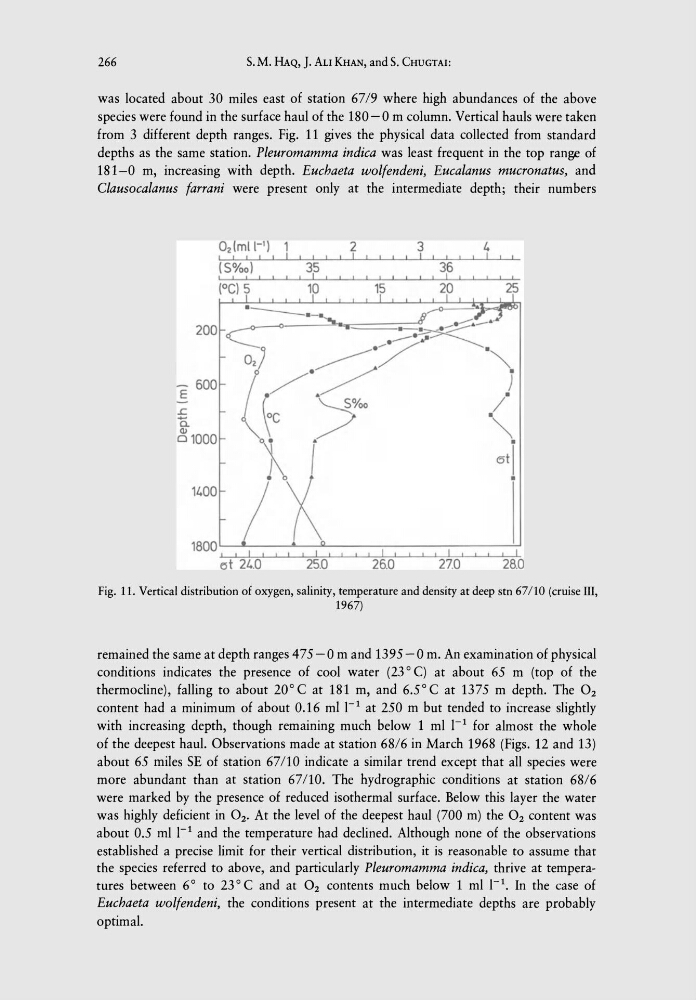
from 3 different depth ranges. Fig. 11 gives the physical data collected from standard
depths as the same station. Pleuromamma indica was least frequent in the top range of
181-0 m, increasing with depth. Euchaeta wolfendeni, Eucalanus mucronatus, and
Clausocalanus farrani were present only at the intermediate depth; their numbers
200
600
E
..c.
0..
~1000
1400
02(mll- l )
2
3
4
I
I
I
I
I
I
I
I I
I
I
I I I I
I I I
(5%0)
35
36
I
I
I I
I
I
I
I
I
I
I I
I
I
(OC) 5
10
15
20
25
elt 24.0
25.0
26.0
27.0
28.0
Fig. 11. Vertical distribution of oxygen, salinity, temperature and density at deep stn 67/10 (cruise III,
1967)
remained the same at depth ranges 475 - 0 m and 13 95- 0 m. An examination of physical
conditions indicates the presence of cool water (23
0
C) at about 65 m (top of the
thermocline), falling to about 20
0
C at 181 m, and 6.5
0
C at 1375 m depth. The Oz
content had a minimum of about 0.16 mll- 1 at 250 m but tended to increase slightly
with increasing depth, though remaining much below 1 ml 1- 1 for almost the whole
of the deepest haul. Observations made at station 68/6 in March 1968 (Figs. 12 and 13)
about 65 miles SE of station 67/10 indicate a similar trend except that all species were
more abundant than at station 67/10. The hydrographic conditions at station 68/6
were marked by the presence of reduced isothermal surface. Below this layer the water
was highly deficient in Oz. At the level of the deepest haul (700 m) the Oz content was
about 0.5 ml 1- 1 and the temperature had declined. Although none of the observations
established a precise limit for their vertical distribution, it is reasonable to assume that
the species referred to above, and particularly Pleuromamma indica, thrive at temperatures between 6 0 to 23 0 C and at Oz contents much below 1 mil-i. In the case of
Euchaeta wolfendeni, the conditions present at the intermediate depths are probably
optimal.
S. M. HAQ, ]. ALI KHAN, and S. CHUGTAI:
was located about 30 miles east of station 67/9 where high abundances of the above
species were found in the surface haul of the 180-0 m column. Vertical hauls were taken
from 3 different depth ranges. Fig. 11 gives the physical data collected from standard
depths as the same station. Pleuromamma indica was least frequent in the top range of
181-0 m, increasing with depth. Euchaeta wolfendeni, Eucalanus mucronatus, and
Clausocalanus farrani were present only at the intermediate depth; their numbers
200
600
E
..c.
0..
~1000
1400
02(mll- l )
2
3
4
I
I
I
I
I
I
I
I I
I
I
I I I I
I I I
(5%0)
35
36
I
I
I I
I
I
I
I
I
I
I I
I
I
(OC) 5
10
15
20
25
elt 24.0
25.0
26.0
27.0
28.0
Fig. 11. Vertical distribution of oxygen, salinity, temperature and density at deep stn 67/10 (cruise III,
1967)
remained the same at depth ranges 475 - 0 m and 13 95- 0 m. An examination of physical
conditions indicates the presence of cool water (23
0
C) at about 65 m (top of the
thermocline), falling to about 20
0
C at 181 m, and 6.5
0
C at 1375 m depth. The Oz
content had a minimum of about 0.16 mll- 1 at 250 m but tended to increase slightly
with increasing depth, though remaining much below 1 ml 1- 1 for almost the whole
of the deepest haul. Observations made at station 68/6 in March 1968 (Figs. 12 and 13)
about 65 miles SE of station 67/10 indicate a similar trend except that all species were
more abundant than at station 67/10. The hydrographic conditions at station 68/6
were marked by the presence of reduced isothermal surface. Below this layer the water
was highly deficient in Oz. At the level of the deepest haul (700 m) the Oz content was
about 0.5 ml 1- 1 and the temperature had declined. Although none of the observations
established a precise limit for their vertical distribution, it is reasonable to assume that
the species referred to above, and particularly Pleuromamma indica, thrive at temperatures between 6 0 to 23 0 C and at Oz contents much below 1 mil-i. In the case of
Euchaeta wolfendeni, the conditions present at the intermediate depths are probably
optimal.