

230
B. KIMOR:
addition to S. pacifica already reported by her from the Gulf of Eilat (1958). In her view
a sporadic and irregular immigration is taking place from the Arabian Sea via the Gulf
of Aden and thus adding to the number of species known from the Red Sea.
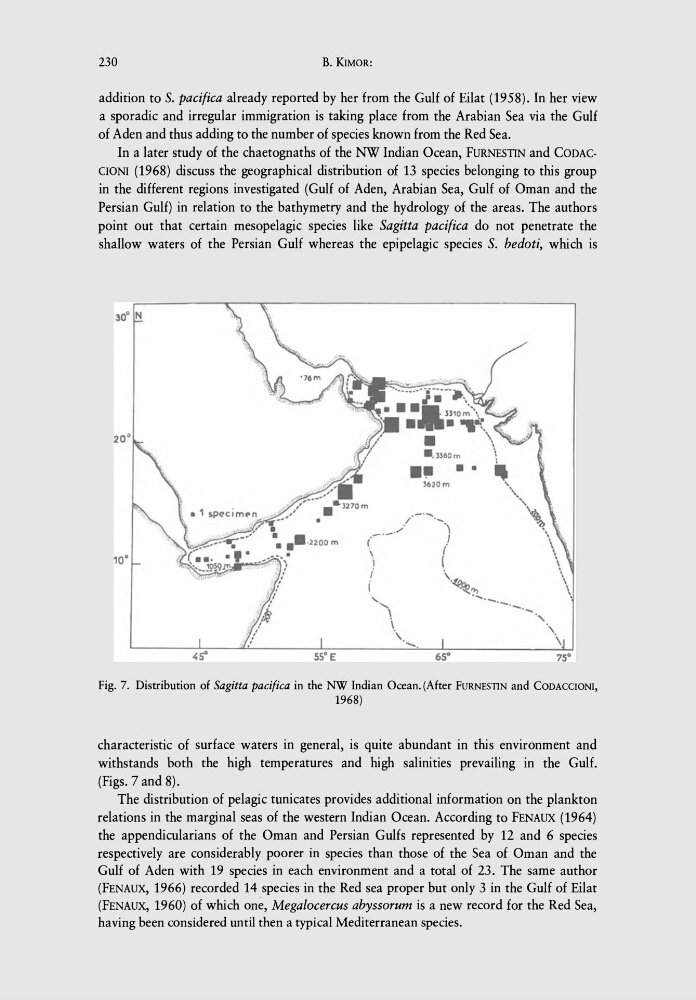
In a later study of the chaetognaths of the NW Indian Ocean, FURNESTIN and CODAC·
CIONI (1968) discuss the geographical distribution of 13 species belonging to this group
in the different regions investigated (Gulf of Aden, Arabian Sea, Gulf of Oman and the
Persian Gulf) in relation to the bathymetry and the hydrology of the areas. The authors
point out that certain mesopelagic species like Sagitta pacifica do not penetrate the
shallow waters of the Persian Gulf whereas the epipelagic species S. bedoti, which is
30·
-. 1160 m
•• • •
1620.."
.-"'
10·
/
.
_._ .. / -\
(
,.I
\
i
,
i
\.t""i
~.~",
....... -.-.
-'- "
65·
Fig. 7. Distribution of Sagitta pacifica in the NW Indian Ocean. (After FURNESTIN and CODACCIONI,
1968)
characteristic of surface waters in general, is quite abundant in this environment and
withstands both the high temperatures and high salinities prevailing in the Gulf.
(Figs. 7 and 8).
The distribution of pelagic tunicates provides additional information on the plankton
relations in the marginal seas of the western Indian Ocean. According to FENAUX (1964)
the appendicularians of the Oman and Persian Gulfs represented by 12 and 6 species
respectively are considerably poorer in species than those of the Sea of Oman and the
Gulf of Aden with 19 species in each environment and a total of 23. The same author
(FENAUX, 1966) recorded 14 species in the Red sea proper but only 3 in the Gulf of Eilat
(FENAux, 1960) of which one, Megalocercus abyssorum is a new record for the Red Sea,
having been considered until then a typical Mediterranean species.
B. KIMOR:
addition to S. pacifica already reported by her from the Gulf of Eilat (1958). In her view
a sporadic and irregular immigration is taking place from the Arabian Sea via the Gulf
of Aden and thus adding to the number of species known from the Red Sea.
In a later study of the chaetognaths of the NW Indian Ocean, FURNESTIN and CODAC·
CIONI (1968) discuss the geographical distribution of 13 species belonging to this group
in the different regions investigated (Gulf of Aden, Arabian Sea, Gulf of Oman and the
Persian Gulf) in relation to the bathymetry and the hydrology of the areas. The authors
point out that certain mesopelagic species like Sagitta pacifica do not penetrate the
shallow waters of the Persian Gulf whereas the epipelagic species S. bedoti, which is
30·
-. 1160 m
•• • •
1620.."
.-"'
10·
/
.
_._ .. / -\
(
,.I
\
i
,
i
\.t""i
~.~",
....... -.-.
-'- "
65·
Fig. 7. Distribution of Sagitta pacifica in the NW Indian Ocean. (After FURNESTIN and CODACCIONI,
1968)
characteristic of surface waters in general, is quite abundant in this environment and
withstands both the high temperatures and high salinities prevailing in the Gulf.
(Figs. 7 and 8).
The distribution of pelagic tunicates provides additional information on the plankton
relations in the marginal seas of the western Indian Ocean. According to FENAUX (1964)
the appendicularians of the Oman and Persian Gulfs represented by 12 and 6 species
respectively are considerably poorer in species than those of the Sea of Oman and the
Gulf of Aden with 19 species in each environment and a total of 23. The same author
(FENAUX, 1966) recorded 14 species in the Red sea proper but only 3 in the Gulf of Eilat
(FENAux, 1960) of which one, Megalocercus abyssorum is a new record for the Red Sea,
having been considered until then a typical Mediterranean species.