

Plankton Relations of the Red Sea, Persian Gulf and Arabian Sea
229
the Gulf of Aden. He stresses the poverty in species of the Persian Gulf where only 2 - 3
species of pteropods were recorded per station, a fact he attributes to the shallow depths
of this Gulf which do not exceed 75 m and thus limit the distribution of species to neritic
forms. The Gulf of Aden as well as the Gulf of Oman is characterized by a large number
of species, although in small numbers, constituting what FRONTIER calls an ecological
semblance.
ARA VINDAKSHAN (1969) notes the presence of a group of Carinaria species present
in the Arabian Sea and the Gulf of Oman and Aden, while absent from the Bay of Bengal.
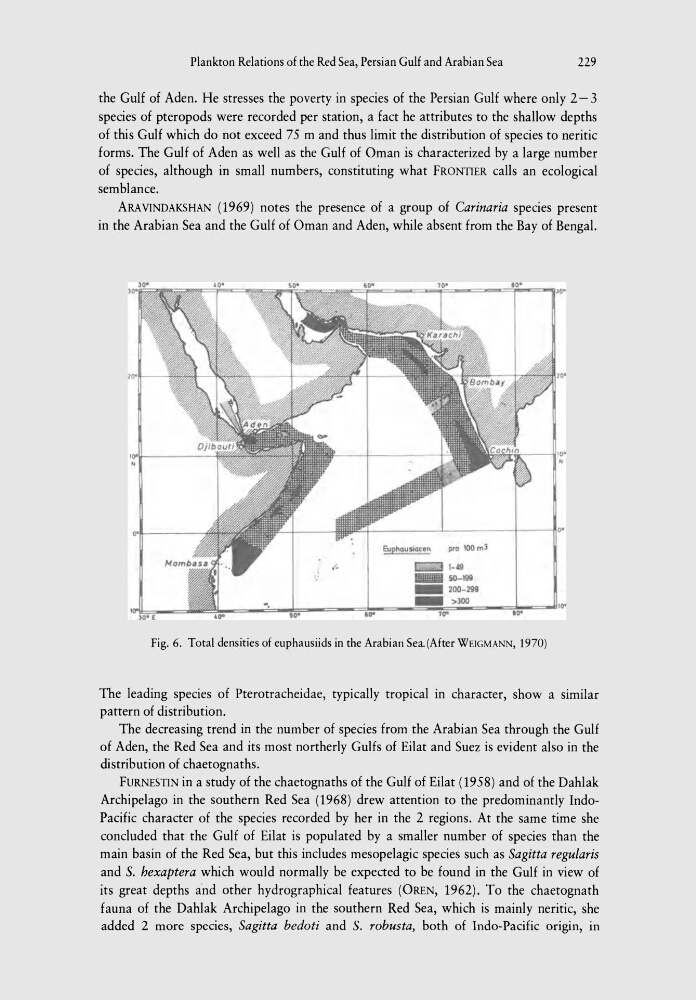
Fig. 6. Total densities of euphausiids in the Arabian Sea. (After WEIGMANN, 1970)
The leading species of Pterotracheidae, typically tropical in character, show a similar
pattern of distribution.
The decreasing trend in the number of species from the Arabian Sea through the Gulf
of Aden, the Red Sea and its most northerly Gulfs of Eilat and Suez is evident also in the
distribution of chaetognaths.
FURNESTIN in a study of the chaetognaths of the Gulf of Eilat (1958) and of the Dahlak
Archipelago in the southern Red Sea (1968) drew attention to the predominantly IndoPacific character of the species recorded by her in the 2 regions. At the same time she
concluded that the Gulf of Eilat is populated by a smaller number of species than the
main basin of the Red Sea, but this includes mesopelagic species such as Sagitta regularis
and S. hexaptera which would normally be expected to be found in the Gulf in view of
its great depths and other hydrographical features (OREN, 1962). To the chaetognath
fauna of the Dahlak Archipelago in the southern Red Sea, which is mainly neritic, she
added 2 more species, Sagitta bedoti and S. robusta, both of Indo-Pacific origin, in
229
the Gulf of Aden. He stresses the poverty in species of the Persian Gulf where only 2 - 3
species of pteropods were recorded per station, a fact he attributes to the shallow depths
of this Gulf which do not exceed 75 m and thus limit the distribution of species to neritic
forms. The Gulf of Aden as well as the Gulf of Oman is characterized by a large number
of species, although in small numbers, constituting what FRONTIER calls an ecological
semblance.
ARA VINDAKSHAN (1969) notes the presence of a group of Carinaria species present
in the Arabian Sea and the Gulf of Oman and Aden, while absent from the Bay of Bengal.
Fig. 6. Total densities of euphausiids in the Arabian Sea. (After WEIGMANN, 1970)
The leading species of Pterotracheidae, typically tropical in character, show a similar
pattern of distribution.
The decreasing trend in the number of species from the Arabian Sea through the Gulf
of Aden, the Red Sea and its most northerly Gulfs of Eilat and Suez is evident also in the
distribution of chaetognaths.
FURNESTIN in a study of the chaetognaths of the Gulf of Eilat (1958) and of the Dahlak
Archipelago in the southern Red Sea (1968) drew attention to the predominantly IndoPacific character of the species recorded by her in the 2 regions. At the same time she
concluded that the Gulf of Eilat is populated by a smaller number of species than the
main basin of the Red Sea, but this includes mesopelagic species such as Sagitta regularis
and S. hexaptera which would normally be expected to be found in the Gulf in view of
its great depths and other hydrographical features (OREN, 1962). To the chaetognath
fauna of the Dahlak Archipelago in the southern Red Sea, which is mainly neritic, she
added 2 more species, Sagitta bedoti and S. robusta, both of Indo-Pacific origin, in