

Plankton Relations of the Red Sea, Persian Gulf and Arabian Sea
231
In a note on the Thaliacea of the Gulf of Eilat GODEAUX (1960) points to several
species as new records for the Red Sea of which Riteriella amboinensis, a typically
Indo-Pacific species, is listed as the most northerly in its distribution in the Indian
Ocean area.
10"
•
•
•. 2200 m
55· E
••
65·
\,
II \ .... '\.\
\ \ \
\ \ \
\,
7S·
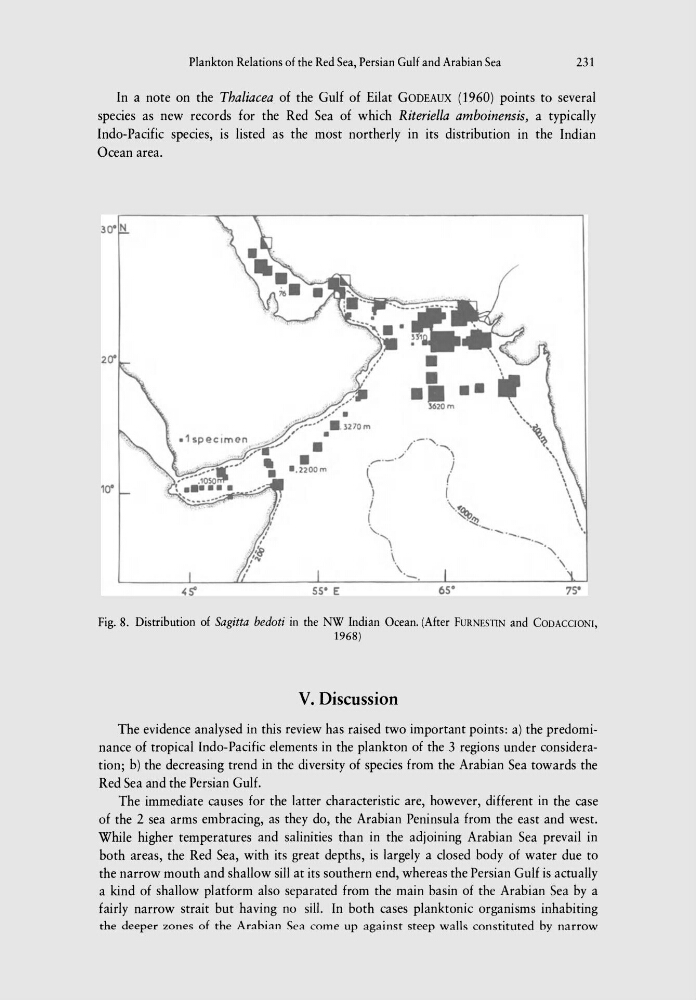
Fig. 8. Distribution of Sagitta bedoti in the NW Indian Ocean. (After FURNESTIN and CODACCIONI,
1968)
v. Discussion
The evidence analysed in this review has raised two important points: a) the predominance of tropical Indo-Pacific elements in the plankton of the 3 regions under consideration; b) the decreasing trend in the diversity of species from the Arabian Sea towards the
Red Sea and the Persian Gulf.
The immediate causes for the latter characteristic are, however, different in the case
of the 2 sea arms embracing, as they do, the Arabian Peninsula from the east and west.
While higher temperatures and salinities than in the adjoining Arabian Sea prevail in
both areas, the Red Sea, with its great depths, is largely a closed body of water due to
the narrow mouth and shallow sill at its southern end, whereas the Persian Gulf is actually
a kind of shallow platform also separated from the main basin of the Arabian Sea by a
fairly narrow strait but having no sill. In both cases planktonic organisms inhabiting
the deeper zones of the Arabian Sea come up against steep walls constituted by narrow
231
In a note on the Thaliacea of the Gulf of Eilat GODEAUX (1960) points to several
species as new records for the Red Sea of which Riteriella amboinensis, a typically
Indo-Pacific species, is listed as the most northerly in its distribution in the Indian
Ocean area.
10"
•
•
•. 2200 m
55· E
••
65·
\,
II \ .... '\.\
\ \ \
\ \ \
\,
7S·
Fig. 8. Distribution of Sagitta bedoti in the NW Indian Ocean. (After FURNESTIN and CODACCIONI,
1968)
v. Discussion
The evidence analysed in this review has raised two important points: a) the predominance of tropical Indo-Pacific elements in the plankton of the 3 regions under consideration; b) the decreasing trend in the diversity of species from the Arabian Sea towards the
Red Sea and the Persian Gulf.
The immediate causes for the latter characteristic are, however, different in the case
of the 2 sea arms embracing, as they do, the Arabian Peninsula from the east and west.
While higher temperatures and salinities than in the adjoining Arabian Sea prevail in
both areas, the Red Sea, with its great depths, is largely a closed body of water due to
the narrow mouth and shallow sill at its southern end, whereas the Persian Gulf is actually
a kind of shallow platform also separated from the main basin of the Arabian Sea by a
fairly narrow strait but having no sill. In both cases planktonic organisms inhabiting
the deeper zones of the Arabian Sea come up against steep walls constituted by narrow