

Plankton Relations of the Red Sea, Persian Gulf and Arabian Sea
223
The direction of flow is determined by the monsoons. In summer, the SW monsoon
generates a flow in a clockwise direction along the Somali and Arabian coasts toward
the western coast of India. During this period, from May to October, north-westerly
winds prevail along the whole of the Red Sea, causing a flow of Red Sea water into the
Gulf of Aden. In winter, the NE monsoon generates a current in the opposite direction
so that during the months of October to March there is a flow from the Gulf of Aden
into the southern part of the Red Sea. During this season the north-westerly winds do not
reach further south than the 20 ° N parallel thus assisting still further the inflow of
surface waters into the Red Sea (Fig. 2).
Africa
·f
<30
30
,....---...... ~
o·
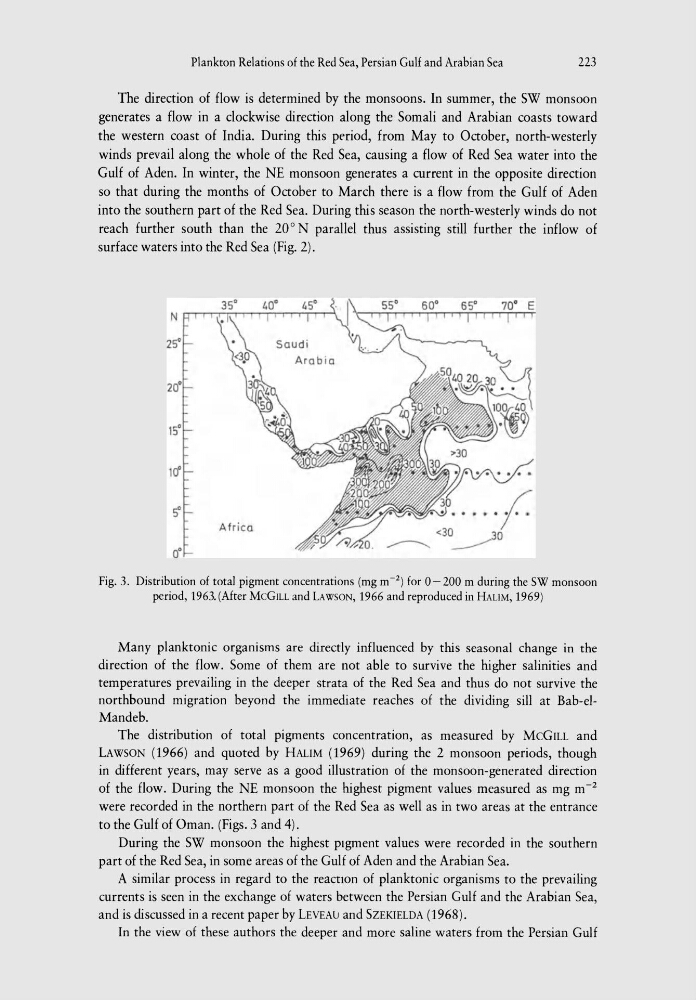
Fig. 3. Distribution of total pigment concentrations (mg m - 2) for 0 - 200 m during the SW monsoon
period, 1963. (After MCGILL and LAWSON, 1966 and reproduced in H ALIM, 1969)
Many planktonic organisms are directly influenced by this seasonal change in the
direction of the flow. Some of them are not able to survive the higher salinities and
temperatures prevailing in the deeper strata of the Red Sea and thus do not survive the
northbound migration beyond the immediate reaches of the dividing sill at Bab-elMandeb.
The distribution of total pigments concentration, as measured by MCGILL and
LAWSON (1966) and quoted by HALIM (1969) during the 2 monsoon periods, though
in different years, may serve as a good illustration of the monsoon-generated direction
of the flow. During the NE monsoon the highest pigment values measured as mg m- 2
were recorded in the northern part of the Red Sea as well as in two areas at the entrance
to the Gulf of Oman. (Figs. 3 and 4).
During the SW monsoon the highest pigment values were recorded in the southern
part of the Red Sea, in some areas of the Gulf of Aden and the Arabian Sea.
A similar process in regard to the reaction of planktonic organisms to the prevailing
currents is seen in the exchange of waters between the Persian Gulf and the Arabian Sea,
and is discussed in a recent paper by LEVEAlJ and SZEKIELDA (1968 ).
In the view of these authors the deeper and more saline waters from the Persian Gulf
223
The direction of flow is determined by the monsoons. In summer, the SW monsoon
generates a flow in a clockwise direction along the Somali and Arabian coasts toward
the western coast of India. During this period, from May to October, north-westerly
winds prevail along the whole of the Red Sea, causing a flow of Red Sea water into the
Gulf of Aden. In winter, the NE monsoon generates a current in the opposite direction
so that during the months of October to March there is a flow from the Gulf of Aden
into the southern part of the Red Sea. During this season the north-westerly winds do not
reach further south than the 20 ° N parallel thus assisting still further the inflow of
surface waters into the Red Sea (Fig. 2).
Africa
·f
<30
30
,....---...... ~
o·
Fig. 3. Distribution of total pigment concentrations (mg m - 2) for 0 - 200 m during the SW monsoon
period, 1963. (After MCGILL and LAWSON, 1966 and reproduced in H ALIM, 1969)
Many planktonic organisms are directly influenced by this seasonal change in the
direction of the flow. Some of them are not able to survive the higher salinities and
temperatures prevailing in the deeper strata of the Red Sea and thus do not survive the
northbound migration beyond the immediate reaches of the dividing sill at Bab-elMandeb.
The distribution of total pigments concentration, as measured by MCGILL and
LAWSON (1966) and quoted by HALIM (1969) during the 2 monsoon periods, though
in different years, may serve as a good illustration of the monsoon-generated direction
of the flow. During the NE monsoon the highest pigment values measured as mg m- 2
were recorded in the northern part of the Red Sea as well as in two areas at the entrance
to the Gulf of Oman. (Figs. 3 and 4).
During the SW monsoon the highest pigment values were recorded in the southern
part of the Red Sea, in some areas of the Gulf of Aden and the Arabian Sea.
A similar process in regard to the reaction of planktonic organisms to the prevailing
currents is seen in the exchange of waters between the Persian Gulf and the Arabian Sea,
and is discussed in a recent paper by LEVEAlJ and SZEKIELDA (1968 ).
In the view of these authors the deeper and more saline waters from the Persian Gulf