

3.2
Plankton Relations of the Red Sea, Persian Gulf and
Arabian Sea
B. KIMOR
In this paper I summarize studies on plankton relations in the Red Sea, Persian Gulf
and the Arabian Sea. These are mainly contemporary contributions made shortly before,
during and following the official closing of the IIOE. Reference to earlier sources of
information relating to expeditions or individual taxa is readily available in several
bibliographies pertaining to these subjects (PRASAD, 1964; PALO!, 1968) or in synoptic
surveys on specific areas such as HALIM's plankton of the Red Sea (1969).
The taxa to be presently considered are those on which the author had most information and which, in his opinion, were of sufficient significance either as biomass formers or
as indicators of specific water masses in the three adjacent seas.
I. Specific Aspects of the Environment
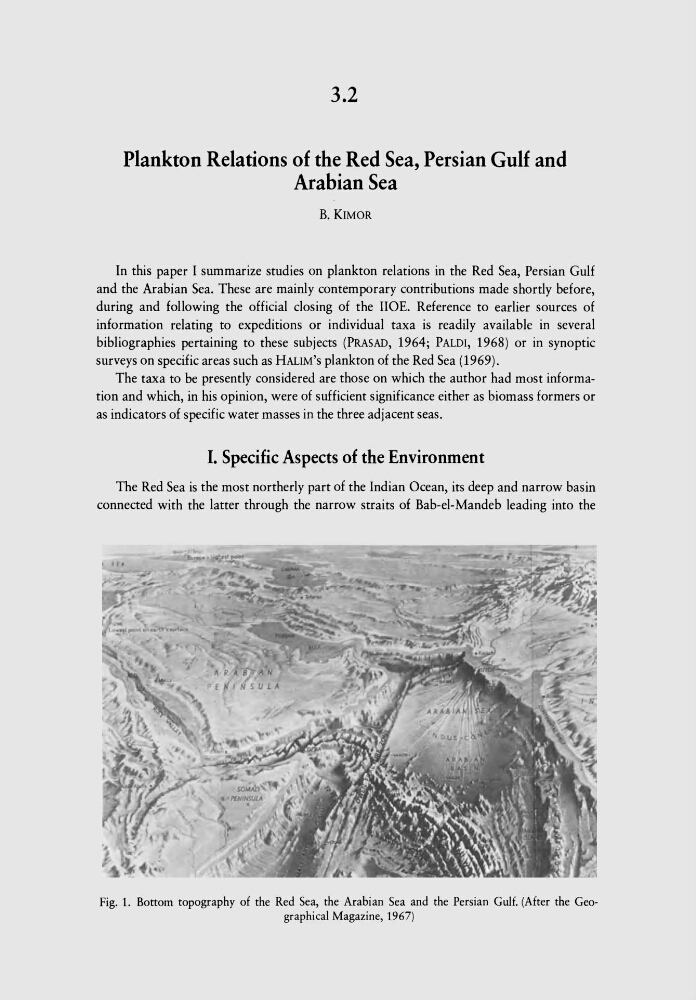
The Red Sea is the most northerly part of the Indian Ocean, its deep and narrow basin
connected with the latter through the narrow straits of Bab-el-Mandeb leading into the
Fig. 1. Bottom topography of the Red Sea, the Arabian Sea and the Persian Gulf. (After the Geographical Magazine, 1967)
Plankton Relations of the Red Sea, Persian Gulf and
Arabian Sea
B. KIMOR
In this paper I summarize studies on plankton relations in the Red Sea, Persian Gulf
and the Arabian Sea. These are mainly contemporary contributions made shortly before,
during and following the official closing of the IIOE. Reference to earlier sources of
information relating to expeditions or individual taxa is readily available in several
bibliographies pertaining to these subjects (PRASAD, 1964; PALO!, 1968) or in synoptic
surveys on specific areas such as HALIM's plankton of the Red Sea (1969).
The taxa to be presently considered are those on which the author had most information and which, in his opinion, were of sufficient significance either as biomass formers or
as indicators of specific water masses in the three adjacent seas.
I. Specific Aspects of the Environment
The Red Sea is the most northerly part of the Indian Ocean, its deep and narrow basin
connected with the latter through the narrow straits of Bab-el-Mandeb leading into the
Fig. 1. Bottom topography of the Red Sea, the Arabian Sea and the Persian Gulf. (After the Geographical Magazine, 1967)