

Agulhas Bank Plankton
207
of Atlantic water constricted the Agulhas water to a narrow band off the Cape of Good
Hope, which then widened out as it proceeded north. In July the Atlantic water also acted
as a block to Agulhas water, because while Indo-Pacific forms were found in great
concentrations at the easternmost deep stations beyond the 200 m isobath south of the
Bank, they were completely absent from the outer stations further to the west, where
Atlantic forms were found.
4. Euphausiacea
The most comprehensive account on the euphausiid fauna of southern African waters,
by BODEN (1954), is based on widespread collections in the area between the tropical
Indian Ocean (10
0
S), the Antarctic Convergence (50
0
S) and the Atlantic waters
bordering the African mainland to as far north as Walvis Bay (23
0
S). This huge area
yielded 42 species. NEPGEN (1957) identified 18 species in a restricted area between
Cape Town and Lamberts Bay (32
0
S) on the west coast, where he found Euphausia
lucens and Nyctiphanes capensis as the dominant species. The following summary has
been condensed from unpublished data obtained by D. Gow, who analysed two years'
monthly samples collected in the routine survey area of the Division of Sea Fisheries
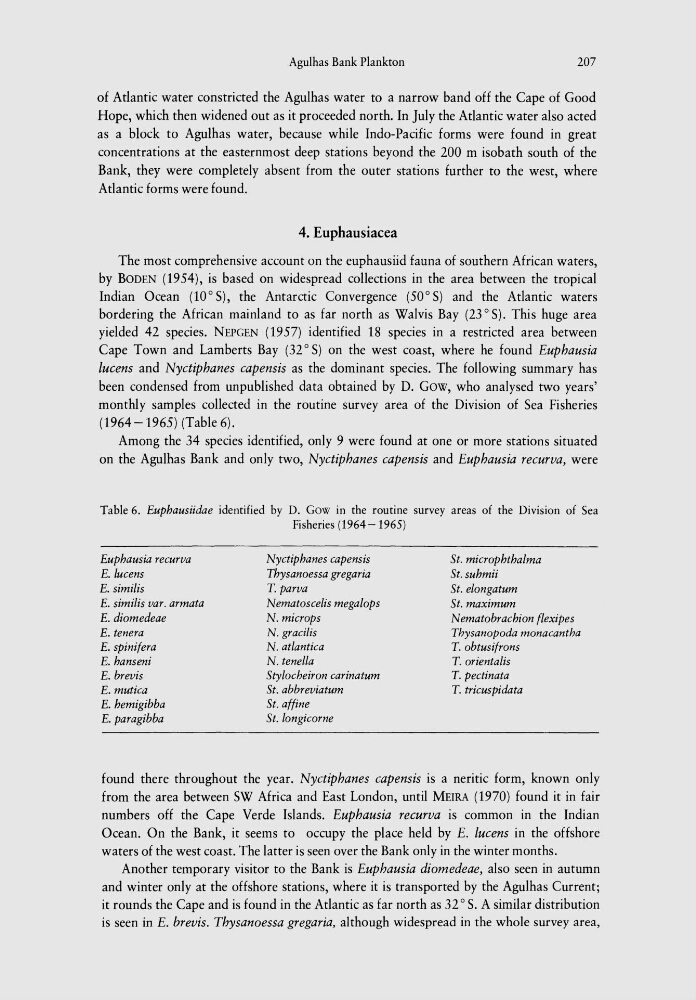
(1964-1965) (Table 6).
Among the 34 species identified, only 9 were found at one or more stations situated
on the Agulhas Bank and only two, Nyctiphanes capensis and Euphausia recur va, were
Table 6. Euphausiidae identified by D. Gow in the routine survey areas of the Division of Sea
Fisheries (1964-1965)
Euphausia recurva
E.lucens
E. similis
E. similis var. armata
E. diomedeae
E. tenera
E. spinifera
E. hanseni
E. brevis
E. mutica
E. hemigibba
E. paragibba
Nyctiphanes capensis
Thysanoessa gregaria
T. parva
Nematoscelis megalops
N. microps
N. gracilis
N. atlantica
N. tene/la
Stylocheiron carina tum
St. abbreviatum
St. affine
St. longicorne
St. microphthalma
St. suhmii
St. elongatum
St. maximum
Nematobrachion flexipes
Thysanopoda monacantha
T. obtusifrons
T. orientalis
T. pectinata
T. tricuspidata
found there throughout the year. Nyctiphanes capensis is a neritic form, known only
from the area between SW Africa and East London, until MElRA (1970) found it in fair
numbers off the Cape Verde Islands. Euphausia recurva is common in the Indian
Ocean. On the Bank, it seems to occupy the place held by E. lucens in the offshore
waters of the west coast. The latter is seen over the Bank only in the winter months.
Another temporary visitor to the Bank is Euphausia diomedeae, also seen in autumn
and winter only at the offshore stations, where it is transported by the Agulhas Current;
it rounds the Cape and is found in the Atlantic as far north as 32
0
S. A similar distribution
is seen in E. brevis. Thysanoessa gregaria, although widespread in the whole survey area,
207
of Atlantic water constricted the Agulhas water to a narrow band off the Cape of Good
Hope, which then widened out as it proceeded north. In July the Atlantic water also acted
as a block to Agulhas water, because while Indo-Pacific forms were found in great
concentrations at the easternmost deep stations beyond the 200 m isobath south of the
Bank, they were completely absent from the outer stations further to the west, where
Atlantic forms were found.
4. Euphausiacea
The most comprehensive account on the euphausiid fauna of southern African waters,
by BODEN (1954), is based on widespread collections in the area between the tropical
Indian Ocean (10
0
S), the Antarctic Convergence (50
0
S) and the Atlantic waters
bordering the African mainland to as far north as Walvis Bay (23
0
S). This huge area
yielded 42 species. NEPGEN (1957) identified 18 species in a restricted area between
Cape Town and Lamberts Bay (32
0
S) on the west coast, where he found Euphausia
lucens and Nyctiphanes capensis as the dominant species. The following summary has
been condensed from unpublished data obtained by D. Gow, who analysed two years'
monthly samples collected in the routine survey area of the Division of Sea Fisheries
(1964-1965) (Table 6).
Among the 34 species identified, only 9 were found at one or more stations situated
on the Agulhas Bank and only two, Nyctiphanes capensis and Euphausia recur va, were
Table 6. Euphausiidae identified by D. Gow in the routine survey areas of the Division of Sea
Fisheries (1964-1965)
Euphausia recurva
E.lucens
E. similis
E. similis var. armata
E. diomedeae
E. tenera
E. spinifera
E. hanseni
E. brevis
E. mutica
E. hemigibba
E. paragibba
Nyctiphanes capensis
Thysanoessa gregaria
T. parva
Nematoscelis megalops
N. microps
N. gracilis
N. atlantica
N. tene/la
Stylocheiron carina tum
St. abbreviatum
St. affine
St. longicorne
St. microphthalma
St. suhmii
St. elongatum
St. maximum
Nematobrachion flexipes
Thysanopoda monacantha
T. obtusifrons
T. orientalis
T. pectinata
T. tricuspidata
found there throughout the year. Nyctiphanes capensis is a neritic form, known only
from the area between SW Africa and East London, until MElRA (1970) found it in fair
numbers off the Cape Verde Islands. Euphausia recurva is common in the Indian
Ocean. On the Bank, it seems to occupy the place held by E. lucens in the offshore
waters of the west coast. The latter is seen over the Bank only in the winter months.
Another temporary visitor to the Bank is Euphausia diomedeae, also seen in autumn
and winter only at the offshore stations, where it is transported by the Agulhas Current;
it rounds the Cape and is found in the Atlantic as far north as 32
0
S. A similar distribution
is seen in E. brevis. Thysanoessa gregaria, although widespread in the whole survey area,