

190
A. DE DECKER:
of the Department of Zoology and of Oceanography of the University of Cape Town
during ICY and HOE, when seasonal cruises were undertaken to survey the Agulhas
Current. The inshore parts of 1 or 2 of the transects were situated on the Agulhas Bank.
I. Physical Environment
Situated between the lower course of the Agulhas Current (temperature at the core
25° C or more) and the origin of the Benguela Current (surface temperature below 10° C
during active upwelling), the water of the Agulhas Bank can display very steep thermohaline gradients, often caused by dynamic or wind-driven upwelling. Vertical gradients of
3J05
35°
22
36°
37°5 @
16°E
1~
23~
18°
Surface Temperature
Continuous Thermograph
January 1964
19o
2CJ>
21°E
Fig.2a
22
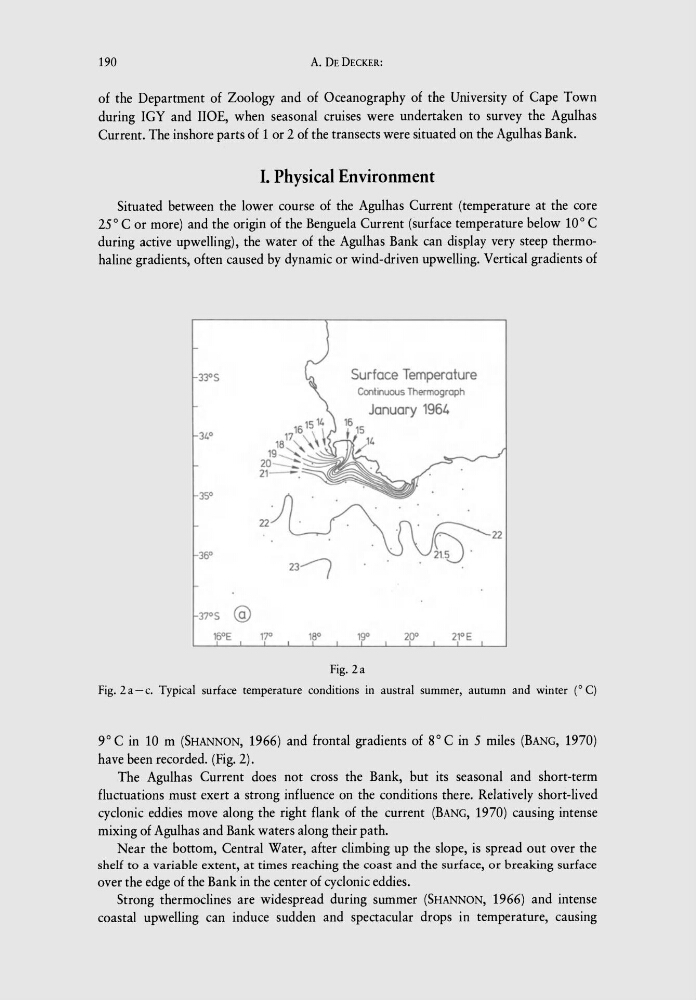
Fig. 2 a-c. Typical surface temperature conditions in austral summer, autumn and winter (0 C)
9° C in 10 m (SHANNON, 1966) and frontal gradients of 8° C in 5 miles (BANG, 1970)
have been recorded. (Fig. 2).
The Agulhas Current does not cross the Bank, but its seasonal and short-term
fluctuations must exert a strong influence on the conditions there. Relatively short-lived
cyclonic eddies move along the right flank of the current (BANG, 1970) causing intense
mixing of Agulhas and Bank waters along their path.
Near the bottom, Central Water, after climbing up the slope, is spread out over the
shelf to a variable extent, at times reaching the coast and the surface, or breaking surface
over the edge of the Bank in the center of cyclonic eddies.
Strong thermoclines are widespread during summer (SHANNON, 1966) and intense
coastal upwelling can induce sudden and spectacular drops in temperature, causing
A. DE DECKER:
of the Department of Zoology and of Oceanography of the University of Cape Town
during ICY and HOE, when seasonal cruises were undertaken to survey the Agulhas
Current. The inshore parts of 1 or 2 of the transects were situated on the Agulhas Bank.
I. Physical Environment
Situated between the lower course of the Agulhas Current (temperature at the core
25° C or more) and the origin of the Benguela Current (surface temperature below 10° C
during active upwelling), the water of the Agulhas Bank can display very steep thermohaline gradients, often caused by dynamic or wind-driven upwelling. Vertical gradients of
3J05
35°
22
36°
37°5 @
16°E
1~
23~
18°
Surface Temperature
Continuous Thermograph
January 1964
19o
2CJ>
21°E
Fig.2a
22
Fig. 2 a-c. Typical surface temperature conditions in austral summer, autumn and winter (0 C)
9° C in 10 m (SHANNON, 1966) and frontal gradients of 8° C in 5 miles (BANG, 1970)
have been recorded. (Fig. 2).
The Agulhas Current does not cross the Bank, but its seasonal and short-term
fluctuations must exert a strong influence on the conditions there. Relatively short-lived
cyclonic eddies move along the right flank of the current (BANG, 1970) causing intense
mixing of Agulhas and Bank waters along their path.
Near the bottom, Central Water, after climbing up the slope, is spread out over the
shelf to a variable extent, at times reaching the coast and the surface, or breaking surface
over the edge of the Bank in the center of cyclonic eddies.
Strong thermoclines are widespread during summer (SHANNON, 1966) and intense
coastal upwelling can induce sudden and spectacular drops in temperature, causing