

3. Standing Stock and Distribution of Phytoplankton,
Zooplankton and Particulate Matter in Selected Areas
3.1
Agulhas Bank Plankton
A. DEDECKER
Information on the plankton of the Agulhas Bank has always been scarce and sporadic.
We had to rely on occasional collections made at a small number of stations by passing
expedition ships. A regular exploration of the Bank from a planktological point of view
has never been attempted.
In recent years, the outlook has much improved as far as research effort and available
material are concerned. During the International Geophysical Year (IGY), RS "Africa.\:. ~'. ~'n FO
"'::: - .- 2
_. ,.....
trill'
-1-, 28
...... .P' 32
". 36 40 Cape Town
/
\. ",'
~/
V:;V)~4856
,/ .. , /\' V.V~V~~76 eo
~,
J.
.[St 6
r"
/ /'
IV'IVY
rr-·
,1/
I,
A / i "I · . i i \ \
/ / ~\ f I.. I \l-\
/ /
I
,- "' 1
.....
f
/
\
37"
'/
\ :
1" .....
\ 1 \
\ I
~
r- ~outini Aleo I JU\ Y1 i 63 1 - Dic.1~61 ~
1.01
0
0
0
17
18
0
0
0
19o 200 21 22 E
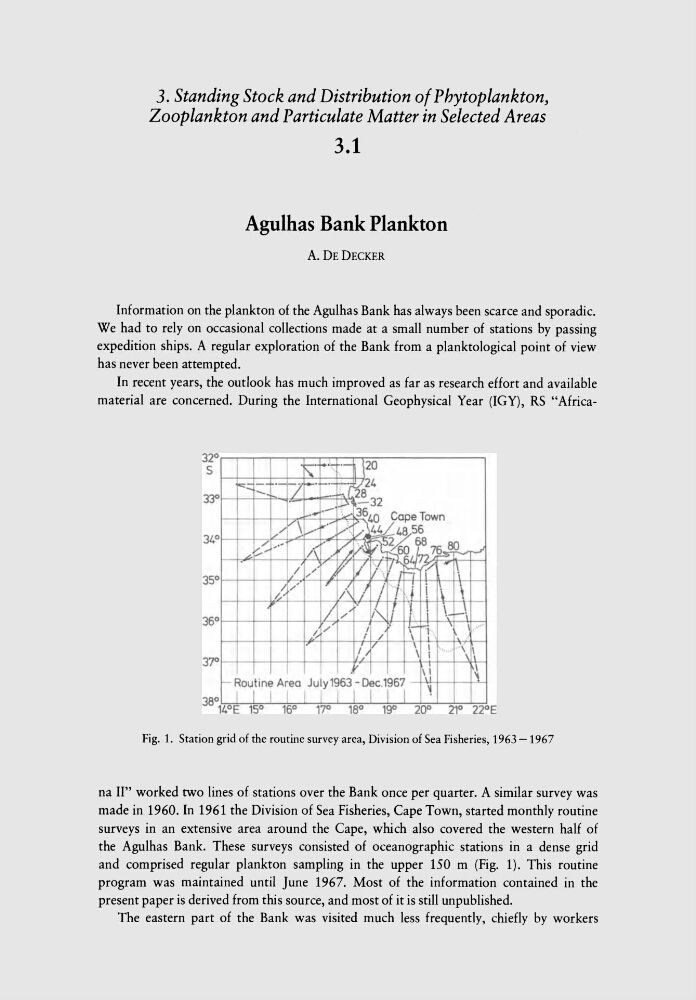
Fig. 1. Station grid of the routine survey area, Division of Sea Fisheries, 1963 -1967
na II" worked two lines of stations over the Bank once per quarter. A similar survey was
made in 1960. In 1961 the Division of Sea Fisheries, Cape Town, started monthly routine
surveys in an extensive area around the Cape, which also covered the western half of
the Agulhas Bank. These surveys consisted of oceanographic stations in a dense grid
and comprised regular plankton sampling in the upper 150 m (Fig. 1). This routine
program was maintained until June 1967. Most of the information contained in the
present paper is derived from this source, and most of it is still unpublished.
The eastern part of the Bank was visited much less frequently, chiefly by workers
Zooplankton and Particulate Matter in Selected Areas
3.1
Agulhas Bank Plankton
A. DEDECKER
Information on the plankton of the Agulhas Bank has always been scarce and sporadic.
We had to rely on occasional collections made at a small number of stations by passing
expedition ships. A regular exploration of the Bank from a planktological point of view
has never been attempted.
In recent years, the outlook has much improved as far as research effort and available
material are concerned. During the International Geophysical Year (IGY), RS "Africa.\:. ~'. ~'n FO
"'::: - .- 2
_. ,.....
trill'
-1-, 28
...... .P' 32
". 36 40 Cape Town
/
\. ",'
~/
V:;V)~4856
,/ .. , /\' V.V~V~~76 eo
~,
J.
.[St 6
r"
/ /'
IV'IVY
rr-·
,1/
I,
A / i "I · . i i \ \
/ / ~\ f I.. I \l-\
/ /
I
,- "' 1
.....
f
/
\
37"
'/
\ :
1" .....
\ 1 \
\ I
~
r- ~outini Aleo I JU\ Y1 i 63 1 - Dic.1~61 ~
1.01
0
0
0
17
18
0
0
0
19o 200 21 22 E
Fig. 1. Station grid of the routine survey area, Division of Sea Fisheries, 1963 -1967
na II" worked two lines of stations over the Bank once per quarter. A similar survey was
made in 1960. In 1961 the Division of Sea Fisheries, Cape Town, started monthly routine
surveys in an extensive area around the Cape, which also covered the western half of
the Agulhas Bank. These surveys consisted of oceanographic stations in a dense grid
and comprised regular plankton sampling in the upper 150 m (Fig. 1). This routine
program was maintained until June 1967. Most of the information contained in the
present paper is derived from this source, and most of it is still unpublished.
The eastern part of the Bank was visited much less frequently, chiefly by workers