

Primary Production in the Indian Ocean I
123
BACH (1969), who tried to distinguish between chlorphylls of different ages by measuring
their red fluorescence. However, chlorophyll values could at most indicate only the
degree or level of primary production in an area.
III. Distribution of Potential Assimilation
Several investigators have attempted to convert the incubator 14C assimilation values
into real in situ primary production rates by means of conversion factors. Such attempts
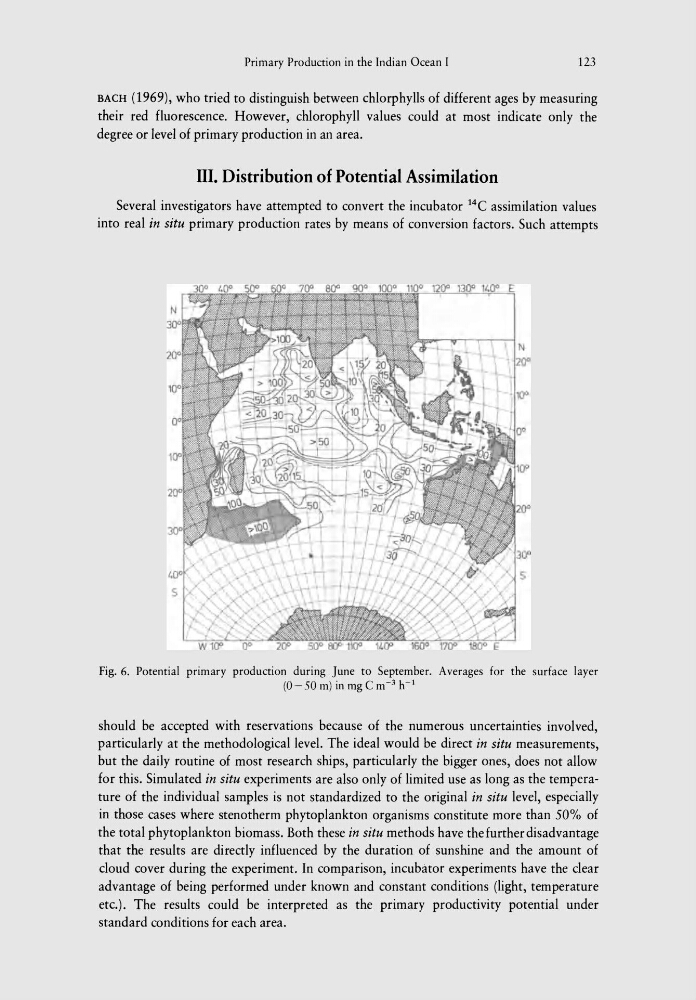
Fig. 6. Potential primary production during June to September. Averages for the surface layer
(O-SO m) in mg C m- 3 h- 1
should be accepted with reservations because of the numerous uncertainties involved,
particularly at the methodological level. The ideal would be direct in situ measurements,
but the daily routine of most research ships, particularly the bigger ones, does not allow
for this. Simulated in situ experiments are also only of limited use as long as the temperature of the individual samples is not standardized to the original in situ level, especially
in those cases where stenotherm phytoplankton organisms constitute more than 50% of
the total phytoplankton biomass. Both these in situ methods have thefurtherdisadvantage
that the results arc directly influenced by the duration of sunshine and the amount of
cloud cover during the experiment. In comparison, incubator experiments have the clear
advantage of being performed under known and constant conditions (light, temperature
etc.). The results could be interpreted as the primary productivity potential under
standard conditions for each area.
123
BACH (1969), who tried to distinguish between chlorphylls of different ages by measuring
their red fluorescence. However, chlorophyll values could at most indicate only the
degree or level of primary production in an area.
III. Distribution of Potential Assimilation
Several investigators have attempted to convert the incubator 14C assimilation values
into real in situ primary production rates by means of conversion factors. Such attempts
Fig. 6. Potential primary production during June to September. Averages for the surface layer
(O-SO m) in mg C m- 3 h- 1
should be accepted with reservations because of the numerous uncertainties involved,
particularly at the methodological level. The ideal would be direct in situ measurements,
but the daily routine of most research ships, particularly the bigger ones, does not allow
for this. Simulated in situ experiments are also only of limited use as long as the temperature of the individual samples is not standardized to the original in situ level, especially
in those cases where stenotherm phytoplankton organisms constitute more than 50% of
the total phytoplankton biomass. Both these in situ methods have thefurtherdisadvantage
that the results arc directly influenced by the duration of sunshine and the amount of
cloud cover during the experiment. In comparison, incubator experiments have the clear
advantage of being performed under known and constant conditions (light, temperature
etc.). The results could be interpreted as the primary productivity potential under
standard conditions for each area.