

122
J. KREY:
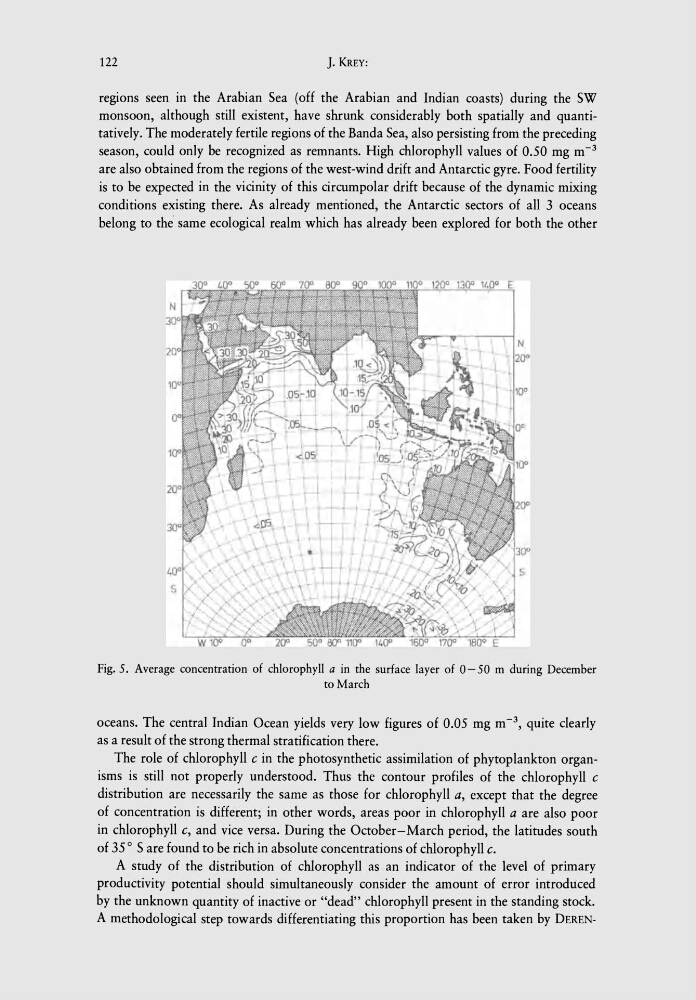
regions seen in the Arabian Sea (off the Arabian and Indian coasts) during the SW
monsoon, although still existent, have shrunk considerably both spatially and quantitatively. The moderately fertile regions of the Banda Sea, also persisting from the preceding
season, could only be recognized as remnants. High chlorophyll values of 0.50 mg m- 3
are also obtained from the regions of the west-wind drift and Antarctic gyre. Food fertility
is to be expected in the vicinity of this circumpolar drift because of the dynamic mixing
conditions existing there. As already mentioned, the Antarctic sectors of all 3 oceans
belong to the same ecological realm which has already been explored for both the other
Fig. 5. Average concentration of chlorophyll a in the surface layer of 0 - 50 m during December
to March
oceans. The central Indian Ocean yields very low figures of 0.05 mg m- 3 , quite clearly
as a result of the strong thermal stratification there.
The role of chlorophyll c in the photosynthetic assimilation of phytoplankton organisms is still not properly understood. Thus the contour profiles of the chlorophyll c
distribution are necessarily the same as those for chlorophyll a, except that the degree
of concentration is different; in other words, areas poor in chlorophyll a are also poor
in chlorophyll c, and vice versa. During the October-March period, the latitudes south
of 35 0 S are found to be rich in absolute concentrations of chlorophyll c.
A study of the distribution of chlorophyll as an indicator of the level of primary
productivity potential should simultaneously consider the amount of error introduced
by the unknown quantity of inactive or "dead" chlorophyll present in the standing stock.
A methodological step towards differentiating this proportion has been taken by DEREN-
J. KREY:
regions seen in the Arabian Sea (off the Arabian and Indian coasts) during the SW
monsoon, although still existent, have shrunk considerably both spatially and quantitatively. The moderately fertile regions of the Banda Sea, also persisting from the preceding
season, could only be recognized as remnants. High chlorophyll values of 0.50 mg m- 3
are also obtained from the regions of the west-wind drift and Antarctic gyre. Food fertility
is to be expected in the vicinity of this circumpolar drift because of the dynamic mixing
conditions existing there. As already mentioned, the Antarctic sectors of all 3 oceans
belong to the same ecological realm which has already been explored for both the other
Fig. 5. Average concentration of chlorophyll a in the surface layer of 0 - 50 m during December
to March
oceans. The central Indian Ocean yields very low figures of 0.05 mg m- 3 , quite clearly
as a result of the strong thermal stratification there.
The role of chlorophyll c in the photosynthetic assimilation of phytoplankton organisms is still not properly understood. Thus the contour profiles of the chlorophyll c
distribution are necessarily the same as those for chlorophyll a, except that the degree
of concentration is different; in other words, areas poor in chlorophyll a are also poor
in chlorophyll c, and vice versa. During the October-March period, the latitudes south
of 35 0 S are found to be rich in absolute concentrations of chlorophyll c.
A study of the distribution of chlorophyll as an indicator of the level of primary
productivity potential should simultaneously consider the amount of error introduced
by the unknown quantity of inactive or "dead" chlorophyll present in the standing stock.
A methodological step towards differentiating this proportion has been taken by DEREN-