

124
J. KREY:
During the June - September period, the general pattern of the distribution of potential
primary production (Fig. 6) agrees quite well with that of chlorophyll concentrations
(Fig. 4), so the integrated average for chlorophyll in the upper 50 m water column is
considered here. Three main areas of high potential production are outstanding in the
SW Indian Ocean, northern Arabian Sea and the shelf regions off Australia. The Equatorial Current region yields medium values, while the "desert regions" north and south
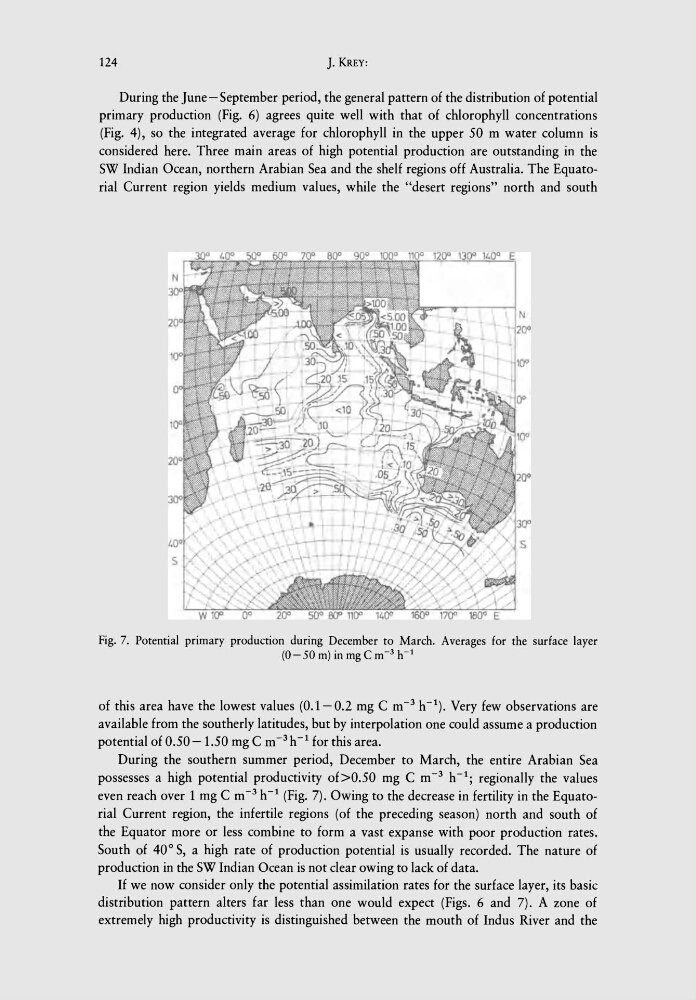
Fig. 7. Potential primary production during December to March. Averages for the surface layer
(0-50 m) in mg C m- 3 h- 1
of this area have the lowest values (0.1-0.2 mg C m- 3 h- 1 ). Very few observations are
available from the southerly latitudes, but by interpolation one could assume a production
potential of 0.50 -1.50 mg C m -3 h -1 for this area.
During the southern summer period, December to March, the entire Arabian Sea
possesses a high potential productivity of>0.50 mg C m- 3 h- 1 ; regionally the values
even reach over 1 mg C m- 3 h- 1 (Fig. 7). Owing to the decrease in fertility in the Equatorial Current region, the infertile regions (of the preceding season) north and south of
the Equator more or less combine to form a vast expanse with poor production rates.
South of 40° S, a high rate of production potential is usually recorded. The nature of
production in the SW Indian Ocean is not clear owing to lack of data.
If we now consider only the potential assimilation rates for the surface layer, its basic
distribution pattern alters far less than one would expect (Figs. 6 and 7). A zone of
extremely high productivity is distinguished between the mouth of Indus River and the
J. KREY:
During the June - September period, the general pattern of the distribution of potential
primary production (Fig. 6) agrees quite well with that of chlorophyll concentrations
(Fig. 4), so the integrated average for chlorophyll in the upper 50 m water column is
considered here. Three main areas of high potential production are outstanding in the
SW Indian Ocean, northern Arabian Sea and the shelf regions off Australia. The Equatorial Current region yields medium values, while the "desert regions" north and south
Fig. 7. Potential primary production during December to March. Averages for the surface layer
(0-50 m) in mg C m- 3 h- 1
of this area have the lowest values (0.1-0.2 mg C m- 3 h- 1 ). Very few observations are
available from the southerly latitudes, but by interpolation one could assume a production
potential of 0.50 -1.50 mg C m -3 h -1 for this area.
During the southern summer period, December to March, the entire Arabian Sea
possesses a high potential productivity of>0.50 mg C m- 3 h- 1 ; regionally the values
even reach over 1 mg C m- 3 h- 1 (Fig. 7). Owing to the decrease in fertility in the Equatorial Current region, the infertile regions (of the preceding season) north and south of
the Equator more or less combine to form a vast expanse with poor production rates.
South of 40° S, a high rate of production potential is usually recorded. The nature of
production in the SW Indian Ocean is not clear owing to lack of data.
If we now consider only the potential assimilation rates for the surface layer, its basic
distribution pattern alters far less than one would expect (Figs. 6 and 7). A zone of
extremely high productivity is distinguished between the mouth of Indus River and the