

388
produce mucins, which interact with IFs, and show a high capacity for absorbing
water (see for details Fudge et al. 2009a , b ). According to the modern hypothesis
(Lim et al. 2006 ; Zintzen et al. 2011 ), production of slime in modern hagfi shes has
numerous functions like immunological response to infectious pathogens as the
epidermal slime of the more evolved fi shes, or, decreasing competition for food by
excluding other scavengers, frighten off different predators, and may also be a
special biological approach that incapacitates prey by suffocating them (Lim et al.
2006 ; Zintzen et al. 2011 ).
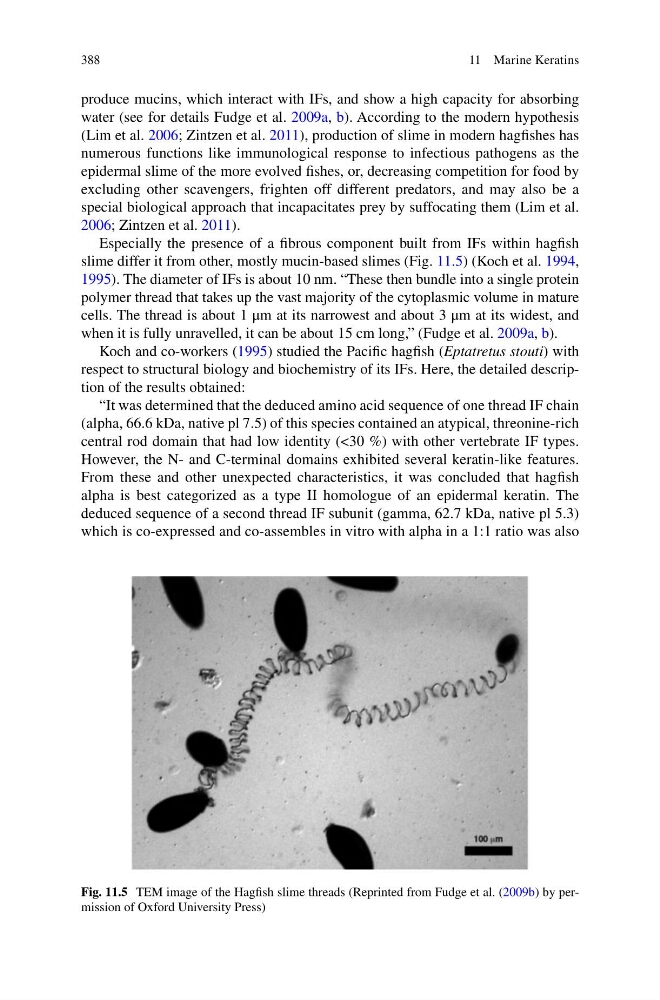
Especially the presence of a fi brous component built from IFs within hagfi sh
slime differ it from other, mostly mucin-based slimes (Fig. 11.5 ) (Koch et al. 1994 ,
1995 ). The diameter of IFs is about 10 nm. “These then bundle into a single protein
polymer thread that takes up the vast majority of the cytoplasmic volume in mature
cells. The thread is about 1 μm at its narrowest and about 3 μm at its widest, and
when it is fully unravelled, it can be about 15 cm long,” (Fudge et al. 2009a , b ).
Koch and co-workers ( 1995 ) studied the Pacifi c hagfi sh ( Eptatretus stouti ) with
respect to structural biology and biochemistry of its IFs. Here, the detailed description of the results obtained:
“It was determined that the deduced amino acid sequence of one thread IF chain
(alpha, 66.6 kDa, native pl 7.5) of this species contained an atypical, threonine-rich
central rod domain that had low identity (<30 %) with other vertebrate IF types.
However, the N- and C-terminal domains exhibited several keratin-like features.
From these and other unexpected characteristics, it was concluded that hagfi sh
alpha is best categorized as a type II homologue of an epidermal keratin. The
deduced sequence of a second thread IF subunit (gamma, 62.7 kDa, native pl 5.3)
which is co-expressed and co-assembles in vitro with alpha in a 1:1 ratio was also
Fig. 11.5 TEM image of the Hagfi sh slime threads (Reprinted from Fudge et al. ( 2009b ) by permission of Oxford University Press)
11 Marine Keratins
produce mucins, which interact with IFs, and show a high capacity for absorbing
water (see for details Fudge et al. 2009a , b ). According to the modern hypothesis
(Lim et al. 2006 ; Zintzen et al. 2011 ), production of slime in modern hagfi shes has
numerous functions like immunological response to infectious pathogens as the
epidermal slime of the more evolved fi shes, or, decreasing competition for food by
excluding other scavengers, frighten off different predators, and may also be a
special biological approach that incapacitates prey by suffocating them (Lim et al.
2006 ; Zintzen et al. 2011 ).
Especially the presence of a fi brous component built from IFs within hagfi sh
slime differ it from other, mostly mucin-based slimes (Fig. 11.5 ) (Koch et al. 1994 ,
1995 ). The diameter of IFs is about 10 nm. “These then bundle into a single protein
polymer thread that takes up the vast majority of the cytoplasmic volume in mature
cells. The thread is about 1 μm at its narrowest and about 3 μm at its widest, and
when it is fully unravelled, it can be about 15 cm long,” (Fudge et al. 2009a , b ).
Koch and co-workers ( 1995 ) studied the Pacifi c hagfi sh ( Eptatretus stouti ) with
respect to structural biology and biochemistry of its IFs. Here, the detailed description of the results obtained:
“It was determined that the deduced amino acid sequence of one thread IF chain
(alpha, 66.6 kDa, native pl 7.5) of this species contained an atypical, threonine-rich
central rod domain that had low identity (<30 %) with other vertebrate IF types.
However, the N- and C-terminal domains exhibited several keratin-like features.
From these and other unexpected characteristics, it was concluded that hagfi sh
alpha is best categorized as a type II homologue of an epidermal keratin. The
deduced sequence of a second thread IF subunit (gamma, 62.7 kDa, native pl 5.3)
which is co-expressed and co-assembles in vitro with alpha in a 1:1 ratio was also
Fig. 11.5 TEM image of the Hagfi sh slime threads (Reprinted from Fudge et al. ( 2009b ) by permission of Oxford University Press)
11 Marine Keratins