

387
(Strahan 1959 , 1963 ; Martini 1998 ; Crystall 2000 ; Fudge 2001 ). Slime glands that
line both sides of the hagfi sh’s body are responsible for production and ejecting of
the slime exudate (Downing et al. 1984 ; Spitzer et al. 1984 , 1988 ; Spitzer and Koch
1998 ). In the classical paper by John Ferry published in 1941, he wrote about overproduction of colorless and transparent slime by a hagfi sh in sea water during a few
seconds. The slime showed a tough, coherent, stringy consistency even being
extremely diluted. The rigidity, exhibiting “elastic recoil”, was reported as the special property of this highly viscous matter (Ferry 1941 ).
Hagfi shes possess a large battery of slime glands (Blackstad 1963 ) and 90–200
associated slime pores running laterally along the full length of each side of their
body (Zintzen et al. 2011 ). The histochemistry (Leppi 1967 , 1968 ), ultrastructure
(Fan 1965 ; Terakado et al. 1975 ), and function of these glands in different hagfi sh
species are well investigated (see for details Newby 1946 ; Lametschwandtner et al.
1986 ; Luchtel et al. 1991 ; Spitzer and Koch 1998 ; Subramanian et al. 2008 ;
Winegard and Fudge 2010 ).
The holocrine (slime glands) and merocrine (epidermal, through the skin) are
two pathways of slime production in hagfi sh (Braun and Northcutt 1998 ). The hagfi sh epidermis is scaleless and consists of three cell types (small mucous cells, epidermal thread cells, and large mucous cells) (Fernholm 1981 ), which are located
within collagenous fi brillar network that forms a fl exible grayish “sheath”. Two
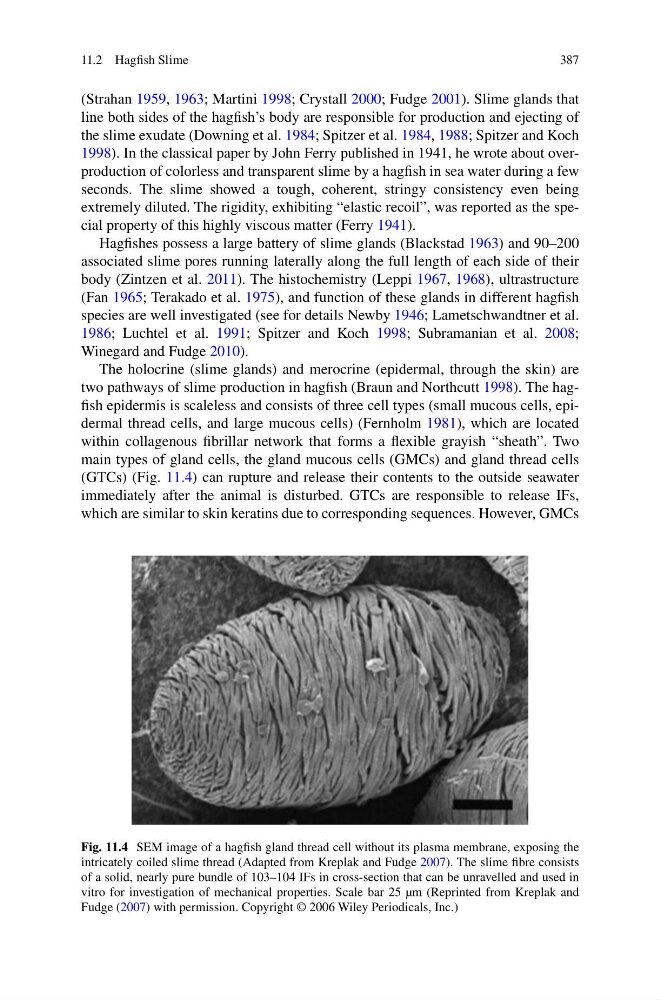
main types of gland cells, the gland mucous cells (GMCs) and gland thread cells
(GTCs) (Fig. 11.4 ) can rupture and release their contents to the outside seawater
immediately after the animal is disturbed. GTCs are responsible to release IFs,
which are similar to skin keratins due to corresponding sequences. However, GMCs
Fig. 11.4 SEM image of a hagfi sh gland thread cell without its plasma membrane, exposing the
intricately coiled slime thread (Adapted from Kreplak and Fudge 2007 ). The slime fi bre consists
of a solid, nearly pure bundle of 103–104 IFs in cross-section that can be unravelled and used in
vitro for investigation of mechanical properties. Scale bar 25 µm (Reprinted from Kreplak and
Fudge ( 2007 ) with permission. Copyright © 2006 Wiley Periodicals, Inc.)
11.2 Hagfi sh Slime
(Strahan 1959 , 1963 ; Martini 1998 ; Crystall 2000 ; Fudge 2001 ). Slime glands that
line both sides of the hagfi sh’s body are responsible for production and ejecting of
the slime exudate (Downing et al. 1984 ; Spitzer et al. 1984 , 1988 ; Spitzer and Koch
1998 ). In the classical paper by John Ferry published in 1941, he wrote about overproduction of colorless and transparent slime by a hagfi sh in sea water during a few
seconds. The slime showed a tough, coherent, stringy consistency even being
extremely diluted. The rigidity, exhibiting “elastic recoil”, was reported as the special property of this highly viscous matter (Ferry 1941 ).
Hagfi shes possess a large battery of slime glands (Blackstad 1963 ) and 90–200
associated slime pores running laterally along the full length of each side of their
body (Zintzen et al. 2011 ). The histochemistry (Leppi 1967 , 1968 ), ultrastructure
(Fan 1965 ; Terakado et al. 1975 ), and function of these glands in different hagfi sh
species are well investigated (see for details Newby 1946 ; Lametschwandtner et al.
1986 ; Luchtel et al. 1991 ; Spitzer and Koch 1998 ; Subramanian et al. 2008 ;
Winegard and Fudge 2010 ).
The holocrine (slime glands) and merocrine (epidermal, through the skin) are
two pathways of slime production in hagfi sh (Braun and Northcutt 1998 ). The hagfi sh epidermis is scaleless and consists of three cell types (small mucous cells, epidermal thread cells, and large mucous cells) (Fernholm 1981 ), which are located
within collagenous fi brillar network that forms a fl exible grayish “sheath”. Two
main types of gland cells, the gland mucous cells (GMCs) and gland thread cells
(GTCs) (Fig. 11.4 ) can rupture and release their contents to the outside seawater
immediately after the animal is disturbed. GTCs are responsible to release IFs,
which are similar to skin keratins due to corresponding sequences. However, GMCs
Fig. 11.4 SEM image of a hagfi sh gland thread cell without its plasma membrane, exposing the
intricately coiled slime thread (Adapted from Kreplak and Fudge 2007 ). The slime fi bre consists
of a solid, nearly pure bundle of 103–104 IFs in cross-section that can be unravelled and used in
vitro for investigation of mechanical properties. Scale bar 25 µm (Reprinted from Kreplak and
Fudge ( 2007 ) with permission. Copyright © 2006 Wiley Periodicals, Inc.)
11.2 Hagfi sh Slime