

386
F-actin fi laments and MTs when observed by electron microscopy. IFs are so much
more fl exible, in fact, that their highly curved appearance is used as a practical way
of distinguishing them from other cytoskeletal fi laments within whole tissue
sections,” (Kreplak and Fudge 2007 ).
There are numerous papers on keratins as intermediate fi laments regarding to
their isolation ( Herrmann et al. 2004 ), atomic structure (Strelkov et al. 2001 ),
molecular structure (Herrmann and Aebi 2004 ) and architecture (Strelkov et al.
2003 ), structural (Er Rafi k et al. 2006 ) and genetic (Arora et al. 2008 ) polymorphism, self-organization properties (Lee and Coulombe 2009 ; Kim et al. 2010 ),
genetics (Bawden et al. 2001 ), and function (Wang and Stamenovic 2000 ; Yoon
et al. 2001 ; Coulombe et al. 2004 ), which have been published during last decade. I
strongly recommend readers also to pay attention to the modern views on nanomechanical properties (Qin et al. 2009 ) as well as on computational and theoretical
modeling of intermediate fi lament networks (Qin and Buehler 2012 ) recently proposed by Marcus Buehler and co-workers at MIT.
11.2 Hagfi sh Slime
Intriguingly, such animals as hagfi sh use intermediate fi laments for defence
(Downing et al. 1981a , b ). In this case, IFs as strictly intracellular entities, possess
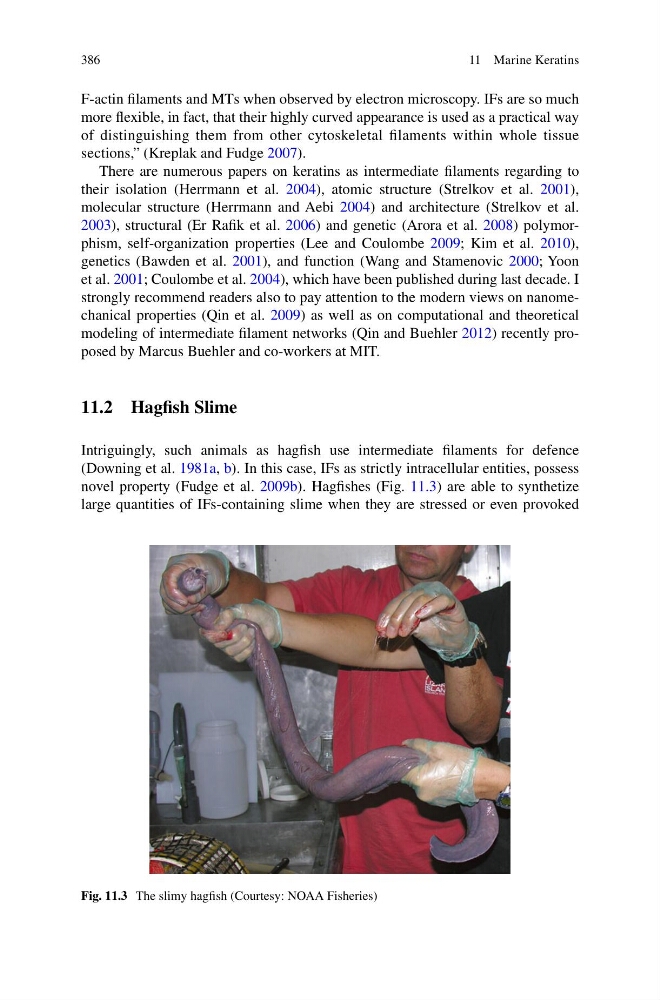
novel property (Fudge et al. 2009b ). Hagfi shes (Fig. 11.3 ) are able to synthetize
large quantities of IFs-containing slime when they are stressed or even provoked
Fig. 11.3 The slimy hagfi sh (Courtesy: NOAA Fisheries)
11 Marine Keratins
F-actin fi laments and MTs when observed by electron microscopy. IFs are so much
more fl exible, in fact, that their highly curved appearance is used as a practical way
of distinguishing them from other cytoskeletal fi laments within whole tissue
sections,” (Kreplak and Fudge 2007 ).
There are numerous papers on keratins as intermediate fi laments regarding to
their isolation ( Herrmann et al. 2004 ), atomic structure (Strelkov et al. 2001 ),
molecular structure (Herrmann and Aebi 2004 ) and architecture (Strelkov et al.
2003 ), structural (Er Rafi k et al. 2006 ) and genetic (Arora et al. 2008 ) polymorphism, self-organization properties (Lee and Coulombe 2009 ; Kim et al. 2010 ),
genetics (Bawden et al. 2001 ), and function (Wang and Stamenovic 2000 ; Yoon
et al. 2001 ; Coulombe et al. 2004 ), which have been published during last decade. I
strongly recommend readers also to pay attention to the modern views on nanomechanical properties (Qin et al. 2009 ) as well as on computational and theoretical
modeling of intermediate fi lament networks (Qin and Buehler 2012 ) recently proposed by Marcus Buehler and co-workers at MIT.
11.2 Hagfi sh Slime
Intriguingly, such animals as hagfi sh use intermediate fi laments for defence
(Downing et al. 1981a , b ). In this case, IFs as strictly intracellular entities, possess
novel property (Fudge et al. 2009b ). Hagfi shes (Fig. 11.3 ) are able to synthetize
large quantities of IFs-containing slime when they are stressed or even provoked
Fig. 11.3 The slimy hagfi sh (Courtesy: NOAA Fisheries)
11 Marine Keratins