

385
rodlike, but too stiff to be modeled as freely fl exible chains; similar to those in
rubberlike networks. More precisely, a fi lament is said to be semifl exible when its
persistence length is of the same order as its contour length. Both in vivo and in vitro,
IFs can be several microns long. When crosslinked into networks, the physically
relevant length is the distance between network junction points, or crosslinks. This is
generally on the order of a 100 to 1000 nm,” (Wagner et al. 2007 ).
Aligned keratin IFs of a hard a -keratin fi bre are embedded in an isotropic, highsulphur protein matrix that can occupy up to 40 % of the fi bre (Kreplak and Fudge
2007 ). According description made by Kreplak et al. ( 2004 ):
“Upon stretching a hard α-keratin fi bre, the coiled coils, which have their axis
parallel to the direction of applied stress, are transformed into a β-sheet structure
with the b-strands running roughly parallel to the fi bre axis. This is the so-called α-β
transition which is the cornerstone of all molecular models of hard a-keratin
mechanics for extensions above 5 %,” (Kreplak et al. 2004 ; see also Crick 1952 ;
Pauling and Corey 1951 ).
Also elastic properties of keratin-containing proteins as well as corresponding
fi lamentous structures have been investigated. Young’s modulus E of about 2GPa
was measured for wet wool and hair, and seems to be characteristic for all single
keratin fi laments because of unifying principles in intermediate fi lament structure
and assembly (Aebi et al. 1988 ). “Hence, IFs would be as rigid as F-actin (E
2.5 GPa) and MTs (E 1 GPa). In reality, IFs directly isolated from cultured cells and
tissues or assembled from purifi ed proteins in vitro appear much more fl exible than
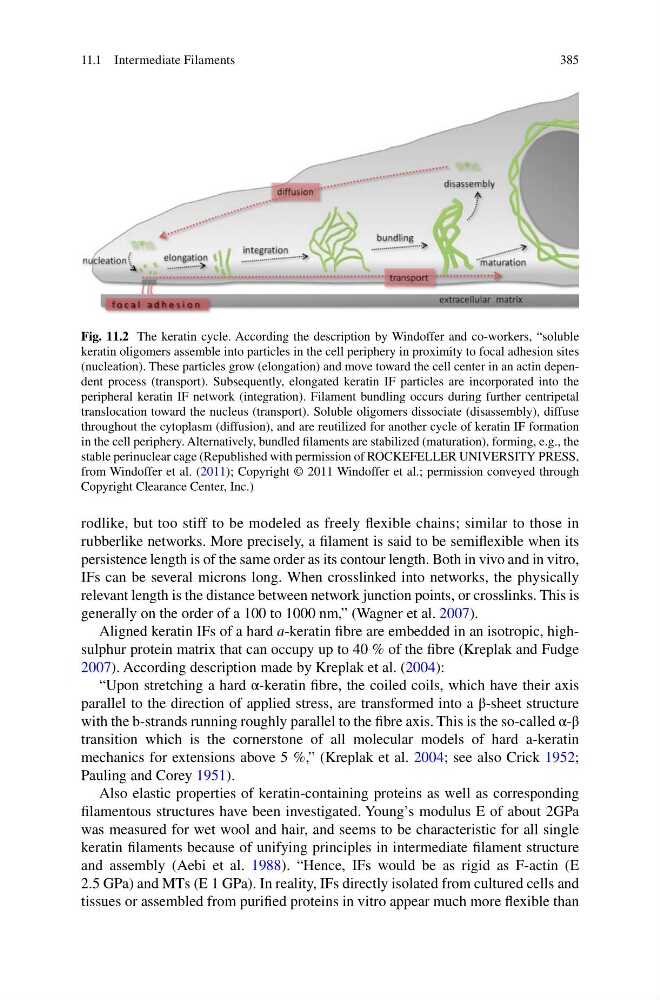
Fig. 11.2 The keratin cycle. According the description by Windoffer and co-workers, “soluble
keratin oligomers assemble into particles in the cell periphery in proximity to focal adhesion sites
(nucleation). These particles grow (elongation) and move toward the cell center in an actin dependent process (transport). Subsequently, elongated keratin IF particles are incorporated into the
peripheral keratin IF network (integration). Filament bundling occurs during further centripetal
translocation toward the nucleus (transport). Soluble oligomers dissociate (disassembly), diffuse
throughout the cytoplasm (diffusion), and are reutilized for another cycle of keratin IF formation
in the cell periphery. Alternatively, bundled fi laments are stabilized (maturation), forming, e.g., the
stable perinuclear cage (Republished with permission of ROCKEFELLER UNIVERSITY PRESS,
from Windoffer et al. ( 2011 ); Copyright © 2011 Windoffer et al.; permission conveyed through
Copyright Clearance Center, Inc.)
11.1 Intermediate Filaments
rodlike, but too stiff to be modeled as freely fl exible chains; similar to those in
rubberlike networks. More precisely, a fi lament is said to be semifl exible when its
persistence length is of the same order as its contour length. Both in vivo and in vitro,
IFs can be several microns long. When crosslinked into networks, the physically
relevant length is the distance between network junction points, or crosslinks. This is
generally on the order of a 100 to 1000 nm,” (Wagner et al. 2007 ).
Aligned keratin IFs of a hard a -keratin fi bre are embedded in an isotropic, highsulphur protein matrix that can occupy up to 40 % of the fi bre (Kreplak and Fudge
2007 ). According description made by Kreplak et al. ( 2004 ):
“Upon stretching a hard α-keratin fi bre, the coiled coils, which have their axis
parallel to the direction of applied stress, are transformed into a β-sheet structure
with the b-strands running roughly parallel to the fi bre axis. This is the so-called α-β
transition which is the cornerstone of all molecular models of hard a-keratin
mechanics for extensions above 5 %,” (Kreplak et al. 2004 ; see also Crick 1952 ;
Pauling and Corey 1951 ).
Also elastic properties of keratin-containing proteins as well as corresponding
fi lamentous structures have been investigated. Young’s modulus E of about 2GPa
was measured for wet wool and hair, and seems to be characteristic for all single
keratin fi laments because of unifying principles in intermediate fi lament structure
and assembly (Aebi et al. 1988 ). “Hence, IFs would be as rigid as F-actin (E
2.5 GPa) and MTs (E 1 GPa). In reality, IFs directly isolated from cultured cells and
tissues or assembled from purifi ed proteins in vitro appear much more fl exible than
Fig. 11.2 The keratin cycle. According the description by Windoffer and co-workers, “soluble
keratin oligomers assemble into particles in the cell periphery in proximity to focal adhesion sites
(nucleation). These particles grow (elongation) and move toward the cell center in an actin dependent process (transport). Subsequently, elongated keratin IF particles are incorporated into the
peripheral keratin IF network (integration). Filament bundling occurs during further centripetal
translocation toward the nucleus (transport). Soluble oligomers dissociate (disassembly), diffuse
throughout the cytoplasm (diffusion), and are reutilized for another cycle of keratin IF formation
in the cell periphery. Alternatively, bundled fi laments are stabilized (maturation), forming, e.g., the
stable perinuclear cage (Republished with permission of ROCKEFELLER UNIVERSITY PRESS,
from Windoffer et al. ( 2011 ); Copyright © 2011 Windoffer et al.; permission conveyed through
Copyright Clearance Center, Inc.)
11.1 Intermediate Filaments