

389
reported. As was found for alpha, the N- and C-terminal domains of gamma have
keratin-like parameters, but the central rod has low identity to IFs of types I–V
(<31 %), a cephalochordate IF (<29 %) and invertebrate IFs (<20 %) and no particular homology to type I or type II keratins. Central rod identity between gamma
and alpha is also low (similar to 23 %), as is typical of comparisons between different rod types but atypical of similar rod types (>50 %). The central rods of both
gamma and alpha lack the 42-residue insert of helix 1B present in lamins and
invertebrate IFs, have unusually high threonine contents (gamma, 10 %; alpha,
13 %) compared to other IF types (2–5 %), contain a number of unexpected residues in consensus conserved sites, and employ a L12 segment of 21 residues rather
than the 16 or 17 residues found in keratins. Theoretical analyses indicate that the
hagfi sh molecules exist as coiled coil heterodimers (alpha/gamma) in which the
chains are parallel, in axial register, and stabilized by signifi cant numbers of ionic
interactions. Fast Fourier-transform analyses revealed that the linear distribution
period of similar to 9.55 for basic and acidic residues in other IF chains are not
completely maintained, partly due to the high threonine content. The threonine
residues occupy mainly outer sites b, c, f in the heptad substructure, possibly abetting parallel alignment of thousands of IFs within the thread, interactions with
mucins at the thread periphery, and hierarchical IF chain assembly. It is suggested
that the gamma and alpha chains from this most primitive extant vertebrate are type
I and type II homologues of epidermal keratin chains, possibly related to early
specialized keratins” (Koch et al. 1995 ).
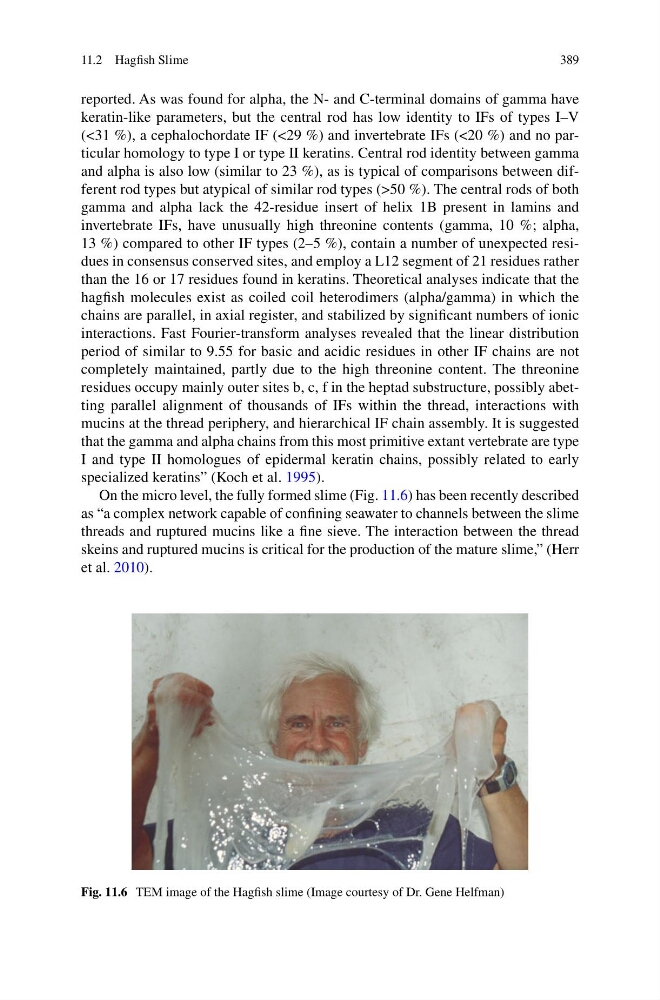
On the micro level, the fully formed slime (Fig. 11.6 ) has been recently described
as “a complex network capable of confi ning seawater to channels between the slime
threads and ruptured mucins like a fi ne sieve. The interaction between the thread
skeins and ruptured mucins is critical for the production of the mature slime,” (Herr
et al. 2010 ).
Fig. 11.6 TEM image of the Hagfi sh slime (Image courtesy of Dr. Gene Helfman)
11.2 Hagfi sh Slime
reported. As was found for alpha, the N- and C-terminal domains of gamma have
keratin-like parameters, but the central rod has low identity to IFs of types I–V
(<31 %), a cephalochordate IF (<29 %) and invertebrate IFs (<20 %) and no particular homology to type I or type II keratins. Central rod identity between gamma
and alpha is also low (similar to 23 %), as is typical of comparisons between different rod types but atypical of similar rod types (>50 %). The central rods of both
gamma and alpha lack the 42-residue insert of helix 1B present in lamins and
invertebrate IFs, have unusually high threonine contents (gamma, 10 %; alpha,
13 %) compared to other IF types (2–5 %), contain a number of unexpected residues in consensus conserved sites, and employ a L12 segment of 21 residues rather
than the 16 or 17 residues found in keratins. Theoretical analyses indicate that the
hagfi sh molecules exist as coiled coil heterodimers (alpha/gamma) in which the
chains are parallel, in axial register, and stabilized by signifi cant numbers of ionic
interactions. Fast Fourier-transform analyses revealed that the linear distribution
period of similar to 9.55 for basic and acidic residues in other IF chains are not
completely maintained, partly due to the high threonine content. The threonine
residues occupy mainly outer sites b, c, f in the heptad substructure, possibly abetting parallel alignment of thousands of IFs within the thread, interactions with
mucins at the thread periphery, and hierarchical IF chain assembly. It is suggested
that the gamma and alpha chains from this most primitive extant vertebrate are type
I and type II homologues of epidermal keratin chains, possibly related to early
specialized keratins” (Koch et al. 1995 ).
On the micro level, the fully formed slime (Fig. 11.6 ) has been recently described
as “a complex network capable of confi ning seawater to channels between the slime
threads and ruptured mucins like a fi ne sieve. The interaction between the thread
skeins and ruptured mucins is critical for the production of the mature slime,” (Herr
et al. 2010 ).
Fig. 11.6 TEM image of the Hagfi sh slime (Image courtesy of Dr. Gene Helfman)
11.2 Hagfi sh Slime