

331
Collagen Sponges with microporous structures from tilapia were also manufactured. According to Sugiura et al. 2009 , corresponding sponge-like constructs were
“reconstituted collagen fi brils using freeze-drying and cross-linked by dehydrothermal treatment […] or additional treatment with water-soluble carbodiimide. […]
The pellet implantation tests into the paravertebral muscle of rabbits demonstrated
that tilapia collagen caused rare infl ammatory responses at 1- and 4-week implantation, statistically similar to those of porcine collagen and a high-density polyethylene as a negative control,” (Sugiura et al. 2009 ).
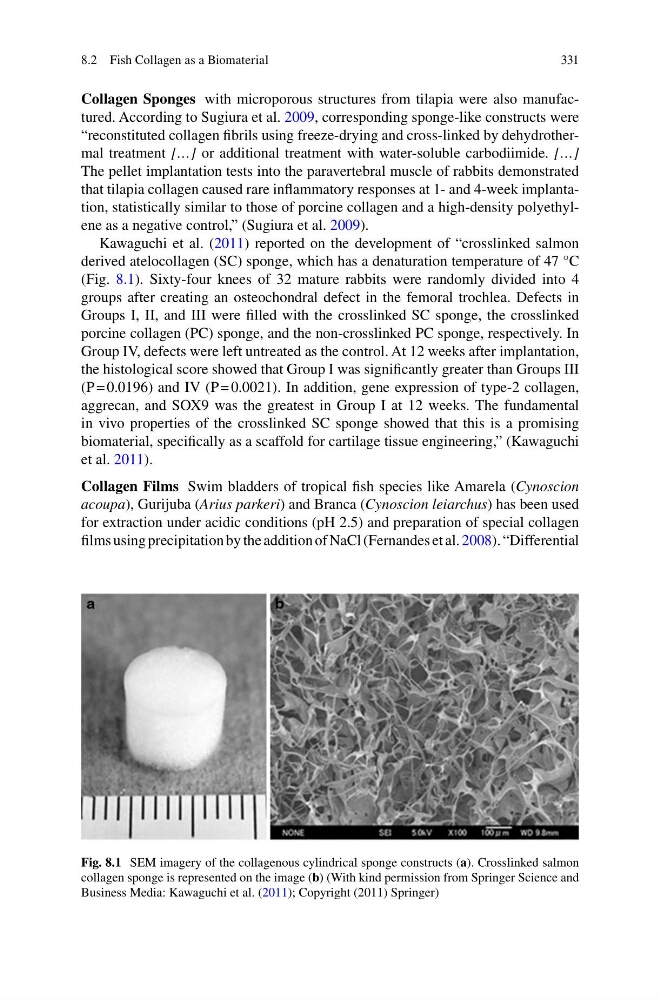
Kawaguchi et al. ( 2011 ) reported on the development of “crosslinked salmon
derived atelocollagen (SC) sponge, which has a denaturation temperature of 47 °C
(Fig. 8.1 ). Sixty-four knees of 32 mature rabbits were randomly divided into 4
groups after creating an osteochondral defect in the femoral trochlea. Defects in
Groups I, II, and III were fi lled with the crosslinked SC sponge, the crosslinked
porcine collagen (PC) sponge, and the non-crosslinked PC sponge, respectively. In
Group IV, defects were left untreated as the control. At 12 weeks after implantation,
the histological score showed that Group I was signifi cantly greater than Groups III
(P = 0.0196) and IV (P = 0.0021). In addition, gene expression of type-2 collagen,
aggrecan, and SOX9 was the greatest in Group I at 12 weeks. The fundamental
in vivo properties of the crosslinked SC sponge showed that this is a promising
biomaterial, specifi cally as a scaffold for cartilage tissue engineering,” (Kawaguchi
et al. 2011 ).
Collagen Films Swim bladders of tropical fi sh species like Amarela ( Cynoscion
acoupa ), Gurijuba ( Arius parkeri ) and Branca ( Cynoscion leiarchus ) has been used
for extraction under acidic conditions (pH 2.5) and preparation of special collagen
fi lms using precipitation by the addition of NaCl (Fernandes et al. 2008 ). “Differential
Fig. 8.1 SEM imagery of the collagenous cylindrical sponge constructs ( a ). Crosslinked salmon
collagen sponge is represented on the image ( b ) (With kind permission from Springer Science and
Business Media: Kawaguchi et al. ( 2011 ); Copyright (2011) Springer)
8.2 Fish Collagen as a Biomaterial
Collagen Sponges with microporous structures from tilapia were also manufactured. According to Sugiura et al. 2009 , corresponding sponge-like constructs were
“reconstituted collagen fi brils using freeze-drying and cross-linked by dehydrothermal treatment […] or additional treatment with water-soluble carbodiimide. […]
The pellet implantation tests into the paravertebral muscle of rabbits demonstrated
that tilapia collagen caused rare infl ammatory responses at 1- and 4-week implantation, statistically similar to those of porcine collagen and a high-density polyethylene as a negative control,” (Sugiura et al. 2009 ).
Kawaguchi et al. ( 2011 ) reported on the development of “crosslinked salmon
derived atelocollagen (SC) sponge, which has a denaturation temperature of 47 °C
(Fig. 8.1 ). Sixty-four knees of 32 mature rabbits were randomly divided into 4
groups after creating an osteochondral defect in the femoral trochlea. Defects in
Groups I, II, and III were fi lled with the crosslinked SC sponge, the crosslinked
porcine collagen (PC) sponge, and the non-crosslinked PC sponge, respectively. In
Group IV, defects were left untreated as the control. At 12 weeks after implantation,
the histological score showed that Group I was signifi cantly greater than Groups III
(P = 0.0196) and IV (P = 0.0021). In addition, gene expression of type-2 collagen,
aggrecan, and SOX9 was the greatest in Group I at 12 weeks. The fundamental
in vivo properties of the crosslinked SC sponge showed that this is a promising
biomaterial, specifi cally as a scaffold for cartilage tissue engineering,” (Kawaguchi
et al. 2011 ).
Collagen Films Swim bladders of tropical fi sh species like Amarela ( Cynoscion
acoupa ), Gurijuba ( Arius parkeri ) and Branca ( Cynoscion leiarchus ) has been used
for extraction under acidic conditions (pH 2.5) and preparation of special collagen
fi lms using precipitation by the addition of NaCl (Fernandes et al. 2008 ). “Differential
Fig. 8.1 SEM imagery of the collagenous cylindrical sponge constructs ( a ). Crosslinked salmon
collagen sponge is represented on the image ( b ) (With kind permission from Springer Science and
Business Media: Kawaguchi et al. ( 2011 ); Copyright (2011) Springer)
8.2 Fish Collagen as a Biomaterial