

332
scanning calorimetry revealed high denaturation temperature peaks at temperatures
ranging from 65.9 to 74.8 °C. The micrographs showed no fi brillar organization
along the material, but rather a spongy structure, with cavity diameters relatively
uniform at around 2 μm. The impedance spectroscopy presented a distributed relaxation process. A. parkeri’s fi lms showed piezoelectricity,” (Fernandes et al. 2008 ).
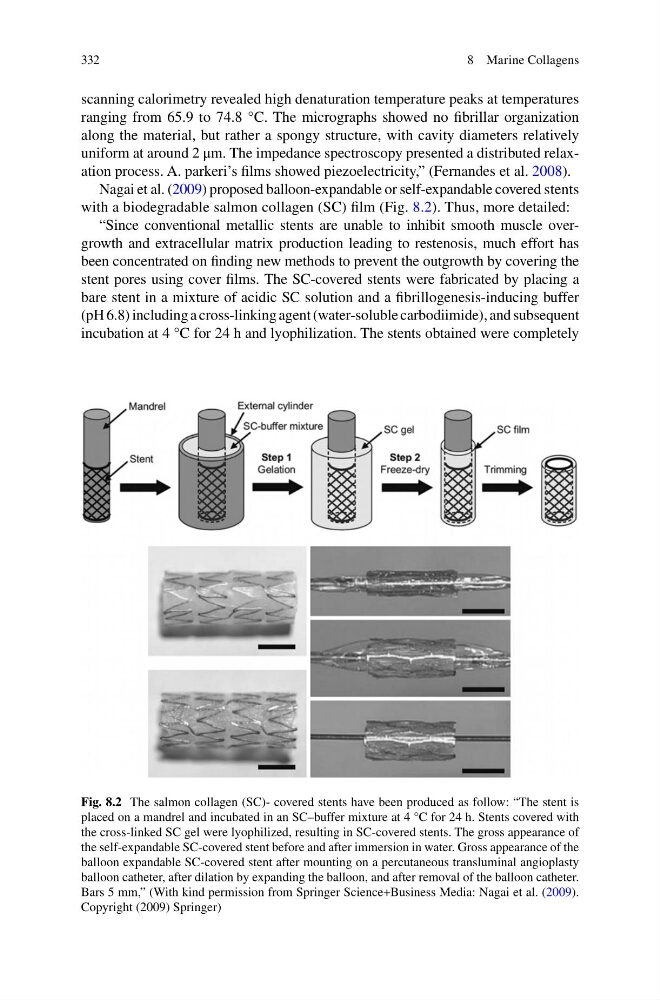
Nagai et al. ( 2009 ) proposed balloon-expandable or self-expandable covered stents
with a biodegradable salmon collagen (SC) fi lm (Fig. 8.2 ). Thus, more detailed:
“Since conventional metallic stents are unable to inhibit smooth muscle overgrowth and extracellular matrix production leading to restenosis, much effort has
been concentrated on fi nding new methods to prevent the outgrowth by covering the
stent pores using cover fi lms. The SC-covered stents were fabricated by placing a
bare stent in a mixture of acidic SC solution and a fi brillogenesis-inducing buffer
(pH 6.8) including a cross-linking agent (water-soluble carbodiimide), and subsequent
incubation at 4 °C for 24 h and lyophilization. The stents obtained were completely
Fig. 8.2 The salmon collagen (SC)- covered stents have been produced as follow: “The stent is
placed on a mandrel and incubated in an SC–buffer mixture at 4 °C for 24 h. Stents covered with
the cross-linked SC gel were lyophilized, resulting in SC-covered stents. The gross appearance of
the self-expandable SC-covered stent before and after immersion in water. Gross appearance of the
balloon expandable SC-covered stent after mounting on a percutaneous transluminal angioplasty
balloon catheter, after dilation by expanding the balloon, and after removal of the balloon catheter.
Bars 5 mm,” (With kind permission from Springer Science+Business Media: Nagai et al. ( 2009 ).
Copyright (2009) Springer)
8 Marine Collagens
scanning calorimetry revealed high denaturation temperature peaks at temperatures
ranging from 65.9 to 74.8 °C. The micrographs showed no fi brillar organization
along the material, but rather a spongy structure, with cavity diameters relatively
uniform at around 2 μm. The impedance spectroscopy presented a distributed relaxation process. A. parkeri’s fi lms showed piezoelectricity,” (Fernandes et al. 2008 ).
Nagai et al. ( 2009 ) proposed balloon-expandable or self-expandable covered stents
with a biodegradable salmon collagen (SC) fi lm (Fig. 8.2 ). Thus, more detailed:
“Since conventional metallic stents are unable to inhibit smooth muscle overgrowth and extracellular matrix production leading to restenosis, much effort has
been concentrated on fi nding new methods to prevent the outgrowth by covering the
stent pores using cover fi lms. The SC-covered stents were fabricated by placing a
bare stent in a mixture of acidic SC solution and a fi brillogenesis-inducing buffer
(pH 6.8) including a cross-linking agent (water-soluble carbodiimide), and subsequent
incubation at 4 °C for 24 h and lyophilization. The stents obtained were completely
Fig. 8.2 The salmon collagen (SC)- covered stents have been produced as follow: “The stent is
placed on a mandrel and incubated in an SC–buffer mixture at 4 °C for 24 h. Stents covered with
the cross-linked SC gel were lyophilized, resulting in SC-covered stents. The gross appearance of
the self-expandable SC-covered stent before and after immersion in water. Gross appearance of the
balloon expandable SC-covered stent after mounting on a percutaneous transluminal angioplasty
balloon catheter, after dilation by expanding the balloon, and after removal of the balloon catheter.
Bars 5 mm,” (With kind permission from Springer Science+Business Media: Nagai et al. ( 2009 ).
Copyright (2009) Springer)
8 Marine Collagens