

307
“Lampreys swim by rhythmic lateral undulations of the body axis. The lamprey
swims forward by propagating lateral axial undulations that increase in amplitude from nose to tail. Similar waves travelling from tail to nose can propel
the lamprey backward. Rhythmic alteration of muscle activity on either side of
the body axis produces a propulsive wave. Lamprey swimming is uncomplicated by pectoral, pelvic, or anal fi ns. Endurance rather than high speed is characteristic of pure anguilliform mode,” (Wilbur et al. 2002 ). Thus, “the lamprey
was selected as an animal model because of its ability to be free to move in
three dimensions, its highly effi cient and maneuverable form of locomotion,
and its ability to navigate in currents,” (Wilbur et al. 2002 ).
(f) RoboGnilos is an example of a motor-driven fi n actuator. As explained by
researchers, It was inspired by amiiform fi sh (Gymnarchus niloticus), “which
generally swim by undulations of a long fl exible dorsal fi n,” (Hu et al. 2009 ).
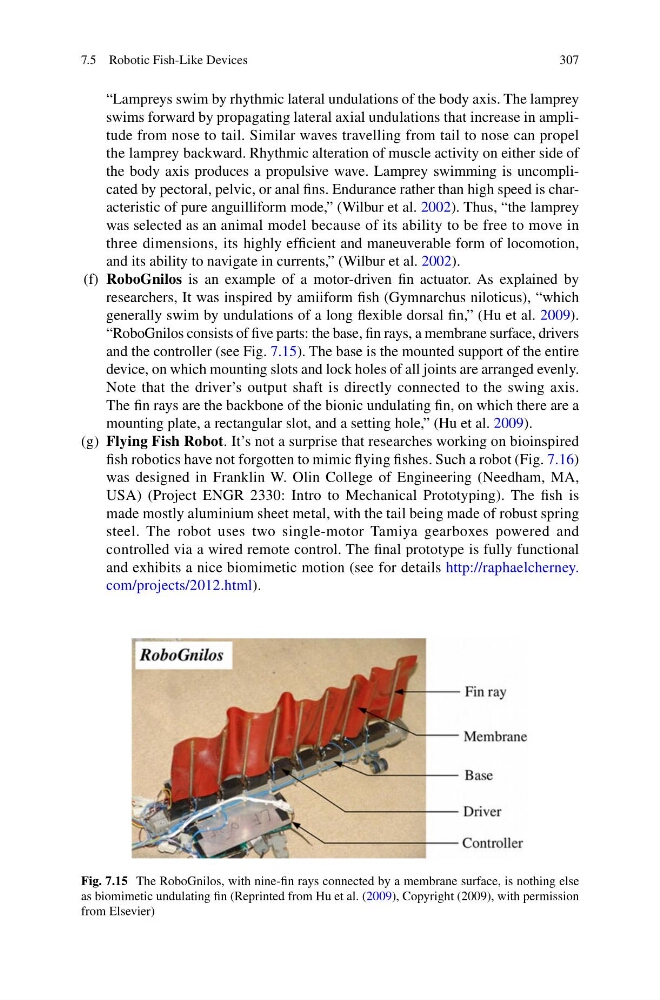
“RoboGnilos consists of fi ve parts: the base, fi n rays, a membrane surface, drivers
and the controller (see Fig. 7.15 ). The base is the mounted support of the entire
device, on which mounting slots and lock holes of all joints are arranged evenly.
Note that the driver’s output shaft is directly connected to the swing axis.
The fi n rays are the backbone of the bionic undulating fi n, on which there are a
mounting plate, a rectangular slot, and a setting hole,” (Hu et al. 2009 ).
(g) Flying Fish Robot . It’s not a surprise that researches working on bioinspired
fi sh robotics have not forgotten to mimic fl ying fi shes. Such a robot (Fig. 7.16 )
was designed in Franklin W. Olin College of Engineering (Needham, MA,
USA) (Project ENGR 2330: Intro to Mechanical Prototyping). The fi sh is
made mostly aluminium sheet metal, with the tail being made of robust spring
steel. The robot uses two single-motor Tamiya gearboxes powered and
controlled via a wired remote control. The fi nal prototype is fully functional
and exhibits a nice biomimetic motion (see for details http://raphaelcherney.
com/projects/2012.html ).
Fig. 7.15 The RoboGnilos, with nine-fi n rays connected by a membrane surface, is nothing else
as biomimetic undulating fi n (Reprinted from Hu et al. ( 2009 ), Copyright (2009), with permission
from Elsevier)
7.5 Robotic Fish-Like Devices
“Lampreys swim by rhythmic lateral undulations of the body axis. The lamprey
swims forward by propagating lateral axial undulations that increase in amplitude from nose to tail. Similar waves travelling from tail to nose can propel
the lamprey backward. Rhythmic alteration of muscle activity on either side of
the body axis produces a propulsive wave. Lamprey swimming is uncomplicated by pectoral, pelvic, or anal fi ns. Endurance rather than high speed is characteristic of pure anguilliform mode,” (Wilbur et al. 2002 ). Thus, “the lamprey
was selected as an animal model because of its ability to be free to move in
three dimensions, its highly effi cient and maneuverable form of locomotion,
and its ability to navigate in currents,” (Wilbur et al. 2002 ).
(f) RoboGnilos is an example of a motor-driven fi n actuator. As explained by
researchers, It was inspired by amiiform fi sh (Gymnarchus niloticus), “which
generally swim by undulations of a long fl exible dorsal fi n,” (Hu et al. 2009 ).
“RoboGnilos consists of fi ve parts: the base, fi n rays, a membrane surface, drivers
and the controller (see Fig. 7.15 ). The base is the mounted support of the entire
device, on which mounting slots and lock holes of all joints are arranged evenly.
Note that the driver’s output shaft is directly connected to the swing axis.
The fi n rays are the backbone of the bionic undulating fi n, on which there are a
mounting plate, a rectangular slot, and a setting hole,” (Hu et al. 2009 ).
(g) Flying Fish Robot . It’s not a surprise that researches working on bioinspired
fi sh robotics have not forgotten to mimic fl ying fi shes. Such a robot (Fig. 7.16 )
was designed in Franklin W. Olin College of Engineering (Needham, MA,
USA) (Project ENGR 2330: Intro to Mechanical Prototyping). The fi sh is
made mostly aluminium sheet metal, with the tail being made of robust spring
steel. The robot uses two single-motor Tamiya gearboxes powered and
controlled via a wired remote control. The fi nal prototype is fully functional
and exhibits a nice biomimetic motion (see for details http://raphaelcherney.
com/projects/2012.html ).
Fig. 7.15 The RoboGnilos, with nine-fi n rays connected by a membrane surface, is nothing else
as biomimetic undulating fi n (Reprinted from Hu et al. ( 2009 ), Copyright (2009), with permission
from Elsevier)
7.5 Robotic Fish-Like Devices