

306
After the robotic fi sh is adjusted to neutral buoyancy, the total weight is about
1 kg. In the robotic fi sh, the propulsive waves along the pectoral fi ns are generated by controlling the oscillation of the fi n rays. When the rigid fi n rays are
driven by eight eudipleural servo-motors producing a sine wave, a propulsion
wave with a wave number of less than 0.5 is propagated along the fi ns. In the
water, the robotic fi sh is capable of freely surging forward and backward, as
well as rapidly swerving without the gyration radius (Yang et al. 2009 ).
(d) SHOAL fi sh . According to report by Jacob Aron ( http://www.newscientist.
com/article/dn21836-robotic-fi sh-shoal-sniffs-out-pollution-in-harbours.html ),
“the SHOAL fi sh are one and a half metres long, comparable to the size and
shape of a tuna, but their neon-yellow plastic shell means they are unlikely to be
mistaken for the real thing. A range of onboard chemical sensors detect lead,
copper and other pollutants, along with measuring water salinity. They are
driven by a dual-hinged tail capable of making tight turns that would be impossible with a propeller-driven robot.
They are also less noisy, reducing the impact on marine life. The robots are
battery powered and capable of running for 8 h between charges. At the moment
the researchers have to recover them by boat, but their plan is that the fi sh will
return to a charging station by themselves,” (Aron 2012 ).
SHOAL robots are currently being tested in the Port of Gijon in Spain.
SHOAL is a collaboration between BMT Group, University of Essex, Tyndall
National Institute, University of Strathclyde, Thales Safare, and the Port
Authority of Gijon. To visit the SHOAL project website please go to: www.
roboshoal.com
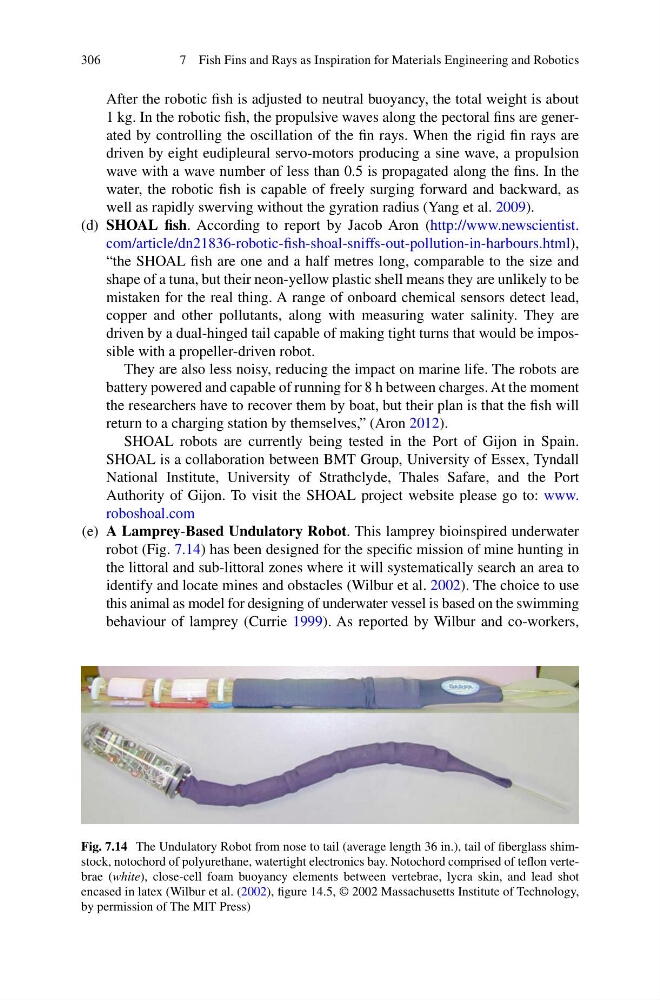
(e) A Lamprey - Based Undulatory Robot . This lamprey bioinspired underwater
robot (Fig. 7.14 ) has been designed for the specifi c mission of mine hunting in
the littoral and sub-littoral zones where it will systematically search an area to
identify and locate mines and obstacles (Wilbur et al. 2002 ). The choice to use
this animal as model for designing of underwater vessel is based on the swimming
behaviour of lamprey (Currie 1999 ). As reported by Wilbur and co-workers,
Fig. 7.14 The Undulatory Robot from nose to tail (average length 36 in.), tail of fi berglass shimstock, notochord of polyurethane, watertight electronics bay. Notochord comprised of tefl on vertebrae ( white ), close-cell foam buoyancy elements between vertebrae, lycra skin, and lead shot
encased in latex (Wilbur et al. ( 2002 ), fi gure 14.5, © 2002 Massachusetts Institute of Technology,
by permission of The MIT Press)
7 Fish Fins and Rays as Inspiration for Materials Engineering and Robotics
After the robotic fi sh is adjusted to neutral buoyancy, the total weight is about
1 kg. In the robotic fi sh, the propulsive waves along the pectoral fi ns are generated by controlling the oscillation of the fi n rays. When the rigid fi n rays are
driven by eight eudipleural servo-motors producing a sine wave, a propulsion
wave with a wave number of less than 0.5 is propagated along the fi ns. In the
water, the robotic fi sh is capable of freely surging forward and backward, as
well as rapidly swerving without the gyration radius (Yang et al. 2009 ).
(d) SHOAL fi sh . According to report by Jacob Aron ( http://www.newscientist.
com/article/dn21836-robotic-fi sh-shoal-sniffs-out-pollution-in-harbours.html ),
“the SHOAL fi sh are one and a half metres long, comparable to the size and
shape of a tuna, but their neon-yellow plastic shell means they are unlikely to be
mistaken for the real thing. A range of onboard chemical sensors detect lead,
copper and other pollutants, along with measuring water salinity. They are
driven by a dual-hinged tail capable of making tight turns that would be impossible with a propeller-driven robot.
They are also less noisy, reducing the impact on marine life. The robots are
battery powered and capable of running for 8 h between charges. At the moment
the researchers have to recover them by boat, but their plan is that the fi sh will
return to a charging station by themselves,” (Aron 2012 ).
SHOAL robots are currently being tested in the Port of Gijon in Spain.
SHOAL is a collaboration between BMT Group, University of Essex, Tyndall
National Institute, University of Strathclyde, Thales Safare, and the Port
Authority of Gijon. To visit the SHOAL project website please go to: www.
roboshoal.com
(e) A Lamprey - Based Undulatory Robot . This lamprey bioinspired underwater
robot (Fig. 7.14 ) has been designed for the specifi c mission of mine hunting in
the littoral and sub-littoral zones where it will systematically search an area to
identify and locate mines and obstacles (Wilbur et al. 2002 ). The choice to use
this animal as model for designing of underwater vessel is based on the swimming
behaviour of lamprey (Currie 1999 ). As reported by Wilbur and co-workers,
Fig. 7.14 The Undulatory Robot from nose to tail (average length 36 in.), tail of fi berglass shimstock, notochord of polyurethane, watertight electronics bay. Notochord comprised of tefl on vertebrae ( white ), close-cell foam buoyancy elements between vertebrae, lycra skin, and lead shot
encased in latex (Wilbur et al. ( 2002 ), fi gure 14.5, © 2002 Massachusetts Institute of Technology,
by permission of The MIT Press)
7 Fish Fins and Rays as Inspiration for Materials Engineering and Robotics