

253
As reviewed by Dean and Bhushan ( 2010 ), “fl uid drag comes in several forms, the
most basic of which are pressure drag and friction drag. Pressure or form drag is the
drag associated with the energy required to move fl uid out from in front of an object
in the fl ow, and then back in place behind the object. Much of the drag associated
with walking through water is pressure drag, as the water directly in front of a body
must be moved out and around the body before the body can move forward. The
magnitude of pressure drag can be reduced by creating streamlined shapes. Drag is
caused by the interactions between the fl uid and a surface parallel to the fl ow, as
well as the attraction between molecules of the fl uid (Fig. 5.16 ). Friction drag is
similar to the motion of a deck of cards sliding across a table. The frictional interactions between the table and the bottom card, as well as between each successive
card, mimic the viscous interactions between molecules of fl uid. Moving away from
the surface of an object in a fl uid fl ow, each fl uid layer has higher velocity until a
layer is reached where the fl uid has velocity equal to the mean fl ow. Fluids of higher
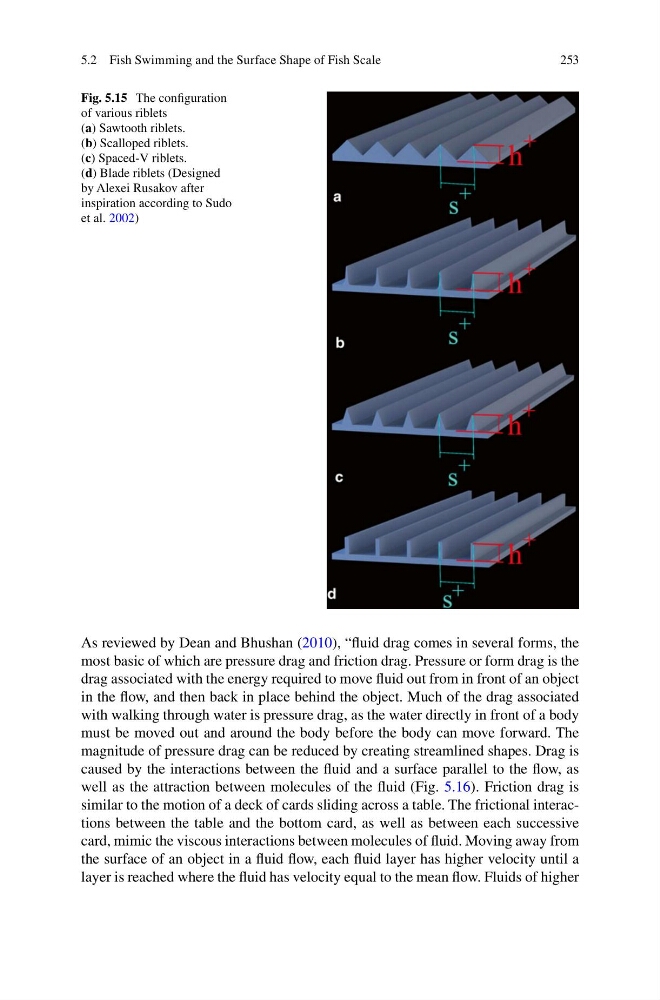
Fig. 5.15 The confi guration
of various riblets
( a ) Sawtooth riblets.
( b ) Scalloped riblets.
( c ) Spaced-V riblets.
( d ) Blade riblets (Designed
by Alexei Rusakov after
inspiration according to Sudo
et al. 2002 )
5.2 Fish Swimming and the Surface Shape of Fish Scale
As reviewed by Dean and Bhushan ( 2010 ), “fl uid drag comes in several forms, the
most basic of which are pressure drag and friction drag. Pressure or form drag is the
drag associated with the energy required to move fl uid out from in front of an object
in the fl ow, and then back in place behind the object. Much of the drag associated
with walking through water is pressure drag, as the water directly in front of a body
must be moved out and around the body before the body can move forward. The
magnitude of pressure drag can be reduced by creating streamlined shapes. Drag is
caused by the interactions between the fl uid and a surface parallel to the fl ow, as
well as the attraction between molecules of the fl uid (Fig. 5.16 ). Friction drag is
similar to the motion of a deck of cards sliding across a table. The frictional interactions between the table and the bottom card, as well as between each successive
card, mimic the viscous interactions between molecules of fl uid. Moving away from
the surface of an object in a fl uid fl ow, each fl uid layer has higher velocity until a
layer is reached where the fl uid has velocity equal to the mean fl ow. Fluids of higher
Fig. 5.15 The confi guration
of various riblets
( a ) Sawtooth riblets.
( b ) Scalloped riblets.
( c ) Spaced-V riblets.
( d ) Blade riblets (Designed
by Alexei Rusakov after
inspiration according to Sudo
et al. 2002 )
5.2 Fish Swimming and the Surface Shape of Fish Scale