

252
5.2 Fish Swimming and the Surface Shape of Fish Scale
The biological function of fi sh scale is to represent an intermediate trade-off between
body protection and maximum mobility (swimming). Fish as aquatic animals “have
evolved form and structures to minimize drag, with the primary decrease coming
from a streamlined body shape to reduce fl ow separation,” (Lang et al. 2008 ).
A great deal of research has examined the links between fi sh body, fi sh skin and fi sh
scale design and swimming performance (see for review the “ Fish Biomechanics ”
by Shadwick and Lauder 2006 ; Lauder 2011 ; Oeffner and Lauder 2012 ). Much of
this work has had a bio-engineering focus (Blake 1983 , 2004 ; Colgate and Lynch
2004 ), attempting to understand how specifi c structures work.
In general, fi sh interact with their surrounding fl uid medium trough their scales
(Sudo et al. 2002 ), which possess the mucous layer and specifi cally structured and
oriented riblets (Fig. 5.15 ). Thus, such scales with micro-grooved surfaces (Cui and
Fu 2012 ) might seem compatible with good (or even excellent) hydrodynamics.
“The mucus secreted by fi sh causes a reduction in drag as they move through water,
and also protects the fi sh from abrasion, by making the fi sh slide across objects
rather than scrape; and disease, by making the surface of the fi sh diffi cult for microscopic organisms to adhere to,” (Dean and Bhushan 2010 ; see also Shephard 1994 ).
According to defi nition by Oeffner and Lauder ( 2012 ), “riblets are fi ne rib-like
surface geometries with sharp surface ridges that can be aligned either parallel or
perpendicular to the fl ow direction and might reduce drag,” (Oeffner and Lauder
2012 ). The diversity of forms of riblets are well described and discussed in the literature (see for review Lee and Lee 2001 ; Sudo et al. 2002 ; Lang et al. 2008 ; Dean
and Bhushan 2010 ; Cui and Fu 2012 ) (Fig. 5.15 ). The nature of fl uid fl ow over an
effective fi sh skin surface is an important point in understanding of the mechanism
of fi sh skin drag reduction. Three types of drag are described for the swimming
animal. These include:
(i) form drag due to a difference in pressure around the body,
(ii) drag-dueto- lift, and
(iii) skin friction due to boundary layer formation (Bushnell and Moore 1991 ).
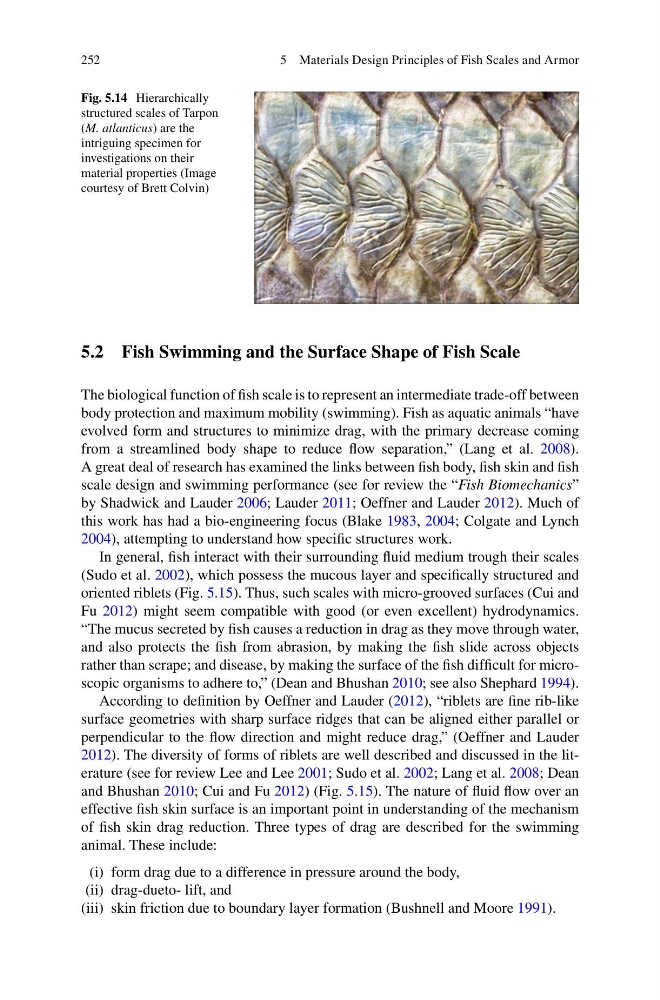
Fig. 5.14 Hierarchically
structured scales of Tarpon
( M. atlanticus ) are the
intriguing specimen for
investigations on their
material properties (Image
courtesy of Brett Colvin)
5 Materials Design Principles of Fish Scales and Armor
5.2 Fish Swimming and the Surface Shape of Fish Scale
The biological function of fi sh scale is to represent an intermediate trade-off between
body protection and maximum mobility (swimming). Fish as aquatic animals “have
evolved form and structures to minimize drag, with the primary decrease coming
from a streamlined body shape to reduce fl ow separation,” (Lang et al. 2008 ).
A great deal of research has examined the links between fi sh body, fi sh skin and fi sh
scale design and swimming performance (see for review the “ Fish Biomechanics ”
by Shadwick and Lauder 2006 ; Lauder 2011 ; Oeffner and Lauder 2012 ). Much of
this work has had a bio-engineering focus (Blake 1983 , 2004 ; Colgate and Lynch
2004 ), attempting to understand how specifi c structures work.
In general, fi sh interact with their surrounding fl uid medium trough their scales
(Sudo et al. 2002 ), which possess the mucous layer and specifi cally structured and
oriented riblets (Fig. 5.15 ). Thus, such scales with micro-grooved surfaces (Cui and
Fu 2012 ) might seem compatible with good (or even excellent) hydrodynamics.
“The mucus secreted by fi sh causes a reduction in drag as they move through water,
and also protects the fi sh from abrasion, by making the fi sh slide across objects
rather than scrape; and disease, by making the surface of the fi sh diffi cult for microscopic organisms to adhere to,” (Dean and Bhushan 2010 ; see also Shephard 1994 ).
According to defi nition by Oeffner and Lauder ( 2012 ), “riblets are fi ne rib-like
surface geometries with sharp surface ridges that can be aligned either parallel or
perpendicular to the fl ow direction and might reduce drag,” (Oeffner and Lauder
2012 ). The diversity of forms of riblets are well described and discussed in the literature (see for review Lee and Lee 2001 ; Sudo et al. 2002 ; Lang et al. 2008 ; Dean
and Bhushan 2010 ; Cui and Fu 2012 ) (Fig. 5.15 ). The nature of fl uid fl ow over an
effective fi sh skin surface is an important point in understanding of the mechanism
of fi sh skin drag reduction. Three types of drag are described for the swimming
animal. These include:
(i) form drag due to a difference in pressure around the body,
(ii) drag-dueto- lift, and
(iii) skin friction due to boundary layer formation (Bushnell and Moore 1991 ).
Fig. 5.14 Hierarchically
structured scales of Tarpon
( M. atlanticus ) are the
intriguing specimen for
investigations on their
material properties (Image
courtesy of Brett Colvin)
5 Materials Design Principles of Fish Scales and Armor